
Megalithic mound (tumulus with integral stones)
Drie Tommen
Also known astumuli of Grimde
DatedEst. 4000–2000 BCE
Photo Picture taken by my father Paul Kempeneers - I scanned it in · CC BY-SA 2.5Source file on Wikimedia Commons
Overview
About this site
What the sources say
De Drie Tommen of Drie Tumuli zijn Gallo-Romeinse grafheuvels te Grimde in de Belgische stad Tienen. Ze zijn opgericht in de latere 2e eeuw als grafmonument voor Marcus Probius Burrus.
Article in DutchRead on Wikipedia7 min readCC BY-SA 4.0
Where it sits in time
The site's dated range, placed against world reference points.
The scale is logarithmic: each step to the left is about ten times older than the last.
The full article
Drie Tommen: the whole story
In briefSources for this section
- Wikipedia (Dutch): Drie Tommen (Tienen)CC BY-SA 4.0
Sources for this section
- Wikipedia (Dutch): Drie Tommen (Tienen)CC BY-SA 4.0
Drie Tommen, also known as the tumuli of Grimde, are three Gallo-Roman burial mounds at Grimde in the Belgian city of Tienen. They were erected in the later 2nd century as a funerary monument for Marcus Probius Burrus. The site stands along the Sint-Truidensesteenweg beside the former lordly road Boulogne-Kassel-Keulen.
Each mound has a diameter of circa 30 m and a height varying from 8 to 12,5 m, making them among the larger mounds of the area. The middle mound contained only a wooden post, possibly the foundation of a statue of Marcus Probius Burrus. Each outer mound held a wooden burial chamber. The eastern chamber contained a gold bar inscribed with Burrus’s name; the western chamber was intended for his wife and yielded a cameo and an engraved gold ring.
The mounds formed part of a funerary garden enclosed by a wall of gobertangesteen. This setting allowed relatives to gather for remembrance. A cameo from the woman’s grave shows a young man in milky-white relief on a dark red background. Although once identified as emperor Augustus, it is more likely his grandson Gaius Vipsanius Agrippa. The openwork gold ring bears the inscription CONCORDI COMMVN and may have been an engagement ring or a wedding ring.
The site was recorded in 1340 and shown on Ferrariskaarten around 1771-1778. Excavations took place in 1748, 1813 and 1892. Finds from the 1892 investigation included a gold bar inscribed MPRO BIVS BVR RVS, bronze sherds, iron, ivory, glass, ceramics, a silver vase, a circular bronze medallion, the ring and the cameo. The site and surrounding land were later transformed into a quiet public park with walking paths and a native flower meadow.
Summary in EnglishSources for this section
- Wikipedia (Dutch): Drie Tommen (Tienen)CC BY-SA 4.0
Sources for this section
- Wikipedia (Dutch): Drie Tommen (Tienen)CC BY-SA 4.0
Drie Tommen is a megalithic mound (tumulus with integral stones) in Tienen, Belgium. Wikidata describes it as: tumulus in Tienen, Belgium. A typological estimate: 4000 BCE to 2000 BCE. No English Wikipedia article exists for it; the full text below is the Dutch article "Drie Tommen (Tienen)", shown in the original language.
BeschrijvingSources for this section
- Wikipedia (Dutch): Drie Tommen (Tienen)CC BY-SA 4.0
Sources for this section
- Wikipedia (Dutch): Drie Tommen (Tienen)CC BY-SA 4.0
De site ligt aan de Sint-Truidensesteenweg, langs de vroegere heirbaan Boulogne-Kassel-Keulen. Met een diameter van circa 30 m en een hoogte variërend van 8 tot 12,5 m, behoren de tumuli tot de grotere van de streek. De middelste bevatte alleen een houten paal, die mogelijk als fundering diende voor een standbeeld van Marcus Probius Burrus. De buitenste tumuli bevatten elk een houten grafkamer. In de oostelijke grafheuvel is een gouden staafje aangetroffen met de naam van M. Probius Burrus. Hij moet een voorname Gallo-Romein zijn geweest in de civitas Tungrorum. In de westelijke grafheuvel zal zijn vrouw zijn begraven. Daar is een bijzondere camee gevonden van Gaius Vipsanius Agrippa en een kunstig bewerkte gouden ring met de inscriptie CONCORDI COMMVN.
De tumuli lagen in een graftuin omgeven door een muurtje uit gobertangesteen. In zo'n grafpark met bloembedden en bomen konden nabestaanden bijeenkomen voor herdenkingen.
CameeSources for this section
- Wikipedia (Dutch): Drie Tommen (Tienen)CC BY-SA 4.0
Sources for this section
- Wikipedia (Dutch): Drie Tommen (Tienen)CC BY-SA 4.0
De camee uit het vrouwengraf is gesneden in een ovale sardonyxsteen, bestaande uit drie lagen van verschillende kleur. Hij is gevat in een bewerkte gouden omlijsting, met daarachter een bronzen speld. De camee draagt het portret van een jonge man in melkwit reliëf op een donkerrode achtergrond. Men heeft gemeend dat het om keizer Augustus ging, maar het is veeleer zijn kleinzoon Gaius Vipsanius Agrippa.
RingSources for this section
- Wikipedia (Dutch): Drie Tommen (Tienen)CC BY-SA 4.0
Sources for this section
- Wikipedia (Dutch): Drie Tommen (Tienen)CC BY-SA 4.0
De ring uit het vrouwengraf is van goud en opengewerkt. Tussen twee rijen amazoneschilden draagt hij het opschrift CONCORDI COMMVN, mogelijk te lezen als Concordi[ae] commun[i] ("in eensgezinde gemeenschap"). Blijkbaar ging het om een persoonlijk bezit dat verwees naar een gelukkig huwelijk. Misschien was het een verlovingsring (annulus pronubus), of was de betekenis te vergelijken met een moderne trouwring.
GeschiedenisSources for this section
- Wikipedia (Dutch): Drie Tommen (Tienen)CC BY-SA 4.0
Sources for this section
- Wikipedia (Dutch): Drie Tommen (Tienen)CC BY-SA 4.0
Uit 1340 dateert een vermelding van de Drie Tommen in de boeken van de Tiense armentafel ("retro Tumbas de Thenis"). Circa 1700 staat in het Chijnsboeck ons gen. heeren shertoghen van Brabant: "twe daechmalen laents gelegen bij de Tommen van Thienen tegenover de gemeyn straete leyende van Thienen naer Goetsenhoeven". Op de Ferrariskaarten (ca. 1771-1778) zijn de tumuli weergegeven langs de weg van Tienen naar Hakendover onder de benaming Tombes de Grunde.
Uit de Oostenrijkse Successieoorlog is een eerste opgraving van de tot dan ongeschonden tumuli bekend. De Franse ingenieur Franquet beschreef hoe hij in 1748 een horizontale en een verticale gang liet graven in een van de tumuli, met als enige resultaat de vondst van een urne met kippenbotten. Mogelijk ging het in werkelijkheid om menselijke crematieresten. Een volgende opgraving werd uitgevoerd in juni 1813 door de stadsarchitect Philippe Robbiet op vraag van graaf François de Neufchâteau. Er werd niets bereikt, behalve een gedeeltelijke instorting van de middelste tumulus.
Op 10 oktober 1892 werden de grafheuvels onderzocht onder de leiding van baron Alfred de Loë. In de derde grafheuvel vond men een gouden staafje met de tekst MPRO BIVS BVR RVS op de zijden gegraveerd. De ontcijfering is heel gemakkelijk: M(arcus) Probius Burrus, d.i. Marcus Probius de Rosse. Naast scherven in brons, ijzer, ivoor, glas en keramiek vond men een zilveren vaas, een bronzen cirkelvormig medaillon (fibula circularis), een gouden ring en een camee.
Het Weldadigheidsbureel van Tienen heeft de vondsten op 27 september 1897 openbaar verkocht. Ze werden verworven door het Jubelparkmuseum, behalve de camee en de ring, die onbetaalbaar waren. Deze stukken werden aangekocht door baron Edmond de Rothschild voor resp. dertigduizend en vijftienhonderd Belgische frank. Voor het museum in Brussel werden replica's gemaakt.
Rijksmaarschalk Hermann Göring eiste tijdens de Tweede Wereldoorlog de geconfisqueerde stukken van de Franse Rothschilds op voor zijn privéverzameling. Na de oorlog werden een groot deel van deze kunstschatten ontdekt in de Oostenrijkse zoutmijnen. Een deel van de verdwenen voorwerpen, waaronder de Tiense camee en verlovingsring, kwam zo terug bij hun rechtmatige eigenaar in Waddesdon Manor terecht.
In Waddesdon Manor, dat sinds 1957 deel uitmaakt van de National Trust, wist men lange tijd niet waar deze juwelen vandaan kwamen. Zij bevonden zich nog in de oorspronkelijke doos, maar elk object was voorzien van een "nazinummer", beginnend met een R. De Romeinse juwelen bleven nog een tijd in het privébezit van James’ weduwe, Dorothy, die ze pas in 1971 aan de National Trust overmaakte. Zij werden op aanvraag van de National Trust door enkele Engelse deskundigen van het British Museum aan een onderzoek onderworpen en door hen als afkomstig uit de 1ste en 2de eeuw gedateerd. Deze stukken werden na een maandenlange speurtocht langs archieven, veilinghuizen en musea door historica Lutgart Vrancken, medewerkster van het Stadsarchief te Tienen, herontdekt.
In 2012-2013 zijn alle bomen en struiken op de Drie Tommen verwijderd door de gemeente Tienen. Na 2016 is, in opdracht van de gemeente Tienen, de locatie samen met omliggend terrein omgevormd tot een rustgevend open park met wandelpaden. Een inheemse bloemenweide moet de zichtbaarheid op de eeuwenoude heuvels vergroten. Binnen het project VIA-VIA, dat de zogenaamde Via Belgica in de schijnwerpers plaatst, wordt de toeristische infrastructuur rond de Drie Tommen verder uitgebouwd.
LiteratuurSources for this section
- Wikipedia (Dutch): Drie Tommen (Tienen)CC BY-SA 4.0
Sources for this section
- Wikipedia (Dutch): Drie Tommen (Tienen)CC BY-SA 4.0
A. de Loë, 1895, "Exploration des tumulus de Tirlemont" in: Annales de la société d'archéologie de Bruxelles, 419-453
M. Martens & L. Vranken, 2007-2008, "De drie tumuli van Grimde (Tienen): de herwaardering van het grafmonument van Marcus Probius Burrus", in: Erfwoord 48, 8-13.
G. Hensen, 2010, Archeologische evaluatie en waardering van de drie Gallo-Romeinse tumuli van Grimde, RAAP Archeologisch Adviesbureau. Online tekst
Pierre Degel, 2011, "De camee en de drie tumuli van Grimde in de schijnwerpers" in: De Muntklapper 69, 1-7
R. Nouwen, 2012, De onderdanen van de keizer. 35 uitzonderlijke verhalen van unieke mensen, Davidsfonds, Leuven, 124-129.
How this page was madeSources for this section
- Wikipedia (Dutch): Drie Tommen (Tienen)CC BY-SA 4.0
Sources for this section
- Wikipedia (Dutch): Drie Tommen (Tienen)CC BY-SA 4.0
The summary at the top of this page was written by MiniMax-M3 (2026-11-07) from the cited Wikipedia article “Drie Tommen (Tienen)”, translated from Dutch. The numbers in it were checked automatically against the source text. The rest of the page is the article itself, the structured records and computed distances.
Tradition and region
About this kind of monument
Low Countries and French barrows
Round barrows are found across the Low Countries and France. Many were raised in the Late Neolithic and the Bronze Age. The Bell Beaker phenomenon of the late third millennium BCE brought a new burial rite to western Europe: individual burials, often under a tumulus and with weapons, in contrast to the collective, weaponless burials of the earlier Neolithic. The Dutch hunebedden, the megalithic tombs of the north, belong to the earlier tradition and are described in their own article.
Round barrows are hemispherical mounds raised over a central burial, which may be an inhumation or a cremation placed in a vessel. Barrows were often reused: later graves were cut into the mound, sometimes long after the first burial, and many attract satellite burials. In France and Belgium, tumuli of the Hallstatt period belong to the early Iron Age, from about 800 BCE; from phase B of the Hallstatt sequence, tumulus burial becomes common and cremation predominates.
Dating relies on pottery and metalwork, and on radiocarbon dating where a mound has been dug. Many have been ploughed down, so the Atlas map reflects where mounds survived and were recorded as much as where they were built.
When visiting, look for the surrounding ditch or kerb, and for a later disturbance at the centre where a later grave or an old digging has cut the mound.
Paraphrased from Wikipedia: Tumulus, Wikipedia: Round barrow, Wikipedia: Bell Beaker culture, Wikipedia: Hallstatt culture, Wikipedia: Hunebed · CC BY-SA 4.0
From the article
Dated moments in the story
- 1340
Uit 1340 dateert een vermelding van de Drie Tommen in de boeken van de Tiense armentafel ("retro Tumbas de Thenis").
Source - 1700
Circa 1700 staat in het Chijnsboeck ons gen. heeren shertoghen van Brabant: "twe daechmalen laents gelegen bij de Tommen van Thienen tegenover de gemeyn straete leyende van Thienen naer Goetsenhoeven".
Source - 1748
De Franse ingenieur Franquet beschreef hoe hij in 1748 een horizontale en een verticale gang liet graven in een van de tumuli, met als enige resultaat de vondst van een urne met kippenbotten.
Source - 1771
Op de Ferrariskaarten (ca. 1771-1778) zijn de tumuli weergegeven langs de weg van Tienen naar Hakendover onder de benaming Tombes de Grunde.
Source - 1813
Een volgende opgraving werd uitgevoerd in juni 1813 door de stadsarchitect Philippe Robbiet op vraag van graaf François de Neufchâteau.
Source - 1892
Op 10 oktober 1892 werden de grafheuvels onderzocht onder de leiding van baron Alfred de Loë.
Source - 1895
A. de Loë, 1895, "Exploration des tumulus de Tirlemont" in: Annales de la société d'archéologie de Bruxelles, 419-453 M.
Source - 1897
Het Weldadigheidsbureel van Tienen heeft de vondsten op 27 september 1897 openbaar verkocht.
Source - 1957
In Waddesdon Manor, dat sinds 1957 deel uitmaakt van de National Trust, wist men lange tijd niet waar deze juwelen vandaan kwamen.
Source - 1971
De Romeinse juwelen bleven nog een tijd in het privébezit van James’ weduwe, Dorothy, die ze pas in 1971 aan de National Trust overmaakte.
Source - 2007
Vranken, 2007-2008, "De drie tumuli van Grimde (Tienen): de herwaardering van het grafmonument van Marcus Probius Burrus", in: Erfwoord 48, 8-13. G.
Source - 2010
Hensen, 2010, Archeologische evaluatie en waardering van de drie Gallo-Romeinse tumuli van Grimde, RAAP Archeologisch Adviesbureau.
Source - 2011
Online tekst Pierre Degel, 2011, "De camee en de drie tumuli van Grimde in de schijnwerpers" in: De Muntklapper 69, 1-7 R.
Source - 2012
In 2012-2013 zijn alle bomen en struiken op de Drie Tommen verwijderd door de gemeente Tienen.
Source
See it in 3D
An interpretive reconstruction of the monument, standing on the real ground at its exact point, under the sun for that place and season. Drag to look around it.
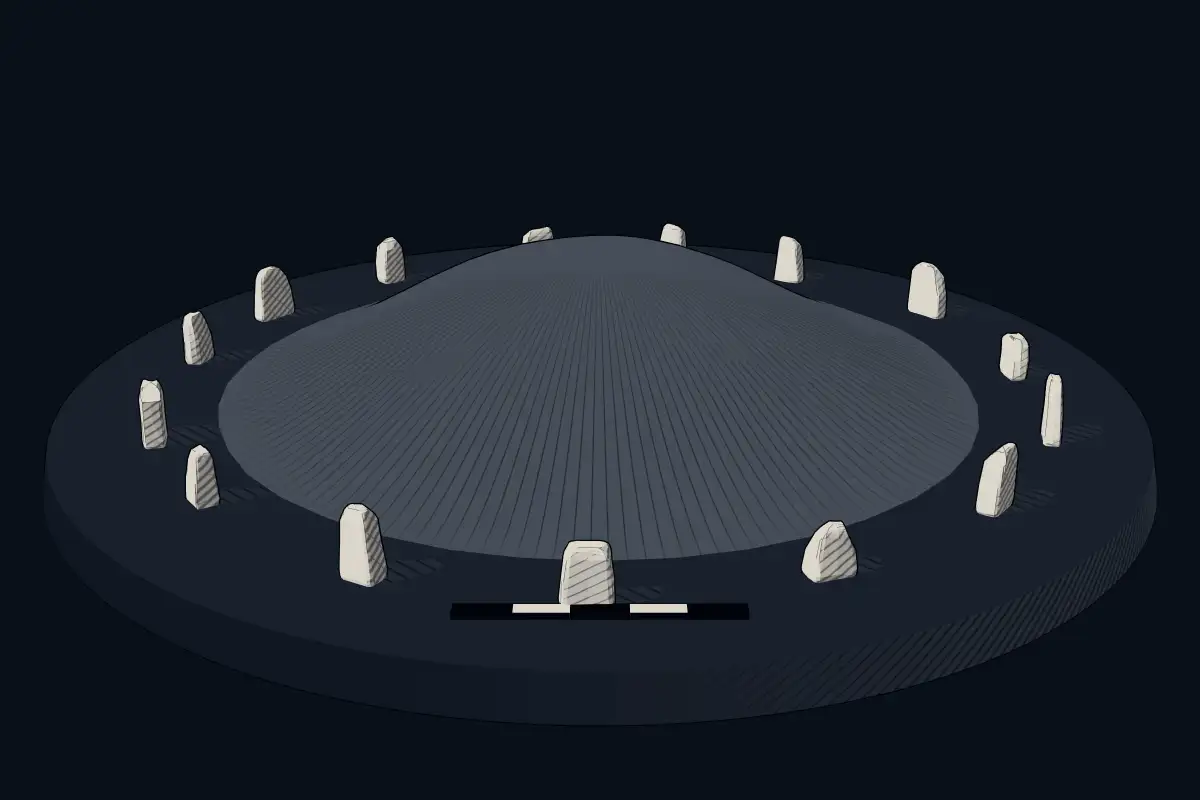
The reconstruction is ours, not a survey: it shows what a monument of this type looks like, at the size the record gives for this one.
Photographs
8 photographs, each with its author and licence
More photographs
Lore
Evidence & Lore
What the sources actually support — and, kept apart, what has been claimed.
What the evidence supports
Dates
Est. 4000–2000 BCEHow this date was established: Type comparisonTypical range for megalithic mounds in Belgium; this site has not been dated itself. Belgian barrows: the tumuli of Weris in the Belgian Luxembourg date from the 4th and 3rd millennia BC and the tumulus of Court-Saint-Etienne to around 3,000 BC.Source for this date
Where it stands
Belgium
The pin marks the monument itself — its exact point.
- Coordinates
- 50°47′59″ N, 4°57′30″ EFor a GPS or map app: 50.79960, 4.95842
Access is as our sources describe it; we have not visited the site to check.
Nearby
The closest sites in the Atlas, by straight line.


Sources
Every record behind this page, with the link it came from.
2 sources behind this page
- 01Wikidata Q517712wikidata.org
- 02Source for this dateen.wikipedia.org
Image files
- Drie Tommen.jpgPicture taken by my father Paul Kempeneers - I scanned it inCC BY-SA 2.5
- Tumuli ou Tombelles, près de Tirlemont – Ronck del. Piringer sculp.jpgAfter Ferdinand RunkPublic domain
- Tumuli van Grimde - 391619 - onroerenderfgoed.jpgVerboven, HildeCC BY 4.0
- Tumuli van Grimde - 391620 - onroerenderfgoed.jpgVerboven, HildeCC BY 4.0
- Société d'archéologie de Bruxelles, 1892, ND6694.jpgMagnien, C., graveur en médailles - MédailleurCC0
- Tienen-Tumuli van Tienen (1).JPGRomaineCC0
- Tienen-Tumuli van Tienen (2).JPGRomaineCC0
- Tienen-Tumuli van Tienen (4).JPGRomaineCC0
Report a correctionWrong date, name, photograph or source? Tell us and it will be put right.
Around this place
The ten nearest sites, by compass
Credit
Text, licence and sources
Text from the Wikipedia article "Drie Tommen (Tienen)" (Dutch), licensed CC BY-SA 4.0; authors are listed in the page history. Reused under CC BY-SA 4.0. Read on Wikipedia · Edit history and authors
- Wikipedia (Dutch): Drie Tommen (Tienen)CC BY-SA 4.0
- Wikidata Q517712CC0