Megalithic mound (tumulus with integral stones)
Yündalan Küçük Koçara 2 Tumulus
DatedEst. 700–50 BCE
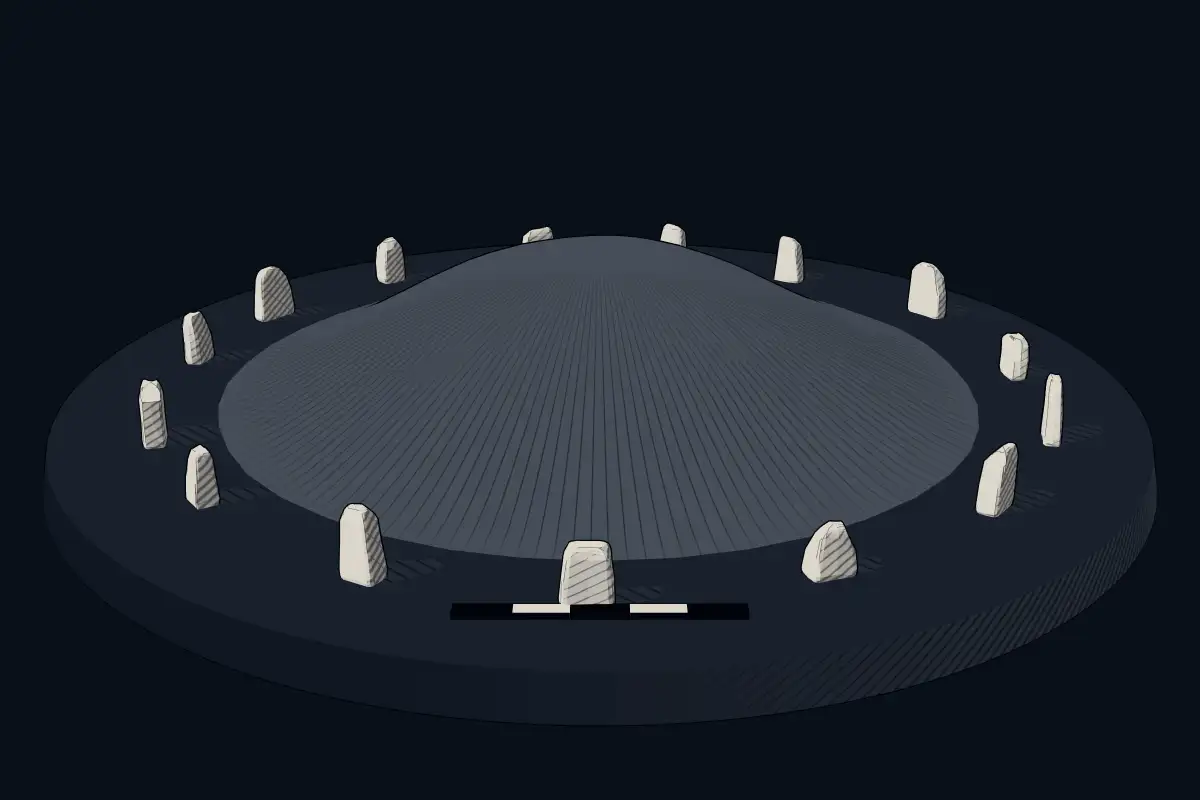
No licensed photograph yetWe have no photograph we may publish for this site, so the interpretive 3D view leads instead.
Overview
About this site
What the sources say
Yündalan Küçük Koçara 2 Tumulus is a megalithic mound recorded in Kırklareli, Turkey. The catalogue places it at 41.7540° N, 27.3425° E and links it to Wikidata item Q135960509.
Built from structured records, not from an articleSources and licences
Where it sits in time
The site's dated range, placed against world reference points.
The scale is logarithmic: each step to the left is about ten times older than the last.
The full article
About Yündalan Küçük Koçara 2 Tumulus
This kind of monument hereSources for this section
- en.wikipedia.orgCC BY-SA 4.0
- en.wikipedia.orgCC BY-SA 4.0
- en.wikipedia.orgCC BY-SA 4.0
- en.wikipedia.orgCC BY-SA 4.0
- en.wikipedia.orgCC BY-SA 4.0
Sources for this section
- en.wikipedia.orgCC BY-SA 4.0
- en.wikipedia.orgCC BY-SA 4.0
- en.wikipedia.orgCC BY-SA 4.0
- en.wikipedia.orgCC BY-SA 4.0
- en.wikipedia.orgCC BY-SA 4.0
Anatolia has a long tradition of piling earth over graves, and the best-known tumuli are those of the Phrygian and Lydian kingdoms of the Iron Age. Near Gordion, the Phrygian capital, there are more than a hundred tumuli of the ninth to sixth centuries BCE. Tumulus W, dated to about 850 BCE, is the earliest known there and the first known anywhere in Anatolia; inhumation burial continued until the late seventh century, when cremation began and the two customs coexisted for another century. Further down this page, About this kind of monument gives the whole of “Turkish tumuli”.
DatingSources for this section
- en.wikipedia.orgCC BY-SA 4.0
Sources for this section
- en.wikipedia.orgCC BY-SA 4.0
Typological estimate, not a date for this site: monuments of this kind in this region are normally dated 700 BCE to 50 BCE. The range comes from what is known about megalithic mound monuments in Turkey; nothing measured on this site itself is on record, so it may be younger or older than the range suggests.
The range rests on this regional background (source: the Wikipedia article “Tumulus”): Anatolian mounds are the Lydian barrows of Bin Tepe and the Phrygian mounds of Gordium; the Commagene tumulus on Mount Nemrut carries a royal tomb from the 1st century BC.
Landscape and neighbours
Within 10 km lie 37 other catalogued sites (3 within 1 km, 15 within 5 km); 36 of them are also classed as megalithic mound. In Kırklareli, Turkey, 154 of the 169 catalogued sites are classed as megalithic mound.
The closest catalogued sites are Yündalan Küçük Koçara 3 Tumulus (0.1 km north, megalithic mound); Yündalan Küçük Koçara 1 Tumulus (0.1 km north-east, megalithic mound); Yündalan Great Koçara Tumulus (0.7 km north, megalithic mound); Üsküp Kumtepeler Tumulus A (2.3 km east, megalithic mound). The catalogue is assembled from open records and is not complete, so unrecorded monuments may lie closer.
Records and protectionSources for this section
Sources for this section
No heritage register entry is attached to this site in the records the Atlas uses; that does not show whether national law covers it. The open records for it are Wikidata (Q135960509), where corrections and further identifiers can be added. Access varies from open common land to private fields; check local access rules, ask where needed, and take care not to damage the monument.
How this page was madeSources for this section
Sources for this section
This page was built automatically from Wikidata (CC0) and the regional article “Turkish tumuli”, written for the Atlas from the Wikipedia articles it cites (CC BY-SA 4.0), plus distances and counts computed from the catalogue coordinates. It contains no AI-written text.
Tradition and region
About this kind of monument
Turkish tumuli
Anatolia has a long tradition of piling earth over graves, and the best-known tumuli are those of the Phrygian and Lydian kingdoms of the Iron Age. Near Gordion, the Phrygian capital, there are more than a hundred tumuli of the ninth to sixth centuries BCE. Tumulus W, dated to about 850 BCE, is the earliest known there and the first known anywhere in Anatolia; inhumation burial continued until the late seventh century, when cremation began and the two customs coexisted for another century.
The largest at Gordion is Tumulus MM, "Midas Mound", built about 740 BCE. It still stands more than fifty metres high with a diameter of about three hundred metres, and when built it was the largest tumulus in Anatolia. Young's excavation of 1957 found the royal occupant lying on purple and golden textiles in an open log coffin, with a large array of bronze vessels and pottery. The name is traditional; it reflects the fame of King Midas, and the identification is a hypothesis, not a proof.
Lydia's cemetery at Bin Tepe, "a thousand mounds", on a ridge north of Sardis near Lake Marmara, holds more than a hundred tumuli of the Lydian and Achaemenid periods; at least 149 once existed, and around 115 survive. The Tumulus of Alyattes in Lydia surpassed Tumulus MM in size some two hundred years later. Bin Tepe was listed in 2025 as part of the Sardis World Heritage Site.
Dates come from tree rings, radiocarbon and pottery; the many undug tumuli are dated only by form.
When visiting, note how the mounds sit on ridges beside routes, as markers for travellers, and how many have been cut by looters' trenches.
Paraphrased from Wikipedia: Tumulus, Wikipedia: Gordion, Wikipedia: Bin Tepe, Wikipedia: Lydia, Wikipedia: Alyattes · CC BY-SA 4.0
See it in 3D
An interpretive reconstruction of the monument, standing on the real ground at its exact point, under the sun for that place and season. Drag to look around it.
The reconstruction is ours, not a survey: it shows what a monument of this type looks like, at the size the record gives for this one.
Lore
Evidence & Lore
What the sources actually support — and, kept apart, what has been claimed.
What the evidence supports
Dates
Est. 700–50 BCEHow this date was established: Type comparisonTypical range for megalithic mounds in Turkey; this site has not been dated itself. Anatolian mounds are the Lydian barrows of Bin Tepe and the Phrygian mounds of Gordium; the Commagene tumulus on Mount Nemrut carries a royal tomb from the 1st century BC.Source for this date
Where it stands
Turkey
The pin marks the monument itself — its exact point.
- Coordinates
- 41°45′15″ N, 27°20′33″ EFor a GPS or map app: 41.75404, 27.34246
Access is as our sources describe it; we have not visited the site to check.
Nearby
The closest sites in the Atlas, by straight line.
- Megalithic mound (tumulus with integral stones)Yündalan Küçük Koçara 3 Tumulus700–50 BCE
- Megalithic mound (tumulus with integral stones)Yündalan Küçük Koçara 1 Tumulus700–50 BCE
- Megalithic mound (tumulus with integral stones)Yündalan Great Koçara Tumulus700–50 BCE
- Megalithic mound (tumulus with integral stones)Üsküp Kumtepeler Tumulus A700–50 BCE
- Megalithic mound (tumulus with integral stones)Üsküp Kumtepeler Tumulus B700–50 BCE
- Megalithic mound (tumulus with integral stones)Üsküp Kumtepeler Tumulus C700–50 BCE
- Megalithic mound (tumulus with integral stones)Üsküp Kumtepeler Tumulus D700–50 BCE
- Megalithic mound (tumulus with integral stones)Üsküp Kumtepeler Tumulus E700–50 BCE
Sources
Every record behind this page, with the link it came from.
2 sources behind this page
- 01Wikidata Q135960509wikidata.org
- 02Source for this dateen.wikipedia.org
Report a correctionWrong date, name, photograph or source? Tell us and it will be put right.
Around this place
The ten nearest sites, by compass
- Yündalan Küçük Koçara 3 Tumulus<0.1 km N
- Yündalan Küçük Koçara 1 Tumulus<0.1 km NE
- Yündalan Great Koçara Tumulus0.7 km N
- Üsküp Kumtepeler Tumulus A2.3 km E
- Üsküp Kumtepeler Tumulus B2.4 km E
- Üsküp Kumtepeler Tumulus C3.1 km E
- Üsküp Kumtepeler Tumulus D3.2 km E
- Üsküp Kumtepeler Tumulus E3.3 km E
- Üsküp Kavala Western Tumulus3.3 km NE
- Üsküp Kumtepeler Tumulus F3.3 km E
Credit
Text, licence and sources
This page is assembled from open records (Wikidata, CC0; OpenStreetMap, ODbL) and a tradition article paraphrasing Wikipedia (CC BY-SA 4.0). No article exists for this site, and nothing here is written by a model.
- Wikidata Q135960509CC0
- en.wikipedia.orgCC BY-SA 4.0
- en.wikipedia.orgCC BY-SA 4.0
- en.wikipedia.orgCC BY-SA 4.0
- en.wikipedia.orgCC BY-SA 4.0
- en.wikipedia.orgCC BY-SA 4.0