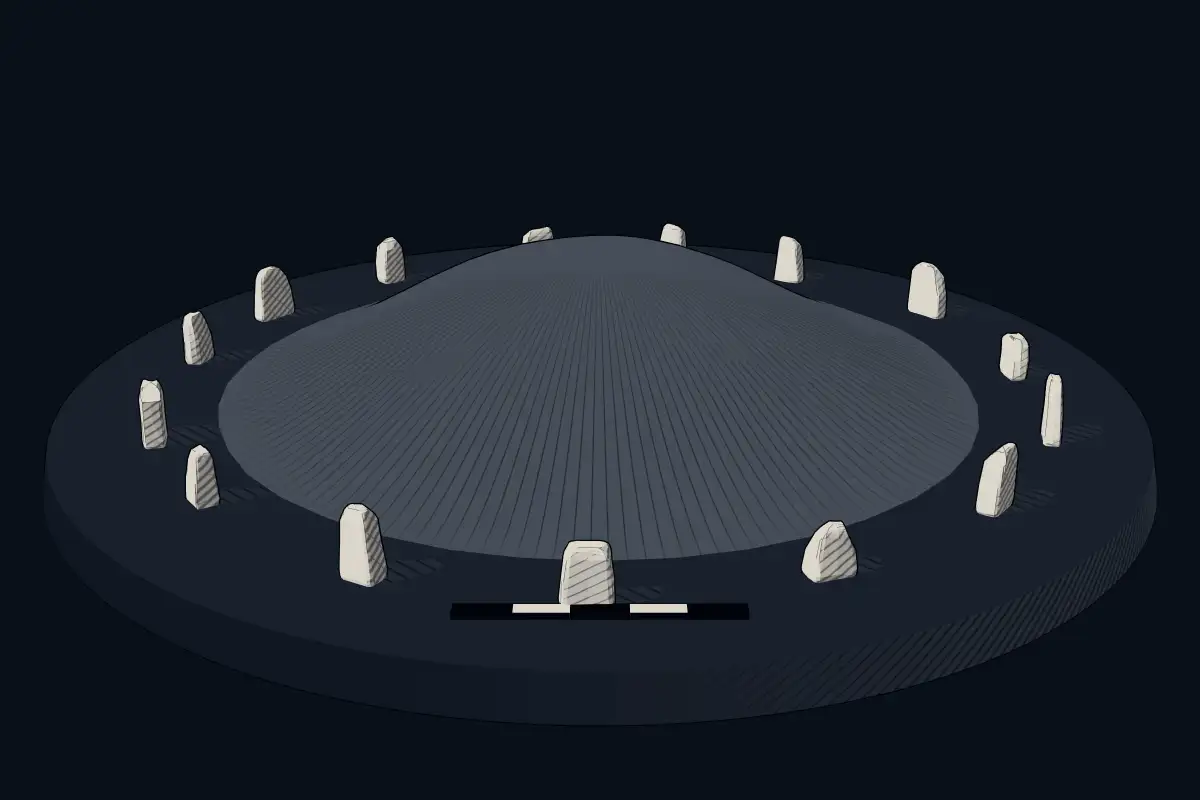
Megalithic mound (tumulus with integral stones)
Gomilno grobišče Popov log
DatedEst. 1500–1 BCE
No licensed photograph yetWe have no photograph we may publish for this site, so the interpretive 3D view leads instead.
Overview
About this site
What the sources say
Gomilno grobišče Popov log is a megalithic mound recorded in Municipality of Turnišče, Slovenia. In open records it appears as Wikidata item Q60344956, mapped at 46.6167° N, 16.3218° E.
Built from structured records, not from an articleSources and licences
Where it sits in time
The site's dated range, placed against world reference points.
The scale is logarithmic: each step to the left is about ten times older than the last.
The full article
About Gomilno grobišče Popov log
This kind of monument hereSources for this section
- en.wikipedia.orgCC BY-SA 4.0
- en.wikipedia.orgCC BY-SA 4.0
- en.wikipedia.orgCC BY-SA 4.0
- en.wikipedia.orgCC BY-SA 4.0
- en.wikipedia.orgCC BY-SA 4.0
Sources for this section
- en.wikipedia.orgCC BY-SA 4.0
- en.wikipedia.orgCC BY-SA 4.0
- en.wikipedia.orgCC BY-SA 4.0
- en.wikipedia.orgCC BY-SA 4.0
- en.wikipedia.orgCC BY-SA 4.0
Central Europe has a long sequence of burial mounds. The Unetice culture of the Early Bronze Age came first, and the Tumulus culture of the Middle Bronze Age, about 1600 to 1300 BCE, raised mounds across Germany, the Czech Republic, Austria, Switzerland and neighbouring regions. The Hallstatt culture of the Early Iron Age made the mound grand again. From the Hallstatt B phase, tumulus burial becomes common, and the Hallstatt period proper, 800 to 450 BCE, produced the "princely" graves of elites who lived in fortified hilltop centres. Further down this page, About this kind of monument gives the whole of “Central European tumuli”.
DatingSources for this section
- en.wikipedia.orgCC BY-SA 4.0
Sources for this section
- en.wikipedia.orgCC BY-SA 4.0
Typological estimate, not a date for this site: monuments of this kind in this region are normally dated 1500 BCE to 0 CE. The range comes from what is known about megalithic mound monuments in Slovenia; nothing measured on this site itself is on record, so it may be younger or older than the range suggests.
The range rests on this regional background (source: the Wikipedia article “Tumulus”): The gomila of the karst are prehistoric structures built in the 2nd and 1st millennia BC from the middle Bronze Age to the end of the Iron Age; a few are Roman-period.
Landscape and neighbours
The catalogue lists 0 other sites within 1 km, 12 within 5 km and 26 within 10 km; 26 of them are also classed as megalithic mound. It is one of 3 megalithic mound records among the 3 sites catalogued in Municipality of Turnišče, Slovenia.
Nearest to it are Gomila (1.1 km north, megalithic mound); Gomilno grobišče Čepeleš (1.9 km north, megalithic mound); Gomilno grobišče Suhi jarek (2.3 km north-east, megalithic mound); Gomilno grobišče Pašnik (2.6 km north-east, megalithic mound). The catalogue is assembled from open records and is not complete, so unrecorded monuments may lie closer.
Records and protectionSources for this section
Sources for this section
Wikidata lists the site with the heritage status registered immobile cultural heritage of Slovenia. The open records for it are Wikidata (Q60344956), where corrections and further identifiers can be added. Sites of this kind often lie on farmland or other private ground, so check local access rules before visiting and leave the monument as you found it.
How this page was madeSources for this section
Sources for this section
This page was built automatically from Wikidata (CC0), the heritage register named above and the regional article “Central European tumuli”, written for the Atlas from the Wikipedia articles it cites (CC BY-SA 4.0), plus distances and counts computed from the catalogue coordinates. It contains no AI-written text.
Tradition and region
About this kind of monument
Central European tumuli
Central Europe has a long sequence of burial mounds. The Unetice culture of the Early Bronze Age came first, and the Tumulus culture of the Middle Bronze Age, about 1600 to 1300 BCE, raised mounds across Germany, the Czech Republic, Austria, Switzerland and neighbouring regions. The Hallstatt culture of the Early Iron Age made the mound grand again. From the Hallstatt B phase, tumulus burial becomes common, and the Hallstatt period proper, 800 to 450 BCE, produced the "princely" graves of elites who lived in fortified hilltop centres.
The largest Hallstatt-period mound in Central Europe is the Magdalenenberg near Villingen-Schwenningen. Its central tomb, of an early Celtic prince, has been dated by tree rings to 616 BCE. The mound once stood 10 to 12 metres high with a diameter of 104 metres; 126 further graves were set in concentric rings around it in the decades after the prince's death, and about 500 BCE the central chamber was plundered by robbers whose wooden spades archaeologists later found. Folklore marks it too: in the 1640s, during a series of witch trials, several women confessed under torture to dancing with the devil on the Magdalenenberg. That is evidence of a belief, not of any event.
The Atlas's records in Slovenia, Austria, Switzerland, the Czech Republic and Slovakia are mostly tumuli of this Bronze Age and Iron Age sequence, and most are dated only by their form.
When visiting, look for mounds grouped in a cemetery rather than alone, since families and communities buried together, and for ploughed-down circular rises in fields.
Paraphrased from Wikipedia: Tumulus culture, Wikipedia: Hallstatt culture, Wikipedia: Magdalenenberg, Wikipedia: Unetice culture, Wikipedia: Tumulus · CC BY-SA 4.0
See it in 3D
An interpretive reconstruction of the monument, standing on the real ground at its exact point, under the sun for that place and season. Drag to look around it.
The reconstruction is ours, not a survey: it shows what a monument of this type looks like, at the size the record gives for this one.
Lore
Evidence & Lore
What the sources actually support — and, kept apart, what has been claimed.
What the evidence supports
Dates
Est. 1500–1 BCEHow this date was established: Type comparisonTypical range for megalithic mounds in Slovenia; this site has not been dated itself. The gomila of the karst are prehistoric structures built in the 2nd and 1st millennia BC from the middle Bronze Age to the end of the Iron Age; a few are Roman-period.Source for this date
Where it stands
Slovenia
The pin marks the monument itself — its exact point.
- Coordinates
- 46°37′00″ N, 16°19′18″ EFor a GPS or map app: 46.61665, 16.32180
Access is as our sources describe it; we have not visited the site to check.
Nearby
The closest sites in the Atlas, by straight line.
- Megalithic mound (tumulus with integral stones)Gomila1500–1 BCE
- Megalithic mound (tumulus with integral stones)Gomilno grobišče Čepeleš1500–1 BCE
- Megalithic mound (tumulus with integral stones)Gomilno grobišče Suhi jarek1500–1 BCE
- Megalithic mound (tumulus with integral stones)Gomilno grobišče Pašnik1500–1 BCE
- Megalithic mound (tumulus with integral stones)Gomilno grobišče Ob Ginji1500–1 BCE
- Megalithic mound (tumulus with integral stones)Rimskodobno gomilno grobišče Vonju1500–1 BCE
- Megalithic mound (tumulus with integral stones)Gomilno grobišče Poseka1500–1 BCE
- Megalithic mound (tumulus with integral stones)Gomilno grobišče Plugi1500–1 BCE
Sources
Every record behind this page, with the link it came from.
2 sources behind this page
- 01Wikidata Q60344956wikidata.org
- 02Source for this dateen.wikipedia.org
Report a correctionWrong date, name, photograph or source? Tell us and it will be put right.
Around this place
The ten nearest sites, by compass
- Gomila1.1 km N
- Gomilno grobišče Čepeleš1.9 km N
- Gomilno grobišče Suhi jarek2.4 km NE
- Gomilno grobišče Pašnik2.6 km NE
- Gomilno grobišče Ob Ginji2.8 km NE
- Rimskodobno gomilno grobišče Vonju3.1 km N
- Gomilno grobišče Poseka3.5 km NE
- Gomilno grobišče Plugi3.5 km N
- Gomilno grobišče3.9 km SE
- Rimskodobna gomila Logarnica4.0 km NW
Credit
Text, licence and sources
This page is assembled from open records (Wikidata, CC0; OpenStreetMap, ODbL) and a tradition article paraphrasing Wikipedia (CC BY-SA 4.0). No article exists for this site, and nothing here is written by a model.
- Wikidata Q60344956CC0
- en.wikipedia.orgCC BY-SA 4.0
- en.wikipedia.orgCC BY-SA 4.0
- en.wikipedia.orgCC BY-SA 4.0
- en.wikipedia.orgCC BY-SA 4.0
- en.wikipedia.orgCC BY-SA 4.0