
Utbogårdens hällkista
DatedEst. 3500–2800 BCE
Photo Oscar Montelius · Public domainSource file on Wikimedia Commons

Overview
About this site
What the sources say
Die Steinkiste von Utbogården (auch Hällkista i Karleby genannt) liegt östlich von Karleby und Falköping in Västra Götaland in Schweden.
Die megalithische Steinkiste in ebenem Gelände lag nach Angaben des Ausgräbers Oscar Montelius (1843–1921) ursprünglich in einer völlig abgetragenen Röse. Sie ist in zwei 4,5 und 0,8 m lange Kammern unterteilt und hat einen etwa 1,0 m langen Vorraum. Ein Seelenloch (schwedisch Gavelhål; übersetzt deutsch Giebelloch genannt) liegt in der Trennwand zwischen den Kammern, die aus zwei 0,1 bis 0,15 m dicken Platten besteht. Das Seelenloch, das durch Auspicken von zwei Platten geteilt ist, bildet den runden Zugang. Die Langseiten bestehen aus 13 erhaltenen 0,6 bis 0,9 m hohen, 0,6 bis 1,0 m breiten und 0,15 m dicken Platten. Die Enden werden durch je zwei Platten gebildet. Alle Decksteine fehlen.
In der Kammer wurden 1874 von Oscar Montelius und Gustaf Retzius (1842–1919) Dolche, Pfeilspitzen und Schaber aus Feuerstein, sowie Schieferanhänger, Nadeln und Knochenwerkzeuge, eine Bernsteinperle, zwei Bronzeperlen, der Teil einer Bronzespitze, vier Gefäße und die Knochen von Menschen und Tieren gefunden.
Article in GermanRead on Wikipedia3 min readCC BY-SA 4.0
Where it sits in time
The site's dated range, placed against world reference points.
The scale is logarithmic: each step to the left is about ten times older than the last.
The full article
Utbogårdens hällkista: the whole story
In briefSources for this section
- Wikipedia (German): Steinkiste von UtbogårdenCC BY-SA 4.0
Sources for this section
- Wikipedia (German): Steinkiste von UtbogårdenCC BY-SA 4.0
Utbogårdens hällkista, also called the Hällkista i Karleby, lies east of Karleby and Falköping in Västra Götaland, Sweden. It is a megalithic stone cist, a small coffin-like stone box made to hold the dead. The monument is dated typologically to 3500 BCE to 2800 BCE.
The cist stands in level ground and originally lay within a cairn that had been completely worn away. It is divided into two chambers, measuring 4,5 and 0,8 m, with an entrance passage about 1,0 m long. A gable hole, or Gavelhål, forms a round opening through the partition between the chambers.
The long sides consist of 13 surviving slabs, each 0,6 to 0,9 m high, 0,6 to 1,0 m wide and 0,15 m thick. Each end is formed by two slabs, while all the covering stones are missing. The partition consists of two slabs, 0,1 to 0,15 m thick, separated to create the gable hole.
In 1874, Oscar Montelius and Gustaf Retzius excavated the chamber. Finds included flint daggers, arrowheads and scrapers, slate pendants, needles and bone tools, one amber bead, two bronze beads, part of a bronze point, four vessels, and human and animal bones. Stone cists in Scandinavia may once have been covered by a cairn or long barrow, and several can occur together within one.
No English Wikipedia article exists for it; the full text below is the German article "Steinkiste von Utbogården", shown in the original language.
Summary in EnglishSources for this section
- Wikipedia (German): Steinkiste von UtbogårdenCC BY-SA 4.0
Sources for this section
- Wikipedia (German): Steinkiste von UtbogårdenCC BY-SA 4.0
Utbogårdens hällkista is a cist in Falköping Municipality, Sweden. A typological estimate: 3500 BCE to 2800 BCE. No English Wikipedia article exists for it; the full text below is the German article "Steinkiste von Utbogården", shown in the original language.
How this page was madeSources for this section
- Wikipedia (German): Steinkiste von UtbogårdenCC BY-SA 4.0
Sources for this section
- Wikipedia (German): Steinkiste von UtbogårdenCC BY-SA 4.0
The summary at the top of this page was written by MiniMax-M3 (2026-11-08) from the cited Wikipedia article “Steinkiste von Utbogården”, translated from German. The numbers in it were checked automatically against the source text. The rest of the page is the article itself, the structured records and computed distances.
Tradition and region
About this kind of monument
Scandinavian and German stone cists
A cist, or kist, is a small stone-built coffin-like box used to hold the bodies of the dead. It may once have been covered by a cairn or a long barrow, and several cists are sometimes found together within the same cairn or barrow. Ornaments are often found in excavated cists, which shows the wealth or prominence of the person buried. In Scandinavia the stone cist is called the hellekiste in Danish and hällkista in Swedish, and in Nordic megalith architecture it is one of the recognised types alongside dolmens and passage graves.
The most spectacular cist in Scandinavia is the central chamber of the King's Grave at Kivik in Scania, from about the fifteenth century BCE. It is about 4 metres long and 1.5 metres wide, made of ten upright slabs of which eight are decorated with carvings of people, ships, birds, fish, horses, axes and a chariot. It was opened in 1748 by farmers who were taking stone for field walls.
Other cists are much smaller. Associated with Nordic Bronze Age settlements are burial cairns, mounds and cemeteries, with interments including oak coffins and urn burials. The cists in the Atlas, many of them in Sweden and Denmark, are usually single graves under a cairn or a barrow.
Dating relies on the objects in the cist and on radiocarbon dating of any surviving bone.
When visiting, look for a box formed by slabs, exposed where its covering mound has gone.
Paraphrased from Wikipedia: Cist, Wikipedia: Kivik grave, Wikipedia: Nordic megalith architecture, Wikipedia: Nordic Bronze Age · CC BY-SA 4.0
From the article
Dated moments in the story
- 1843
Die megalithische Steinkiste in ebenem Gelände lag nach Angaben des Ausgräbers Oscar Montelius (1843–1921) ursprünglich in einer völlig abgetragenen Röse.
Source - 1874
In der Kammer wurden 1874 von Oscar Montelius und Gustaf Retzius (1842–1919) Dolche, Pfeilspitzen und Schaber aus Feuerstein, sowie Schieferanhänger, Nadeln und Knochenwerkzeuge, eine Bernsteinperle, zwei Bronzeperlen, der Teil einer Bronzespitze, vier Gefäße und die Knochen von Menschen und Tieren gefunden.
Source
See it in 3D
An interpretive reconstruction of the monument, standing on the real ground at its exact point, under the sun for that place and season. Drag to look around it.
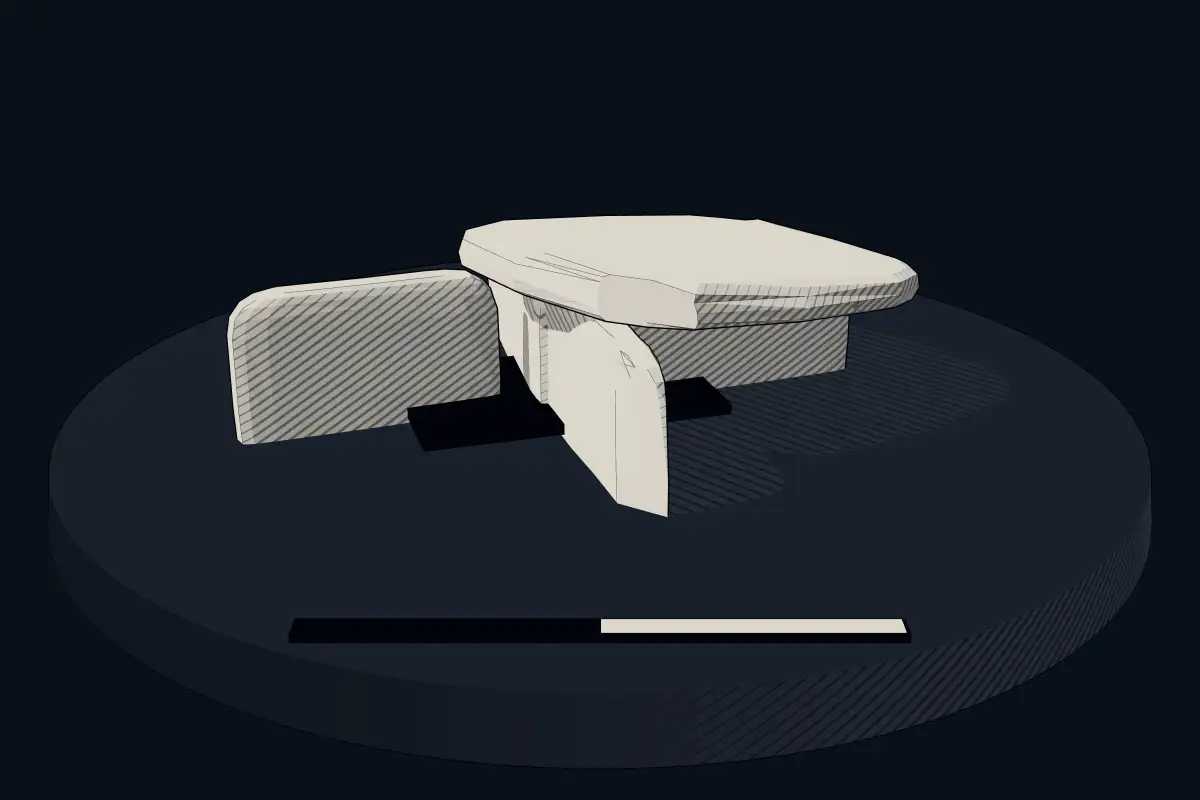
The reconstruction is ours, not a survey: it shows what a monument of this type looks like, at the size the record gives for this one.
Photographs
2 photographs, each with its author and licence
More photographs

Lore
Evidence & Lore
What the sources actually support — and, kept apart, what has been claimed.
What the evidence supports
Dates
Est. 3500–2800 BCEHow this date was established: Type comparisonTypical range for cists in Sweden; this site has not been dated itself. Swedish stone cists (stenkistor) belong to the Nordic megalith tradition which emerged predominantly between 3500 and 2800 BC.Source for this date
Where it stands
Sweden
The pin marks the monument itself — its exact point.
- Coordinates
- 58°09′48″ N, 13°38′50″ EFor a GPS or map app: 58.16346, 13.64719
Access is as our sources describe it; we have not visited the site to check.
Nearby
The closest sites in the Atlas, by straight line.
- Megalithic mound (tumulus with integral stones)Karleby 74:32000 BCE–1050 CE
- Megalithic mound (tumulus with integral stones)Karleby 85:12000 BCE–1050 CE
- MegalithKarleby 84:12000–500 BCE
 Karleby 76:12000–500 BCE
- Megalithic mound (tumulus with integral stones)Karleby 75:12000 BCE–1050 CE
- Megalithic mound (tumulus with integral stones)Karleby 87:12000 BCE–1050 CE
- MegalithElins sten el Ilia sten2000–500 BCE
 Karleby 60:12000–500 BCE


Sources
Every record behind this page, with the link it came from.
2 sources behind this page
- 01Wikidata Q29579291wikidata.org
- 02Source for this dateen.wikipedia.org
Image files
- Cist grave excavation in 1874.jpgOscar MonteliusPublic domain
- Utbogården - KMB - 16001000183224.jpgOscar MonteliusPublic domain
Report a correctionWrong date, name, photograph or source? Tell us and it will be put right.
Around this place
The ten nearest sites, by compass
Credit
Text, licence and sources
Text from the Wikipedia article "Steinkiste von Utbogården" (German), licensed CC BY-SA 4.0; authors are listed in the page history. Reused under CC BY-SA 4.0. Read on Wikipedia · Edit history and authors