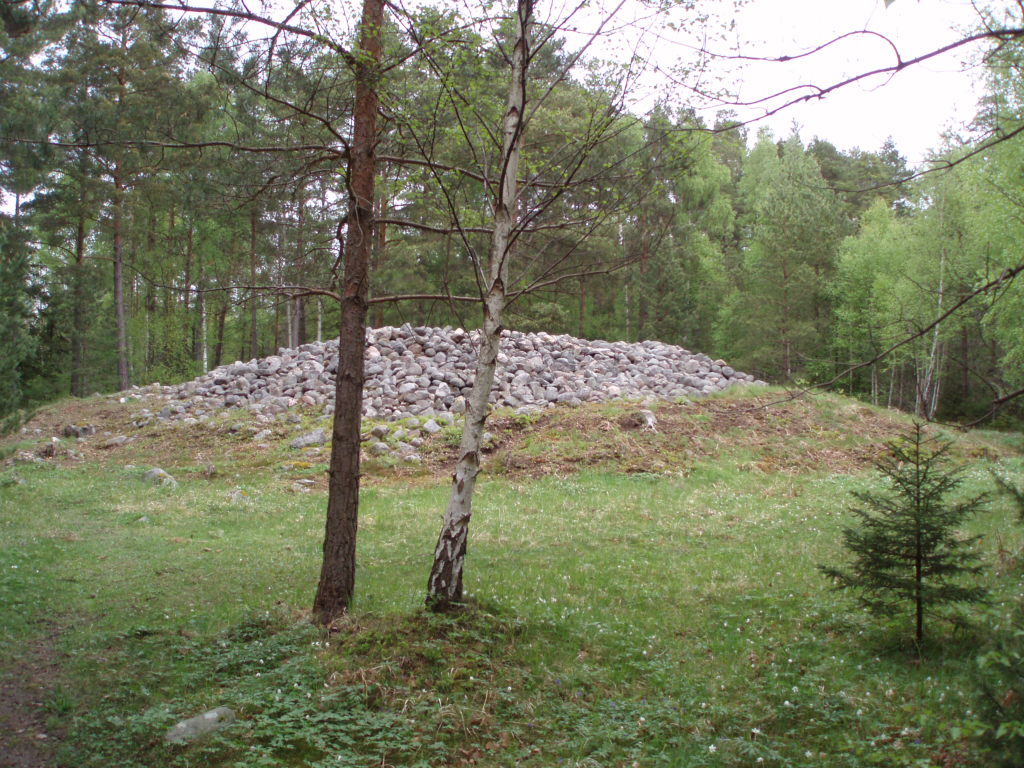
Rannarve grave field
DatedEst. 1000 BCE–1000 CE
Photo BH2008 · CC BY-SA 3.0Source file on Wikimedia Commons

Overview
About this site
Overview
The Rannarve grave field (Rannarveskeppen) is a grave field of the Younger Bronze Age in Klinte parish on western Gotland, Sweden, just north-east of Klintehamn. It contains eight ancient monuments: six ship settings, one round stone setting and one standing stone.
Four of the ship settings stand in a row, are exactly the same size and share stem stones. The site was investigated and restored in 1966-1967.
Read on Wikipedia2 min readCC BY-SA 4.0
Where it sits in time
The site's dated range, placed against world reference points.
The scale is logarithmic: each step to the left is about ten times older than the last.
Article
Rannarve grave field
The four conjoined ship settings together measure 32 metres in length and are four metres wide.
DescriptionSources for this section
- Wikipedia (Swedish): RannarveskeppenCC BY-SA 4.0
Sources for this section
- Wikipedia (Swedish): RannarveskeppenCC BY-SA 4.0
The four conjoined ship settings together measure 32 metres in length and are four metres wide. Their stones are upright and closely set, and the stem stones are higher than the rest, about two metres. The burial is aligned north-south. The other two ship settings are smaller, and one of them is damaged.
ExcavationsSources for this section
- Wikipedia (Swedish): RannarveskeppenCC BY-SA 4.0
Sources for this section
- Wikipedia (Swedish): RannarveskeppenCC BY-SA 4.0
Rannarveskeppen was investigated and restored in 1966-1967. In the second southernmost of the four conjoined ship settings lay a cist of grey stone containing an unusual house urn with cremated bones and two miniature knives of bronze.
In one of the two smaller ship settings the excavations found a biconical urn with cremated bones and miniature objects of bronze, including tweezers and a razor.
SettingSources for this section
- Wikipedia (Swedish): RannarveskeppenCC BY-SA 4.0
Sources for this section
- Wikipedia (Swedish): RannarveskeppenCC BY-SA 4.0
The area around Rannarve is rich in ancient remains. Following the path 300 metres to the north leads to a large burial cairn that is just under three metres high and 21 metres in diameter.
ContextSources for this section
- Wikipedia (Swedish): RannarveskeppenCC BY-SA 4.0
Sources for this section
- Wikipedia (Swedish): RannarveskeppenCC BY-SA 4.0
The stone ship, or ship setting, was a burial custom in Scandinavia, northern Germany and the Baltic states, in which a grave or cremation was surrounded by stones set in the outline of a ship. Ship settings were raised from about 1000 BCE to 1000 CE and are often found in grave fields. Excavations show that they are usually from the later part of the Nordic Bronze Age, about 1000 to 500 BCE, as on Gotland.
Tradition and region
About this kind of monument
Stone ship settings
The stone ship, or ship setting, was an early burial custom in Scandinavia, northern Germany and the Baltic states. A grave or cremation was surrounded by slabs or stones set in the outline of a ship, and the ships were raised from about 1000 BCE to 1000 CE. They are often found in grave fields, though sometimes far from other remains. The largest known, the mostly destroyed Jelling stone ship in Denmark, was at least 170 metres long, and in Sweden sizes range from 67 metres at Ale's Stones to a few metres.
Excavations show that stone ships are usually from the later part of the Nordic Bronze Age, about 1000 to 500 BCE, as on Gotland, or from the Germanic Iron Age, the Vendel period and the Viking Age, as in Blekinge and Scania. Scholars have suggested that the stone ship developed from the wish to equip the dead with everything they had in life, or that it was associated with the journey to Hel, the realm of the dead in Norse myth.
Ale's Stones in Scania is an oval ship of 59 boulders, each up to 5 tonnes, 67 metres long. Radiocarbon dating gave seven results: one about 5,500 years old and six of about 1,400 years, the likely date, at the end of the Nordic Iron Age. Its purpose is much disputed: it is generally believed to be a grave monument or a cult centre, and another theory, that it is a sun calendar, remains unproven. In 1989 the first scientific excavation found a decorated clay pot holding burned human bones inside the ship.
When visiting, look at the large stones at the stem and stern, and consider how the ship is laid out in relation to the sea or valley.
Paraphrased from Wikipedia: Ship setting, Wikipedia: Ale's Stones, Wikipedia: Lindholm Høje, Wikipedia: Anundshög · CC BY-SA 4.0
From the article
Dated moments in the story
- 1966
Rannarveskeppen undersöktes och restaurerades 1966-1967. I den näst sydligaste av de fyra sammanbyggda skeppssättningarna låg en gråstenskista, vilken innehöll en ovanlig husurna med brända ben och två miniatyrknivar i brons.
Source
Photographs
1 photograph, each with its author and licence
Lore
Evidence & Lore
What the sources actually support — and, kept apart, what has been claimed.
What the evidence supports
Dates
Est. 1000 BCE–1000 CEHow this date was established: Type comparisonTypical range for ship settings in Sweden; this site has not been dated itself. The stone ships vary in size and were erected from c. 1000 BCE to 1000 CE.Source for this date
Where it stands
Sweden
The pin marks the monument itself — its exact point.
- Coordinates
- 57°23′46″ N, 18°13′26″ EFor a GPS or map app: 57.39617, 18.22389
Access is as our sources describe it; we have not visited the site to check.
Nearby
The closest sites in the Atlas, by straight line.
- Megalithic mound (tumulus with integral stones)Klinte 29:12000 BCE–1050 CE
- Megalithic mound (tumulus with integral stones)Klinte 4:12000 BCE–1050 CE
- Megalithic mound (tumulus with integral stones)Klinte 26:12000 BCE–1050 CE
- Stone circleSanda 53:12000 BCE–800 CE
- Megalithic mound (tumulus with integral stones)Sanda 100:12000 BCE–1050 CE
- Stone circleSanda 50:12000 BCE–800 CE
- Megalithic mound (tumulus with integral stones)Sanda 49:12000 BCE–1050 CE
- Megalithic mound (tumulus with integral stones)Sanda 51:12000 BCE–1050 CE
Sources
Every record behind this page, with the link it came from.
2 sources behind this page
- 01Wikidata Q10649627wikidata.org
- 02Source for this dateen.wikipedia.org
Image files
Report a correctionWrong date, name, photograph or source? Tell us and it will be put right.
Around this place
The ten nearest sites, by compass
Credit
Text, licence and sources
Adapted from the Wikipedia article "Rannarveskeppen" (Swedish), licensed CC BY-SA 4.0; authors are listed in the page history. Reused under CC BY-SA 4.0. Read on Wikipedia · Edit history and authors
- Wikipedia (Swedish): RannarveskeppenCC BY-SA 4.0
- Wikidata Q10649627CC0