
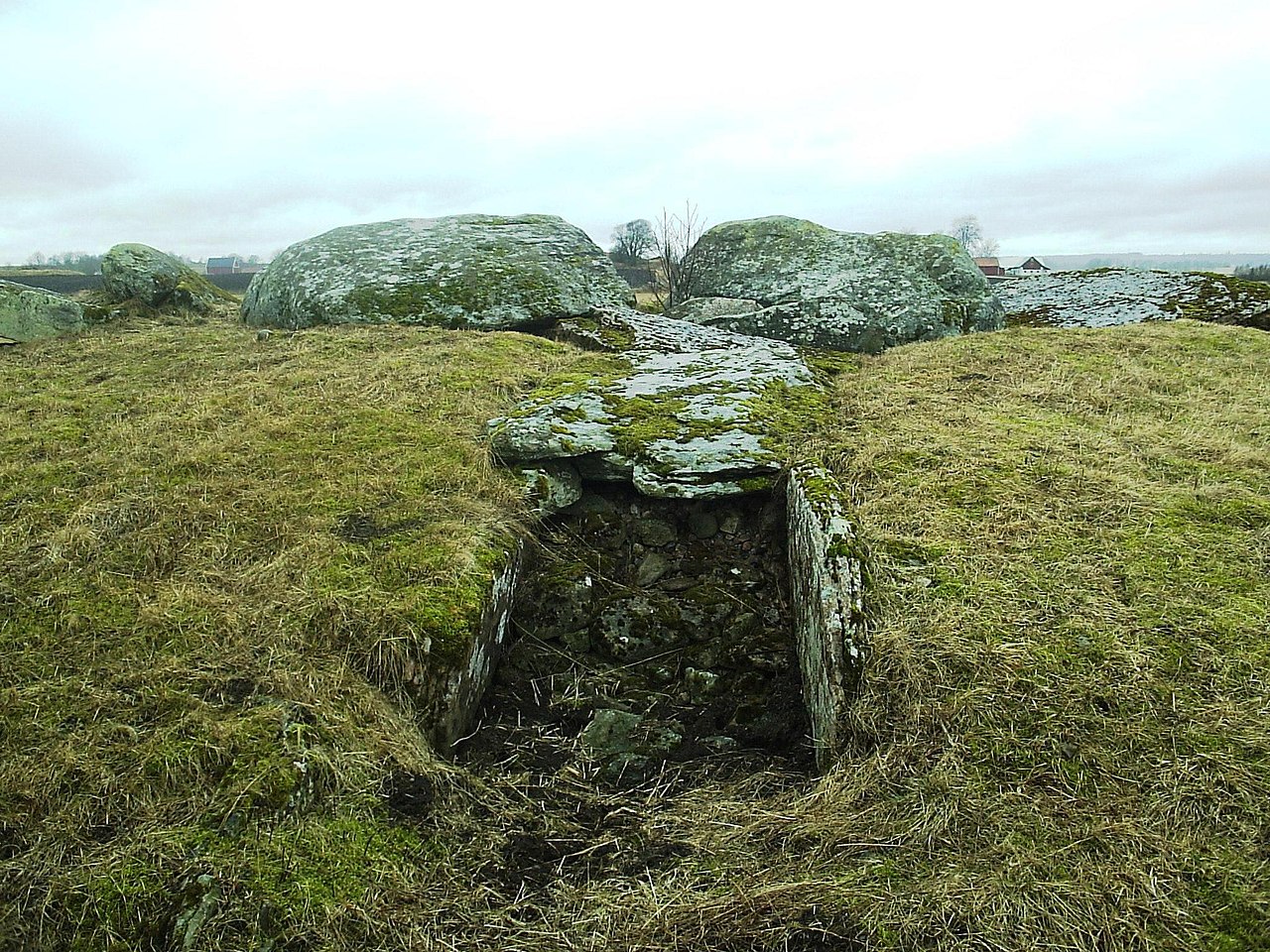
Ragnvalds grav
DatedEst. 2000–500 BCE
Photo Harri Blomberg · CC BY-SA 3.0Source file on Wikimedia Commons

Overview
About this site
What the sources say
Ragnvalds grav is a megalith in Falköping Municipality, Sweden. The catalogue places it at 58.1536° N, 13.6379° E and links it to Wikidata item Q29579273.
Built from structured records, not from an articleSources and licences
Where it sits in time
The site's dated range, placed against world reference points.
The scale is logarithmic: each step to the left is about ten times older than the last.
The full article
About Ragnvalds grav
This kind of monument hereSources for this section
- en.wikipedia.orgCC BY-SA 4.0
- en.wikipedia.orgCC BY-SA 4.0
- en.wikipedia.orgCC BY-SA 4.0
- en.wikipedia.orgCC BY-SA 4.0
- en.wikipedia.orgCC BY-SA 4.0
Sources for this section
- en.wikipedia.orgCC BY-SA 4.0
- en.wikipedia.orgCC BY-SA 4.0
- en.wikipedia.orgCC BY-SA 4.0
- en.wikipedia.orgCC BY-SA 4.0
- en.wikipedia.orgCC BY-SA 4.0
The Atlas files over 2,000 Swedish and Finnish records, and a handful of Norwegian ones, under the general heading "megalith". They are the many kinds of stone setting that the Nordic Bronze Age and Iron Age left behind: standing stones, round and triangular settings, stone circles, ship settings and cairns, usually forming part of a grave field. The full article, “Nordic standing stones and stone settings”, follows below under About this kind of monument.
DatingSources for this section
- en.wikipedia.orgCC BY-SA 4.0
Sources for this section
- en.wikipedia.orgCC BY-SA 4.0
The Atlas shows 2000 BCE to 500 BCE for this site, but that is a regional estimate for this kind of monument, not a date for this particular megalith. No excavation, radiocarbon sample or other measurement is recorded for it, so the real age could fall anywhere within the range, or outside it.
The range rests on this regional background (source: the Wikipedia article “Nordic Bronze Age”): Swedish megalithic monuments are mostly Bronze Age barrows and stone settings of the Nordic Bronze Age (c. 2000-500 BC).
Landscape and neighbours
Within 10 km lie 353 other catalogued sites (11 within 1 km, 102 within 5 km); 179 of them are also classed as megalith. That puts it inside a dense cluster of monuments. It is one of 267 megalith records among the 791 sites catalogued in Falköping Municipality, Sweden.
Nearest to it are Ragnvalds grav (0.0 km north-west, passage tomb); Klövagården (0.1 km south, passage tomb); Karleby 57:1 (0.1 km south, megalith); Logårdens gånggrift (0.1 km north, passage tomb). The catalogue is assembled from open records and is not complete, so unrecorded monuments may lie closer.
Records and protectionSources for this section
Sources for this section
Wikidata lists the site with the heritage status monument in Fornminnesregistret. The open records for it are Wikidata (Q29579273), where corrections and further identifiers can be added. Access varies from open common land to private fields; check local access rules, ask where needed, and take care not to damage the monument.
How this page was madeSources for this section
Sources for this section
This page was built automatically from Wikidata (CC0), the heritage register named above and the regional article “Nordic standing stones and stone settings”, written for the Atlas from the Wikipedia articles it cites (CC BY-SA 4.0), plus distances and counts computed from the catalogue coordinates. It contains no AI-written text.
Tradition and region
About this kind of monument
Nordic standing stones and stone settings
The Atlas files over 2,000 Swedish and Finnish records, and a handful of Norwegian ones, under the general heading "megalith". They are the many kinds of stone setting that the Nordic Bronze Age and Iron Age left behind: standing stones, round and triangular settings, stone circles, ship settings and cairns, usually forming part of a grave field.
The clearest guide is the site at Anundshög near Västerås. It covers an area of about 215 by 205 metres and has 42 remains: 12 burial mounds, 10 round stone settings, 5 stone ships, 14 standing stones and one runestone. The largest mound is 64 to 68 metres across and 9.2 metres high, and a hearth at its base was radiocarbon dated to between 210 and 540 CE. Such a mixed site is typical: many of the "megaliths" of the north are not Neolithic monuments of the western European kind, but grave markers of the Bronze Age, the Iron Age and the Viking Age.
In Scandinavia a standing stone is a bauta (bautastein). The Heimskringla of Snorri Sturluson says that the custom was to burn the dead and raise monoliths for them, and in Sweden menhirs were raised as markers for warriors' graves until the thirteenth century. The ship settings, with outlines of ships made of stones, belong to the same world: they were erected from about 1000 BCE to 1000 CE.
Dating is usually by typology, since few of these settings have been excavated. Where charcoal has been found, as at Anundshög, radiocarbon dates give the period.
A setting of unknown type is given a broad range from the Bronze Age to the Viking Age.
When visiting, look for settings in grave fields on dry ridges, and notice how the shapes (round, triangular, ship-shaped) change from one group to the next.
Paraphrased from Wikipedia: Stone circle, Wikipedia: Ship setting, Wikipedia: Bautastone, Wikipedia: Anundshög, Wikipedia: List of menhirs · CC BY-SA 4.0
Photographs
1 photograph, each with its author and licence
Lore
Evidence & Lore
What the sources actually support — and, kept apart, what has been claimed.
What the evidence supports
Dates
Est. 2000–500 BCEHow this date was established: Type comparisonTypical range for megaliths in Sweden; this site has not been dated itself. Swedish megalithic monuments are mostly Bronze Age barrows and stone settings of the Nordic Bronze Age (c. 2000-500 BC).Source for this date
Where it stands
Sweden
The pin marks the monument itself — its exact point.
- Coordinates
- 58°09′13″ N, 13°38′16″ EFor a GPS or map app: 58.15358, 13.63789
Access is as our sources describe it; we have not visited the site to check.
Nearby
The closest sites in the Atlas, by straight line.
 Ragnvalds grav3500–2800 BCE
 Karleby 57:12000–500 BCE
- Klövagården3500–2800 BCE
 Logårdens gånggrift3500–2800 BCE
- MegalithKarleby 55:12000–500 BCE
 Karleby 60:12000–500 BCE
- Megalithic mound (tumulus with integral stones)Karleby 48:12000 BCE–1050 CE
- Megalithic mound (tumulus with integral stones)Karleby 158:32000 BCE–1050 CE


Sources
Every record behind this page, with the link it came from.
2 sources behind this page
- 01Wikidata Q29579273wikidata.org
- 02Source for this dateen.wikipedia.org
Image files
Report a correctionWrong date, name, photograph or source? Tell us and it will be put right.
Around this place
The ten nearest sites, by compass
Credit
Text, licence and sources
This page is assembled from open records (Wikidata, CC0; OpenStreetMap, ODbL) and a tradition article paraphrasing Wikipedia (CC BY-SA 4.0). No article exists for this site, and nothing here is written by a model.
- Wikidata Q29579273CC0
- en.wikipedia.orgCC BY-SA 4.0
- en.wikipedia.orgCC BY-SA 4.0
- en.wikipedia.orgCC BY-SA 4.0
- en.wikipedia.orgCC BY-SA 4.0
- en.wikipedia.orgCC BY-SA 4.0
- en.wikipedia.orgCC BY-SA 4.0