
Megalithic mound (tumulus with integral stones)
Digerrojr
DatedEst. 2000 BCE–1050 CE
Photo Sjunnesson · CC BY-SA 4.0Source file on Wikimedia Commons

Overview
About this site
Overview
Digerrojr (also Digerråir) is a Bronze Age burial cairn in Garde parish on Gotland, Sweden, and one of the largest burial cairns on the island. It lies in Alskogen, about 1.2 km north-east of the farm Folkedarve, and can be reached by a small forest road leading from the road between Lau and Ljugarn.
The cairn is built of unearthed grey stone, stands 4-5 metres high and has a diameter of 35 metres.
Read on Wikipedia2 min readCC BY-SA 4.0
Where it sits in time
The site's dated range, placed against world reference points.
The scale is logarithmic: each step to the left is about ten times older than the last.
Article
Digerrojr
The cairn is surrounded by a double kerb of stones that includes blocks up to two metres long.
DescriptionSources for this section
- Wikipedia (Swedish): DigerrojrCC BY-SA 4.0
Sources for this section
- Wikipedia (Swedish): DigerrojrCC BY-SA 4.0
The cairn is surrounded by a double kerb of stones that includes blocks up to two metres long. In the middle of the interior is a large pit. Older notes attribute the pit to treasure hunting, but it had formed earlier, when a burial chamber collapsed. This was a timbered chamber raised for the deceased, and when it fell in over time it left the crater-like depression.
SettingSources for this section
- Wikipedia (Swedish): DigerrojrCC BY-SA 4.0
Sources for this section
- Wikipedia (Swedish): DigerrojrCC BY-SA 4.0
The cairn lies at the outer edge of the Gålrum area, which is rich in ancient monuments and includes a whole fleet of ship settings. One of the seven ship settings there has separated from the rest of the group and almost touches the foot of the cairn with its front stem. The ships, probably more numerous originally, are dated by finds to the Late Bronze Age. Gålrum also has a number of smaller mounds and stone settings and a Viking Age picture stone.
Similar large cairns on Gotland include Uggarde rojr in Rone parish and Bro stajnkalm.
FolkloreSources for this section
- Wikipedia (Swedish): DigerrojrCC BY-SA 4.0
Sources for this section
- Wikipedia (Swedish): DigerrojrCC BY-SA 4.0
According to a legend, Digerrojr was built as a burial monument for Graip, a Gotlandic chieftain who was a grandson of Tjelvar. For this reason it is also called Graiprs råir. Tjelvar's own grave is said to be the ship setting in Boge parish.
ContextSources for this section
- Wikipedia (Swedish): DigerrojrCC BY-SA 4.0
Sources for this section
- Wikipedia (Swedish): DigerrojrCC BY-SA 4.0
Many prehistoric graves in Sweden are round earth mounds (gravhögar) or heaps of stone (rösen, or cairns). Many belong to the Nordic Bronze Age, roughly 1700 to 500 BCE. Numerous such graves have not been excavated, and their dates are inferred from shape, setting and the grave goods of excavated neighbours.
Tradition and region
About this kind of monument
Swedish burial mounds and cairns
Sweden's landscape is thick with prehistoric graves, and most of the mounds in the Atlas are round earth mounds (gravhögar) or heaps of stone (rösen, or cairns). Many belong to the Nordic Bronze Age, roughly 1700 to 500 BCE, when the elite were buried beneath mounds of earth or stone. In the early part of that period the dead were often laid in oak coffins or stone cists; towards the end of the second millennium BCE cremation became the norm, and the ashes went into an urn or a small pit under a cairn.
Many of these graves have not been excavated. Their dates are inferred from shape, setting and the grave goods of excavated neighbours, so the Atlas gives a range instead of a single year.
The showpiece is the King's Grave at Kivik in Scania, the remains of an unusually grand double burial of about the fifteenth century BCE. Its restored cairn is some 75 metres across and 3.5 metres high. At the centre is a cist about 4 metres long, built of ten upright slabs, eight of them carved on the inside with ships, a two-horse chariot, lur players, axes, birds and fish. Farmers opened the chamber in 1748 while taking stone for field walls, and the carvings were first recognised in 1756. The excavation of 1931 recovered only teeth, bone fragments and broken bronze, because the grave had been looted. In the nineteenth century some scholars read the carvings as the work of Phoenician settlers; that idea was later rejected.
When visiting, look for mounds on ridges with a view over farmland or water, for kerb stones at the foot of a cairn, and for a shallow dip in the top that often marks an old digging.
Paraphrased from Wikipedia: Tumulus, Wikipedia: Nordic Bronze Age, Wikipedia: Kivik grave, Wikipedia: Burial mound · CC BY-SA 4.0
See it in 3D
An interpretive reconstruction of the monument, standing on the real ground at its exact point, under the sun for that place and season. Drag to look around it.
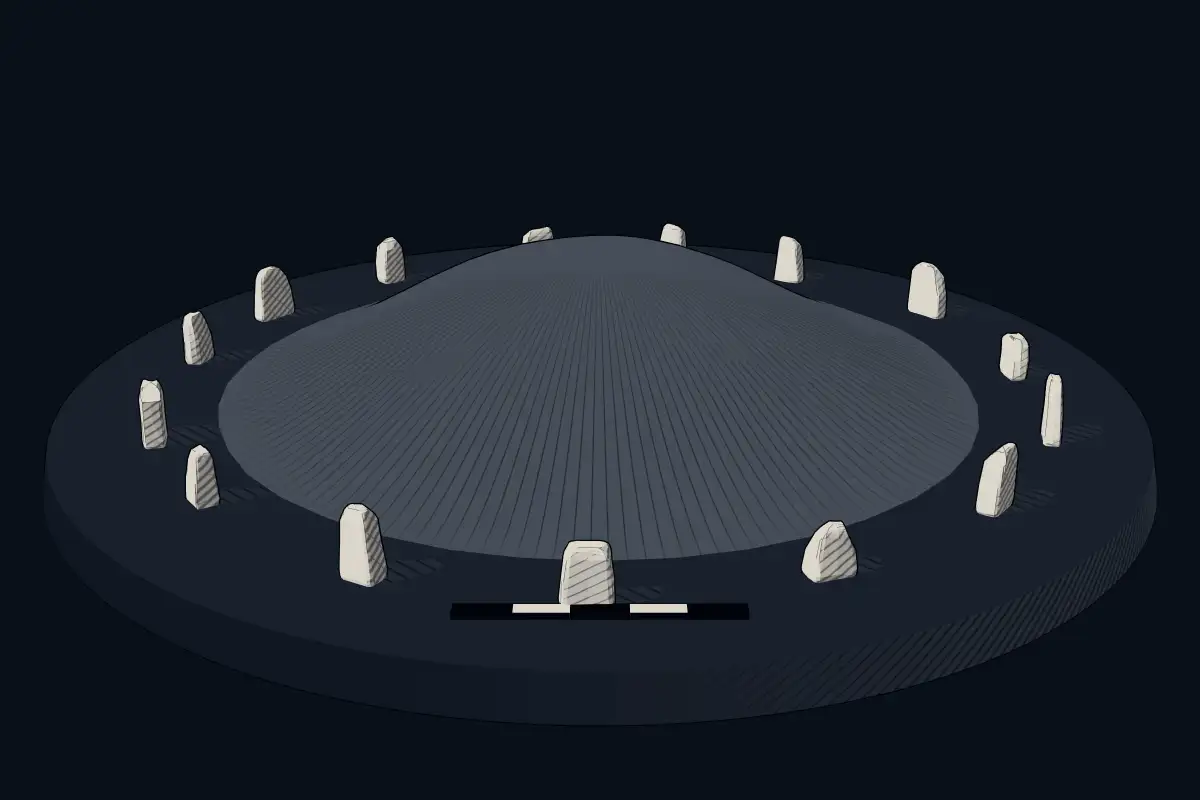
The reconstruction is ours, not a survey: it shows what a monument of this type looks like, at the size the record gives for this one.
Photographs
4 photographs, each with its author and licence
More photographs


Lore
Evidence & Lore
What the sources actually support — and, kept apart, what has been claimed.
What the evidence supports
Dates
Est. 2000 BCE–1050 CEHow this date was established: Type comparisonTypical range for megalithic mounds in Sweden; this site has not been dated itself. Swedish barrows are mostly Bronze Age rosen of the Nordic Bronze Age (c. 2000-500 BC); the Viking-age royal mounds of Gamla Uppsala belong to the Viking Age (about 800-1050 CE).Source for this date
Where it stands
Sweden
The pin marks the monument itself — its exact point.
- Coordinates
- 57°19′49″ N, 18°39′27″ EFor a GPS or map app: 57.33035, 18.65739
Access is as our sources describe it; we have not visited the site to check.
Nearby
The closest sites in the Atlas, by straight line.
 Gålrums grave field1000 BCE–1000 CE
- Stone circleAlskog 7:12000 BCE–800 CE
- Stone circleAlskog 7:32000 BCE–800 CE
- Megalithic mound (tumulus with integral stones)Alskog 137:12000 BCE–1050 CE
- Megalithic mound (tumulus with integral stones)Alskog 138:12000 BCE–1050 CE
- Megalithic mound (tumulus with integral stones)Alskog 241:12000 BCE–1050 CE
- Megalithic mound (tumulus with integral stones)Alskog 239:12000 BCE–1050 CE
- Megalithic mound (tumulus with integral stones)Alskog 243:12000 BCE–1050 CE

Sources
Every record behind this page, with the link it came from.
2 sources behind this page
- 01Wikidata Q10472428wikidata.org
- 02Source for this dateen.wikipedia.org
Image files
- Digerrojr.jpgSjunnessonCC BY-SA 4.0
- Digerrojr - KMB - 16000300024350.jpgJan NorrmanCC BY 2.5
- Digerrojr - KMB - 16000300024474.jpgJan NorrmanCC BY 2.5
- Digerrojr - KMB - 16000300024476.jpgJan NorrmanCC BY 2.5
Report a correctionWrong date, name, photograph or source? Tell us and it will be put right.
Lore, kept apart
Legends and claims
These are stories and claims reported by the sources. They are not evidence, and they never stand in for the dating above.
- Tradition
Digerrojr eller Digerråir i Garde socken är ett av Gotlands största gravrösen från bronsåldern.
Digerrojr eller Digerråir i Garde socken är ett av Gotlands största gravrösen från bronsåldern. Det ligger i Alskogen ca 1,2 km nordost om gården Folkedarve. Från vägen mellan Lau och Ljugarn går en mindre skogsväg som leder in till platsen. Röset som består av ojordad gråsten har en höjd på 4-5 m och en diameter på 35 m. I dess omkransande dubbla fotkedja ingår upp till två meter långa block och i dess inre mitt är en större grop, som enligt äldre noteringar lär vara orsakad av en skattjakt. Gropen har dock innan dess bildats av en ihopsjunken gravkammare, ett timrat vilorum som restes åt den avlidne och när detta med tiden rasade samman, uppstod den kraterlika fördjupningen. Digerrojr byggdes enligt en sägen som ett gravmonument över Graip, en gotländsk hövding som var sonson till Tjelvar. Av den anledningen så kallas det också för Graiprs råir. Tjelvars grav består i sin tur av en skeppssättning i Boge socken. Röset ligger i yttre kanten av Gålrums fornlämningsrika område, som bland annat erbjuder en hel flotta med skeppssättningar. En av dessa sju skeppssättningar har frigjort sig från den övriga gruppen och tangerar nästan med sin främre stäv, nedre fotfästet till Griprs digra råir. Skeppen som förmodligen från början varit fler, är via fynd daterade till yngre bronsåldern. Inom Gålrum finns även ett antal mindre högar och stensättningar, samt en vikingatida bildsten. Ett par andra liknande storrösen på Gotland är Uggarde rojr i Rone socken och Bro stajnkalm.
Source
Around this place
The ten nearest sites, by compass
Credit
Text, licence and sources
Adapted from the Wikipedia article "Digerrojr" (Swedish), licensed CC BY-SA 4.0; authors are listed in the page history. Reused under CC BY-SA 4.0. Read on Wikipedia · Edit history and authors
- Wikipedia (Swedish): DigerrojrCC BY-SA 4.0
- Wikidata Q10472428CC0