
Megalithic mound (tumulus with integral stones)
Blårör
DatedEst. 2000 BCE–1050 CE
Photo Olaf Meister · CC BY-SA 3.0Source file on Wikimedia Commons

Overview
About this site
What the sources say
Blårör är Ölands största gravröse och är belägen nedanför vägen mellan Borgholm och Köpingsvik. Graven anlades på bronsåldern och låg då på grund av landhöjningen ännu närmare stranden i ett flackt och låglänt område.
Det mäktiga gravröset mäter 40 meter i diameter och är tre meter högt. Stenarna är vanligen tre till fyra decimeter stora och rundade. På toppen av röset finns en halv meter djup grop omkring två meter i diameter. Vid den nord-nord-västra sidan finns en insjunkning vid rösets fot, fyra meter lång och en meter djup. Det ger intryck av en vara en "port" till rösets inre.
Article in SwedishRead on Wikipedia4 min readCC BY-SA 4.0
Where it sits in time
The site's dated range, placed against world reference points.
The scale is logarithmic: each step to the left is about ten times older than the last.
The full article
Blårör: the whole story
In briefSources for this section
- Wikipedia (Swedish): BlårörCC BY-SA 4.0
Sources for this section
- Wikipedia (Swedish): BlårörCC BY-SA 4.0
Blårör is a megalithic mound on Öland, Sweden, situated below the road between Borgholm and Köpingsvik. It is the largest grave mound on Öland. The mound was built during the Bronze Age, when it stood closer to the shore in a flat, low-lying area because of later land uplift. Its estimated date range is 2000 BCE to 1050 CE.
The mound measures 40 meters in diameter and is three meters high. Its rounded stones are usually three to four decimeters across. A depression about two meters wide and half a meter deep lies on top. On the north-northwestern side, a four-meter-long, one-meter-deep hollow at the foot of the mound resembles a “port” leading into its interior.
The grave was examined in 1849, when attention focused on its centre. Treasure seekers had already been there, and the remains of a stone cist contained only bone fragments and a bone button. During restoration in 1927, four graves were found: two inhumation graves dated to the earlier Bronze Age and two cremation graves from the later Bronze Age. One cremation grave held a sword probably made in Denmark, with no known equivalent in Sweden.
The name Blårör is also used for three other places on Öland, including two stone settings in Alböke socken, a mound north of Rälla and Ekerum, and a mound between Ramsättra and Ramdala that may have given the name. In the surrounding area are cup-marked stones, fixed in the ground and carved with hollows that may have had religious or ritual significance. Such stones are generally found in settings associated with the Bronze Age or earlier Iron Age.
No English Wikipedia article exists for it; the full text below is the Swedish article "Blårör", shown in the original language.
Summary in EnglishSources for this section
- Wikipedia (Swedish): BlårörCC BY-SA 4.0
Sources for this section
- Wikipedia (Swedish): BlårörCC BY-SA 4.0
Blårör is a megalithic mound (tumulus with integral stones) in Sweden. A typological estimate: 2000 BCE to 1050 CE. No English Wikipedia article exists for it; the full text below is the Swedish article "Blårör", shown in the original language.
Funnet i gravenSources for this section
- Wikipedia (Swedish): BlårörCC BY-SA 4.0
Sources for this section
- Wikipedia (Swedish): BlårörCC BY-SA 4.0
Graven har undersökts två gånger, första gången 1849 av riksantikvarien, som då koncentrerade sig på den centrala delen. Här hade skattsökare redan varit och i resterna av en hällkista påträffades endast benfragment och en benknapp. I samband med en restaurering 1927 hittade man fyra gravar, varav två skelettgravar och två brandgravar. De två skelettgravarna kunde dateras till äldre bronsålder medan de två brandgravarna, som låg ytligt i röset, tillhörde den yngre bronsåldern. I den ena av brandgravarna påträffades ett svärd som förmodligen är tillverkat i Danmark och utan annan motsvarighet i Sverige.
OmgivningSources for this section
- Wikipedia (Swedish): BlårörCC BY-SA 4.0
Sources for this section
- Wikipedia (Swedish): BlårörCC BY-SA 4.0
I den omedelbara omgivningen finns flera skålgropsblock, det vill säga jordfasta stenar med inknackade gropar som kan ha haft en religiös/rituell innebörd. Skålgropar i Norden brukar återfinnas i miljöer som kan knytas till bronsålder eller äldre järnålder. Den bebyggelse öster om Borgholm, som detta Blårör ligger i, har av SCB avgränsats till småorten Furuhäll, Blårör och Solbergamarken. I Blårör finns flera välbesökta badplatser på promenadavstånd från Borgholm.
Fyra Blårör på ÖlandSources for this section
- Wikipedia (Swedish): BlårörCC BY-SA 4.0
Sources for this section
- Wikipedia (Swedish): BlårörCC BY-SA 4.0
Enligt Lantmäteriets register och som namnen är fastställda och redovisas i Lantmäteriets grundläggande geodata så finns det fyra Blårör på Öland som alla stavas på samma sätt, dvs. sammansatt Blårör, även om särskrivning, Blå rör, också förekommer. Det mest kända är det Blårör som tas upp här. Ett andra Blårör finns i Alböke socken mellan Äleklinta och Djupvik som är namnet på två stensättningar. Det tredje återfinns norr om Rälla och Ekerum i Högsrums socken och är namnet på ett röse som är 20 meter i diameter och 2 meter högt. Och ett fjärde Blårör finns mellan Ramsättra och Ramdala strax sydöst om Borgholm i Köpings socken där ett stort röse (30 meter i diameter och 3 meter högt) sannolikt har varit namngivande.
EtymologiSources for this section
- Wikipedia (Swedish): BlårörCC BY-SA 4.0
Sources for this section
- Wikipedia (Swedish): BlårörCC BY-SA 4.0
Rör avser ett stenröse, och är den vanligaste beteckningen för gravrösen, men kan i vissa fall även syfta på naturliga bildningar. Blå är färgadjektiv, som i äldre tid även kunde åsyfta något mörkt eller svart.
How this page was madeSources for this section
- Wikipedia (Swedish): BlårörCC BY-SA 4.0
Sources for this section
- Wikipedia (Swedish): BlårörCC BY-SA 4.0
The summary at the top of this page was written by MiniMax-M3 (2026-11-07) from the cited Wikipedia article “Blårör”, translated from Swedish. The numbers in it were checked automatically against the source text. The rest of the page is the article itself, the structured records and computed distances.
Tradition and region
About this kind of monument
Swedish burial mounds and cairns
Sweden's landscape is thick with prehistoric graves, and most of the mounds in the Atlas are round earth mounds (gravhögar) or heaps of stone (rösen, or cairns). Many belong to the Nordic Bronze Age, roughly 1700 to 500 BCE, when the elite were buried beneath mounds of earth or stone. In the early part of that period the dead were often laid in oak coffins or stone cists; towards the end of the second millennium BCE cremation became the norm, and the ashes went into an urn or a small pit under a cairn.
Many of these graves have not been excavated. Their dates are inferred from shape, setting and the grave goods of excavated neighbours, so the Atlas gives a range instead of a single year.
The showpiece is the King's Grave at Kivik in Scania, the remains of an unusually grand double burial of about the fifteenth century BCE. Its restored cairn is some 75 metres across and 3.5 metres high. At the centre is a cist about 4 metres long, built of ten upright slabs, eight of them carved on the inside with ships, a two-horse chariot, lur players, axes, birds and fish. Farmers opened the chamber in 1748 while taking stone for field walls, and the carvings were first recognised in 1756. The excavation of 1931 recovered only teeth, bone fragments and broken bronze, because the grave had been looted. In the nineteenth century some scholars read the carvings as the work of Phoenician settlers; that idea was later rejected.
When visiting, look for mounds on ridges with a view over farmland or water, for kerb stones at the foot of a cairn, and for a shallow dip in the top that often marks an old digging.
Paraphrased from Wikipedia: Tumulus, Wikipedia: Nordic Bronze Age, Wikipedia: Kivik grave, Wikipedia: Burial mound · CC BY-SA 4.0
See it in 3D
An interpretive reconstruction of the monument, standing on the real ground at its exact point, under the sun for that place and season. Drag to look around it.
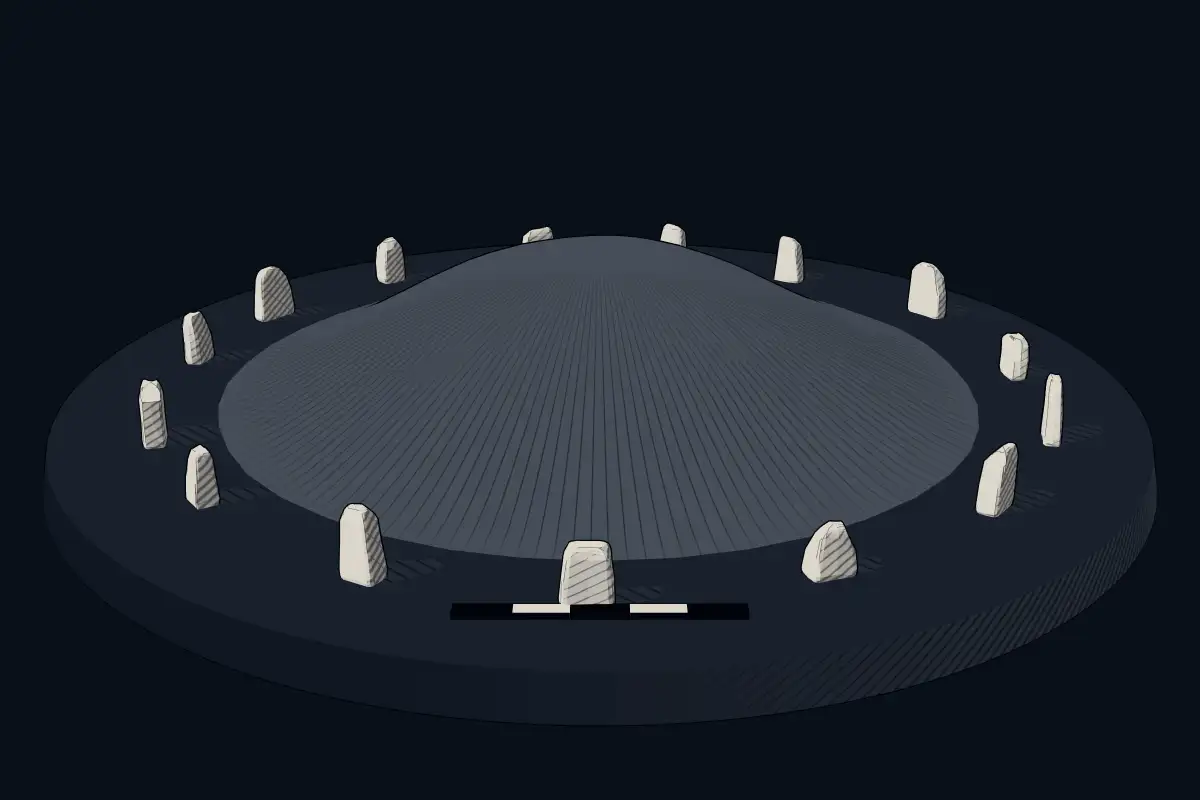
The reconstruction is ours, not a survey: it shows what a monument of this type looks like, at the size the record gives for this one.
Photographs
1 photograph, each with its author and licence
Lore
Evidence & Lore
What the sources actually support — and, kept apart, what has been claimed.
What the evidence supports
Dates
Est. 2000 BCE–1050 CEHow this date was established: Type comparisonTypical range for megalithic mounds in Sweden; this site has not been dated itself. Swedish barrows are mostly Bronze Age rosen of the Nordic Bronze Age (c. 2000-500 BC); the Viking-age royal mounds of Gamla Uppsala belong to the Viking Age (about 800-1050 CE).Source for this date
Where it stands
Sweden
The pin marks the monument itself — its exact point.
- Coordinates
- 56°52′51″ N, 16°40′56″ EFor a GPS or map app: 56.88075, 16.68217
Access is as our sources describe it; we have not visited the site to check.
Nearby
The closest sites in the Atlas, by straight line.
 Blårör2000 BCE–1050 CE
- Megalithic mound (tumulus with integral stones)Borgholm 18:12000 BCE–1050 CE
 Borgholm 1:12000 BCE–800 CE
- Stone circleKöping 48:12000 BCE–800 CE
- Stone circleKöping 48:32000 BCE–800 CE
- Stone circleKöping 48:22000 BCE–800 CE
- Megalithic mound (tumulus with integral stones)Köping 21:12000 BCE–1050 CE
- Megalithic mound (tumulus with integral stones)Räpplinge 187:12000 BCE–1050 CE

Sources
Every record behind this page, with the link it came from.
2 sources behind this page
- 01Wikidata Q887035wikidata.org
- 02Source for this dateen.wikipedia.org
Image files
- Bla rör Borgholm.JPGOlaf MeisterCC BY-SA 3.0
Report a correctionWrong date, name, photograph or source? Tell us and it will be put right.
Around this place
The ten nearest sites, by compass
Credit
Text, licence and sources
Text from the Wikipedia article "Blårör" (Swedish), licensed CC BY-SA 4.0; authors are listed in the page history. Reused under CC BY-SA 4.0. Read on Wikipedia · Edit history and authors
- Wikipedia (Swedish): BlårörCC BY-SA 4.0
- Wikidata Q887035CC0