
Ale's Stones
Datedc. 3474 BCE–626 CE*
Photo Sven Rosborn · CC BY-SA 3.0Source file on Wikimedia Commons

Overview
About this site
Overview
Ale's Stones (Swedish: Ales stenar) is a megalithic monument in Scania in southern Sweden. It is a ship setting, oval in outline, with the stones at each end markedly larger than the rest. It is 67 m (220 ft) long and formed by 59 large boulders weighing up to 5 tonnes each.
Radiocarbon dating suggests that it was created about 1,400 years ago, towards the end of the Nordic Iron Age.
Read on Wikipedia3 min readCC BY-SA 4.0
Age sources
Sources disagree on the age of this site
Sources do not agree on how old this site is. Each claim is listed with where it comes from; the mainstream reading is marked.
Range across all claimsc. 3474 BCE–626 CE*
MeasuredWhat this badge means
A physical measurement of this site: a radiocarbon date, a tree-ring count, a luminescence date, or a record that can itself be dated.
- 550 CERadiocarbon datingThe suggested creation date follows the radiocarbon results and the board's interpretation.Source: en.wikipedia.org
- 600 CEAtlas research notesc. 600 CE (six radiocarbon samples ~1,400 years ago)Source: en.wikipedia.org
- 626 CEAtlas research notesc. 600 CE (six radiocarbon samples ~1,400 years ago)Source: en.wikipedia.org
- 3474 BCEAtlas research notes[date:wp] [coord:Wikidata only] WD Q686510 'Ale's Stones' (stone ship in Ystad, Sweden) One sample ~5,500 years old (Wikipedia); stone ship setting.Source: en.wikipedia.org
Where it sits in time
The site's dated range, placed against world reference points.
The scale is logarithmic: each step to the left is about ten times older than the last.
Article
Ale's Stones
In 1989, during the first excavations to investigate and date the monument scientifically, archaeologists found a decorated clay pot with burned human bones inside the ship setting.
ExcavationsSources for this section
- Wikipedia (English): Ale's StonesCC BY-SA 4.0
Sources for this section
- Wikipedia (English): Ale's StonesCC BY-SA 4.0
In 1989, during the first excavations to investigate and date the monument scientifically, archaeologists found a decorated clay pot with burned human bones inside the ship setting. The bones are thought to come from a pyre and to have been placed in the pot at a later date. Some of the contents dated from 330 to 540 CE, while a piece of charred food crust was determined to be from 540 to 650 CE. Birch charcoal from 540 to 650 CE was found underneath an undisturbed boulder.
DatingSources for this section
- Wikipedia (English): Ale's StonesCC BY-SA 4.0
Sources for this section
- Wikipedia (English): Ale's StonesCC BY-SA 4.0
Seven carbon-14 results exist from the site. One indicates that the material is around 5,500 years old, while the remaining six indicate a date about 1,400 years ago. The diverging sample came from soot-covered stones believed to be the remnants of an older hearth found close to the ship setting. According to the Swedish National Heritage Board, six samples are from around 600 CE and one is from ca. 3500 BCE. The Board has set a suggested date of creation of 1,400 BP, which is the year 550 CE.
InterpretationSources for this section
- Wikipedia (English): Ale's StonesCC BY-SA 4.0
Sources for this section
- Wikipedia (English): Ale's StonesCC BY-SA 4.0
The function and purpose of Ale's Stones is much disputed. It is generally believed to be a grave monument or a cult centre, but another theory holds that it is a sun calendar. Howard Crowhurst has claimed that the monument is connected with the summer solstice and with lunar standstills, proposing alignments of the stones along the sunset direction on summer solstice and along the possible northern moonset on major and minor lunar standstills.
ContextSources for this section
- Wikipedia (English): Ale's StonesCC BY-SA 4.0
Sources for this section
- Wikipedia (English): Ale's StonesCC BY-SA 4.0
The stone ship, or ship setting, was an early burial custom in Scandinavia, northern Germany and the Baltic states, in which a grave or cremation was surrounded by stones set in the outline of a ship. Ships were raised from about 1000 BCE to 1000 CE. Excavations show that stone ships are usually from the later part of the Nordic Bronze Age, about 1000 to 500 BCE, or from the Germanic Iron Age, the Vendel period and the Viking Age, as in Blekinge and Scania. In Sweden, sizes range from 67 metres at Ale's Stones to a few metres.
Tradition and region
About this kind of monument
Stone ship settings
The stone ship, or ship setting, was an early burial custom in Scandinavia, northern Germany and the Baltic states. A grave or cremation was surrounded by slabs or stones set in the outline of a ship, and the ships were raised from about 1000 BCE to 1000 CE. They are often found in grave fields, though sometimes far from other remains. The largest known, the mostly destroyed Jelling stone ship in Denmark, was at least 170 metres long, and in Sweden sizes range from 67 metres at Ale's Stones to a few metres.
Excavations show that stone ships are usually from the later part of the Nordic Bronze Age, about 1000 to 500 BCE, as on Gotland, or from the Germanic Iron Age, the Vendel period and the Viking Age, as in Blekinge and Scania. Scholars have suggested that the stone ship developed from the wish to equip the dead with everything they had in life, or that it was associated with the journey to Hel, the realm of the dead in Norse myth.
Ale's Stones in Scania is an oval ship of 59 boulders, each up to 5 tonnes, 67 metres long. Radiocarbon dating gave seven results: one about 5,500 years old and six of about 1,400 years, the likely date, at the end of the Nordic Iron Age. Its purpose is much disputed: it is generally believed to be a grave monument or a cult centre, and another theory, that it is a sun calendar, remains unproven. In 1989 the first scientific excavation found a decorated clay pot holding burned human bones inside the ship.
When visiting, look at the large stones at the stem and stern, and consider how the ship is laid out in relation to the sea or valley.
Paraphrased from Wikipedia: Ship setting, Wikipedia: Ale's Stones, Wikipedia: Lindholm Høje, Wikipedia: Anundshög · CC BY-SA 4.0
From the article
Dated moments in the story
- 540 CE
The pot's contents varied in age; some material was from 330 to 540 CE while a piece of charred food crust also found inside was determined to be from 540 to 650 CE.
Source - 550 CE
On the basis of these results, the Swedish National Heritage Board has set a suggested date of creation for Ale's Stones to 1,400 BP, which is the year 550 CE.
Source - 600 CE
According to the Swedish National Heritage Board, carbon-14 dating of the organic material from the site indicates that six of the samples are from around 600 CE, while one sample is from ca. 3500 BCE.
Source - 650 CE
The archaeologists working on the project also found birch charcoal remains from 540 to 650 CE underneath an undisturbed boulder.
Source - 1989
In 1989, during the first archaeological excavations performed in order to scientifically investigate and date the monument, archaeologists found a decorated clay pot with burned human bones inside the ship setting.
Source
See it in 3D
An interpretive reconstruction of the monument, standing on the real ground at its exact point, under the sun for that place and season. Drag to look around it.
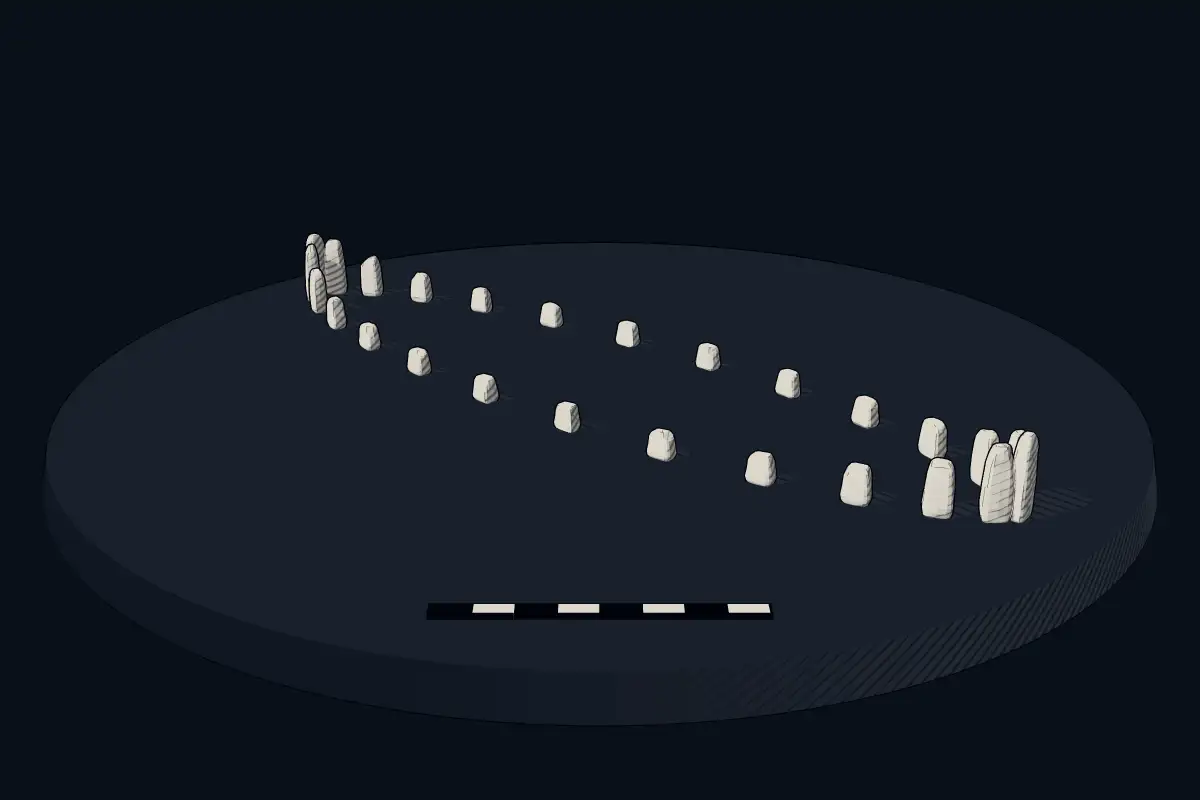
The reconstruction is ours, not a survey: it shows what a monument of this type looks like, at the size the record gives for this one.
Photographs
8 photographs, each with its author and licence
More photographs


Lore
Evidence & Lore
What the sources actually support — and, kept apart, what has been claimed.
What the evidence supports
Dates
How this date was established: Radiocarbon datingThe suggested creation date follows the radiocarbon results and the board's interpretation.Source for this date
Measured facts
- Form
- Oval stone shipSource: Form
- Length
- 67 m (220 ft)Source: Length
- Boulders
- 59 large boulders weighing up to 5 tonnes eachSource: Boulders
- Location
- Scania, southern SwedenSource: Location
- Excavation
- First scientific archaeological excavations in 1989Source: Excavation
- Burial evidence
- A decorated clay pot containing burned human bonesSource: Burial evidence
- Culture
- SwedesSource: Culture
- Material
- stoneSource: Material
- Heritage designation
- monument in FornminnesregistretSource: Heritage designation
Where it stands
Sweden
The pin marks the monument itself — its exact point.
- Coordinates
- 55°22′58″ N, 14°03′16″ EFor a GPS or map app: 55.38270, 14.05440
Access is as our sources describe it; we have not visited the site to check.
Nearby
The closest sites in the Atlas, by straight line.
- Megalithic mound (tumulus with integral stones)Valleberga 149:12000 BCE–1050 CE
- Megalithic mound (tumulus with integral stones)Valleberga 16:12000 BCE–1050 CE
 Valleberga 17:12000 BCE–1050 CE
 Valleberga 18:12000 BCE–1050 CE
- Megalithic mound (tumulus with integral stones)Valleberga 14:12000 BCE–1050 CE
 Snaftahög2000 BCE–1050 CE
- Megalithic mound (tumulus with integral stones)Valleberga 13:12000 BCE–1050 CE
- Megalithic mound (tumulus with integral stones)Valleberga 99:12000 BCE–1050 CE


Sources
Every record behind this page, with the link it came from.
3 sources behind this page
- 01Wikidata Q686510wikidata.org
- 02Wikipedia (en)en.wikipedia.org
- 03Wikipedia: Ale's Stonesen.wikipedia.org
Image files
- Ale stenar Skåne Sweden.jpgSven RosbornCC BY-SA 3.0
- Ale Stenar (4864907129).jpgHåkan Dahlström from Malmö, SwedenCC BY 2.0
- Ale stenar 29 maj 2021.jpgCC0
- Ale Stenar Skåne 4.jpgDanilovitch2CC BY-SA 4.0
- Ale Stenar Skåne 4 (cropped).jpgDanilovitch2CC BY-SA 4.0
- Ale stenar 2025-04-29 01.jpgJohan Jönsson ( Julle )CC BY-SA 4.0
- Ale stenar 2025-04-29 02.jpgJohan Jönsson ( Julle )CC BY-SA 4.0
- Ale Stenar 01.jpgNiklasmagnussonstockholmCC BY-SA 4.0
Report a correctionWrong date, name, photograph or source? Tell us and it will be put right.
Around this place
The ten nearest sites, by compass
Credit
Text, licence and sources
Adapted from the Wikipedia article "Ale's Stones" (English), licensed CC BY-SA 4.0; authors are listed in the page history. Reused under CC BY-SA 4.0. Read on Wikipedia · Edit history and authors
- Wikipedia (English): Ale's StonesCC BY-SA 4.0
- Wikidata Q686510CC0