.jpg/1920px-Dolmen_da_Herdade_do_Barrocal_-_Portugal_(9029207738).jpg 1920w)
Antas do Barrocal
Also known asBarrocal Antas · Barrocal Dolmens
Datedc. 3000 BCE
Photo Vitor Oliveira from Torres Vedras, PORTUGAL · CC BY-SA 2.0Source file on Wikimedia Commons

Overview
About this site
Overview
The Antas do Barrocal, also known as the Antas Herdade do Barrocal, are a set of Neolithic dolmens, or megalithic funeral chambers, at Monte do Barrocal, in the parish of Nossa Senhora da Tourega, Évora District, in the Alentejo region of Portugal. They lie in an area with a high concentration of megalithic sites and have been classified as a National Monument since 1910.
Nine dolmens have been identified, but only two (Numbers 1 and 2) are more than remnants, and only Number 1 can be visited.
Read on Wikipedia2 min readCC BY-SA 4.0
Where it sits in time
The site's dated range, placed against world reference points.
The scale is logarithmic: each step to the left is about ten times older than the last.
Article
Antas do Barrocal
Anta do Barrocal 1 was constructed between the beginning of the fourth and the middle of the third millennium BC.
DescriptionSources for this section
- Wikipedia (English): Antas do BarrocalCC BY-SA 4.0
Sources for this section
- Wikipedia (English): Antas do BarrocalCC BY-SA 4.0
Anta do Barrocal 1 was constructed between the beginning of the fourth and the middle of the third millennium BC. It is a dolmen built with seven coarse-grained granite pillars, of which five are in their original position, each just over 2 metres high. They create a polygonal burial chamber with a diameter of about three metres, covered by an almost intact capstone. There is an access chamber, although it has been destroyed and only two broken stones remain. No remains survive of the tumulus that is likely to have covered the chamber. The dolmen is oriented east-west.
Anta do Barrocal 2 lies one hundred metres west of Anta 1, on private land with no access. It was originally essentially identical to Anta 1. Its capstone is no longer in place, having fallen off quite recently.
ConservationSources for this section
- Wikipedia (English): Antas do BarrocalCC BY-SA 4.0
Sources for this section
- Wikipedia (English): Antas do BarrocalCC BY-SA 4.0
The two dolmens were restored in the 1970s.
ContextSources for this section
- Wikipedia (English): Antas do BarrocalCC BY-SA 4.0
Sources for this section
- Wikipedia (English): Antas do BarrocalCC BY-SA 4.0
Around Évora, in the Alentejo, megalithic tombs are called antas, and some of the largest in Iberia stand here.
Tradition and region
About this kind of monument
Portuguese antas of the Alentejo
Around Évora, in the Alentejo, megalithic tombs are called antas, and some of the largest in Iberia stand here. The Great Dolmen of Zambujeiro, near Valverde in the municipality of Évora, is considered one of the biggest such structures in Iberia. Research has dated it to between 4000 and 3000 BCE, concurrent with the megalithic building of the Évora region, and it is linked to the Great Dolmen of Comenda da Igreja at Montemor-o-Novo. Henrique Leonor Pina excavated it in 1965, and although his methods caused some controversy, the work recovered slate tablets, necklaces, crosiers, copper objects, ceramics and carinated bowls. The Portuguese government declared it a national monument in 1971.
The finds show that the tombs were used for generations: slate tablets, personal ornaments and copper objects in the chambers reach into the Chalcolithic, so one anta can carry evidence for several centuries of burial custom. Excavated anta chambers are the main source for dating, since the stones themselves cannot be dated.
Nearby, the Almendres Cromlech is a large group of standing stones, a reminder that the Alentejo's megalithic landscape also includes open-air stone enclosures and single menhirs, not only tombs.
The Atlas's records here include small antas, some reduced to a few standing slabs, and many lack a secure excavation date. They are labelled with a typological range.
When visiting, look for the chamber and the passage that leads to it, and for the way the monument sits in its field. Check access in advance.
Paraphrased from Wikipedia: Great Dolmen of Zambujeiro, Wikipedia: Great Dolmen of Comenda da Igreja, Wikipedia: Almendres Cromlech, Wikipedia: Dolmen · CC BY-SA 4.0
From the article
Dated moments in the story
- 1910
This has been classified as a National Monument since 1910. Anta do Barrocal 1 was constructed between the beginning of the fourth and the middle of the third millennium BC.
Source
See it in 3D
An interpretive reconstruction of the monument, standing on the real ground at its exact point, under the sun for that place and season. Drag to look around it.
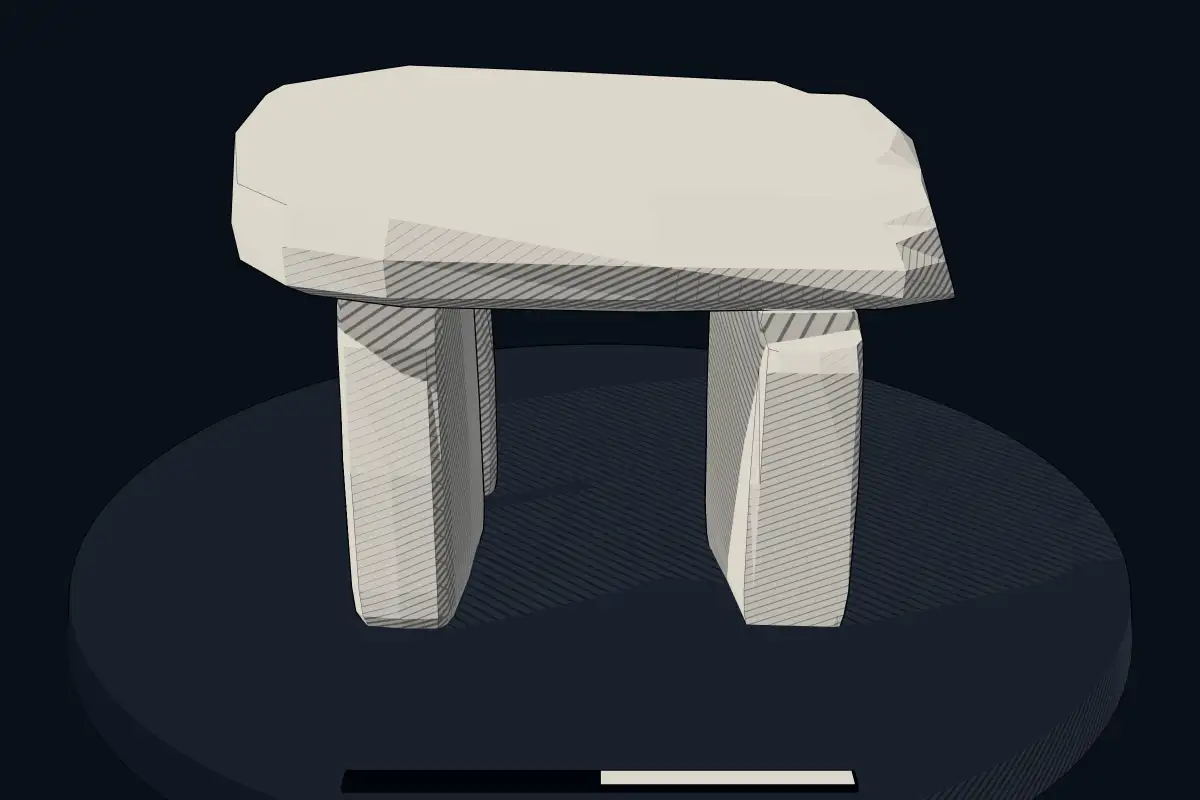
The reconstruction is ours, not a survey: it shows what a monument of this type looks like, at the size the record gives for this one.
Photographs
6 photographs, each with its author and licence
More photographs


Lore
Evidence & Lore
What the sources actually support — and, kept apart, what has been claimed.
What the evidence supports
Dates
Est. 4000–3000 BCEHow this date was established: Type comparisonTypical range for dolmens in Portugal; this site has not been dated itself. Most dolmens date from the Late Neolithic period (4000-3000 BCE); megalithic tombs at Algarve in Portugal date to c. 2500 BC.Source for this date
Where it stands
Portugal
The pin marks the monument itself — its exact point.
- Coordinates
- 38°30′33″ N, 8°00′24″ WFor a GPS or map app: 38.50910, -8.00670
Access is as our sources describe it; we have not visited the site to check.
Nearby
The closest sites in the Atlas, by straight line.
 Great Dolmen of Zambujeiro4000–3000 BCE
 Menir dos Almendres2800–1800 BCE
- Stone circleAlmendres Cromlech6000–4000 BCE
 Dolmen-Chapel of São Brissos4000–3000 BCE
- Dolmenantas do Pinheiro do Campo4000–3000 BCE
- DolmenAnta da Moita do Gato4000–3000 BCE
- DolmenPatalim dolmen4000–3000 BCE
 Menires da Herdade da Casbarra2800–1800 BCE


Sources
Every record behind this page, with the link it came from.
3 sources behind this page
- 01Wikidata Q9616954wikidata.org
- 02Source for this dateen.wikipedia.org
- 03Wikipedia: Antas do Barrocalen.wikipedia.org
Image files
- Dolmen da Herdade do Barrocal - Portugal (9029207738).jpgVitor Oliveira from Torres Vedras, PORTUGALCC BY-SA 2.0
- Dolmen da Herdade do Barrocal - Portugal (9506762604).jpgVitor Oliveira from Torres Vedras, PORTUGALCC BY-SA 2.0
- AntadoBarrocal 1.jpgRoundtheworldCC BY-SA 4.0
- Anta2-barrocal-tourega-evora.1.pngGarsdCC BY-SA 3.0
- Anta2-barrocal-tourega-evora.2.pngGarsdCC BY-SA 3.0
- AntadoBarrocal 2.jpgRoundtheworldCC BY-SA 4.0
Report a correctionWrong date, name, photograph or source? Tell us and it will be put right.
Around this place
The ten nearest sites, by compass
- Great Dolmen of Zambujeiro3.4 km N
- Menir dos Almendres7.1 km NW
- Almendres Cromlech7.2 km NW
- Dolmen-Chapel of São Brissos11 km W
- antas do Pinheiro do Campo12 km NW
- Anta da Moita do Gato12 km N
- Patalim dolmen12 km N
- Menires da Herdade da Casbarra12 km N
- Cromeleque de Vale de Maria do Meio13 km N
- Cromeleque da Portela de Modos13 km N
Credit
Text, licence and sources
Adapted from the Wikipedia article "Antas do Barrocal" (English), licensed CC BY-SA 4.0; authors are listed in the page history. Reused under CC BY-SA 4.0. Read on Wikipedia · Edit history and authors
- Wikipedia (English): Antas do BarrocalCC BY-SA 4.0
- Wikidata Q9616954CC0