
Megalithic mound (tumulus with integral stones)
Wanda Mound
DatedEst. 4300–3500 BCE
Photo Mach240390 · CC BY-SA 3.0Source file on Wikimedia Commons
Overview
About this site
What the sources say
Wanda's Mound (Polish: kopiec Wandy) is a tumulus located in Mogiła (since 1949, a neighbourhood of the Nowa Huta district of Kraków, Poland). The mound is the presumptive resting place of Princess Wanda, daughter of the mythical Krakus, or Krak, the founder of Kraków.
According to one version of her story, Wanda committed suicide by drowning in the Vistula River to avoid unwanted marriage to a German.
The mound is located close to the spot on the riverbank where legend says her body was found. Archaeological studies, conducted in 1913 and mid-1960, provided no conclusive evidence of the mound's age or purpose.
The mound base, some 50 metres (164 ft) in diameter, is at 238 metres (781 ft) AMSL, and its height is 14 metres (46 ft). Unlike the other three mounds in Kraków, this one is not located on a natural hill.
The first written record of the mound comes from the 13th century. In 1225, within two kilometres (one mile) of the mound's site, Kraków's Bishop Iwo Odrowąż built a monastery called the Mogiła Abbey, which remains active. In 1860 it became part of Austro-Hungarian fortifications that were pulled down only in 1968-70.
In 1890 a monument designed by Jan Matejko was erected atop the mound: an eagle on a plinth decorated with a relief of a sword and distaff, and below that, the inscription "Wanda".
Read on Wikipedia3 min readCC BY-SA 4.0
Where it sits in time
The site's dated range, placed against world reference points.
The scale is logarithmic: each step to the left is about ten times older than the last.
The full article
Wanda Mound: the whole story
In briefSources for this section
- Wikipedia (English): Wanda's MoundCC BY-SA 4.0
Sources for this section
- Wikipedia (English): Wanda's MoundCC BY-SA 4.0
Wanda's Mound (Polish: kopiec Wandy) is a tumulus in Mogila, which since 1949 has been a neighbourhood of the Nowa Huta district of Krakow, Poland. It is the presumptive resting place of Princess Wanda, daughter of the mythical Krakus, or Krak, the founder of Krakow.
The mound has a base some 50 metres (164 ft) in diameter, lies at 238 metres (781 ft) AMSL, and is 14 metres (46 ft) high. Unlike the other three mounds in Krakow, it is not located on a natural hill. A monument designed by Jan Matejko was erected on top in 1890: an eagle on a plinth decorated with a relief of a sword and distaff, and below that, the inscription Wanda.
According to one version of her story, Wanda committed suicide by drowning in the Vistula River to avoid an unwanted marriage to a German. The mound is close to the spot on the riverbank where legend says her body was found. Archaeological studies, conducted in 1913 and in the mid-1960s, provided no conclusive evidence of the mound's age or purpose, so its connection with Wanda rests on tradition rather than proof.
The first written record of the mound comes from the 13th century. In 1225, within two kilometres (one mile) of the site, Krakow's Bishop Iwo Odrowaz built a monastery called the Mogila Abbey, which remains active. In 1860 the mound became part of Austro-Hungarian fortifications that were pulled down only in 1968-70.
Burial mounds of this kind mark territories along the southern and eastern shores of the Baltic. The Atlas notes that many records in the region are barrow cemeteries rather than megaliths, rooted in a West Baltic barrow culture of the early Iron Age.
How this page was madeSources for this section
- Wikipedia (English): Wanda's MoundCC BY-SA 4.0
Sources for this section
- Wikipedia (English): Wanda's MoundCC BY-SA 4.0
The summary at the top of this page was written by Claude Sonnet 5.5 (2026-11-06) from the cited Wikipedia article “Wanda's Mound”. The numbers in it were checked automatically against the source text. The rest of the page is the article itself, the structured records and computed distances.
Tradition and region
About this kind of monument
Baltic barrow cemeteries
Along the southern and eastern shores of the Baltic, burial mounds mark the territories of the Baltic peoples. In Lithuanian they are called pilkapiai, and the Atlas's Lithuanian and Belarusian records are mostly cemeteries of small mounds recorded in national registers. They are barrow cemeteries and not megaliths.
The deepest root of the tradition is the West Baltic barrow culture of the early Iron Age, from which most of the Western Baltic culture arose. That culture, of the Bronze Age and Iron Age along the southern coast of the Baltic, was ethnically Baltic and shared similar monuments and funeral rites; its tribes included the Old Prussians, Galindians, Yotvingians and Skalvians. Further north, the Curonians, a medieval Baltic tribe of the fifth to sixteenth centuries CE, lived on the coast of what are now western Latvia and Lithuania, and their neighbours the Samogitians lived inland to the east. Mounds of the broader barrow tradition, the kurgans, had spread into eastern and northern Europe as early as the third millennium BCE.
Because a cemetery is made up of many small mounds, it records an ordinary community and not a single ruler. Many of these mounds have not been excavated, so the Atlas gives them a broad range and does not claim a date.
When visiting, look for a group of small round mounds under trees or on a river terrace, and note how the mounds are laid out along the terrace or ridge.
Paraphrased from Wikipedia: Western Baltic culture, Wikipedia: Curonians, Wikipedia: Samogitians, Wikipedia: Kurgan, Wikipedia: Tumulus · CC BY-SA 4.0
From the article
Dated moments in the story
- 1225
In 1225, within two kilometres (one mile) of the mound's site, Kraków's Bishop Iwo Odrowąż built a monastery called the Mogiła Abbey, which remains active.
Source - 1860
In 1860 it became part of Austro-Hungarian fortifications that were pulled down only in 1968-70. In 1890 a monument designed by Jan Matejko was erected atop the mound: an eagle on a plinth decorated with a relief of a sword and distaff, and below that, the inscription "Wanda".
Source - 1913
Archaeological studies, conducted in 1913 and mid-1960, provided no conclusive evidence of the mound's age or purpose.
Source - 1949
Wanda's Mound (Polish: kopiec Wandy) is a tumulus located in Mogiła (since 1949, a neighbourhood of the Nowa Huta district of Kraków, Poland).
Source
See it in 3D
An interpretive reconstruction of the monument, standing on the real ground at its exact point, under the sun for that place and season. Drag to look around it.
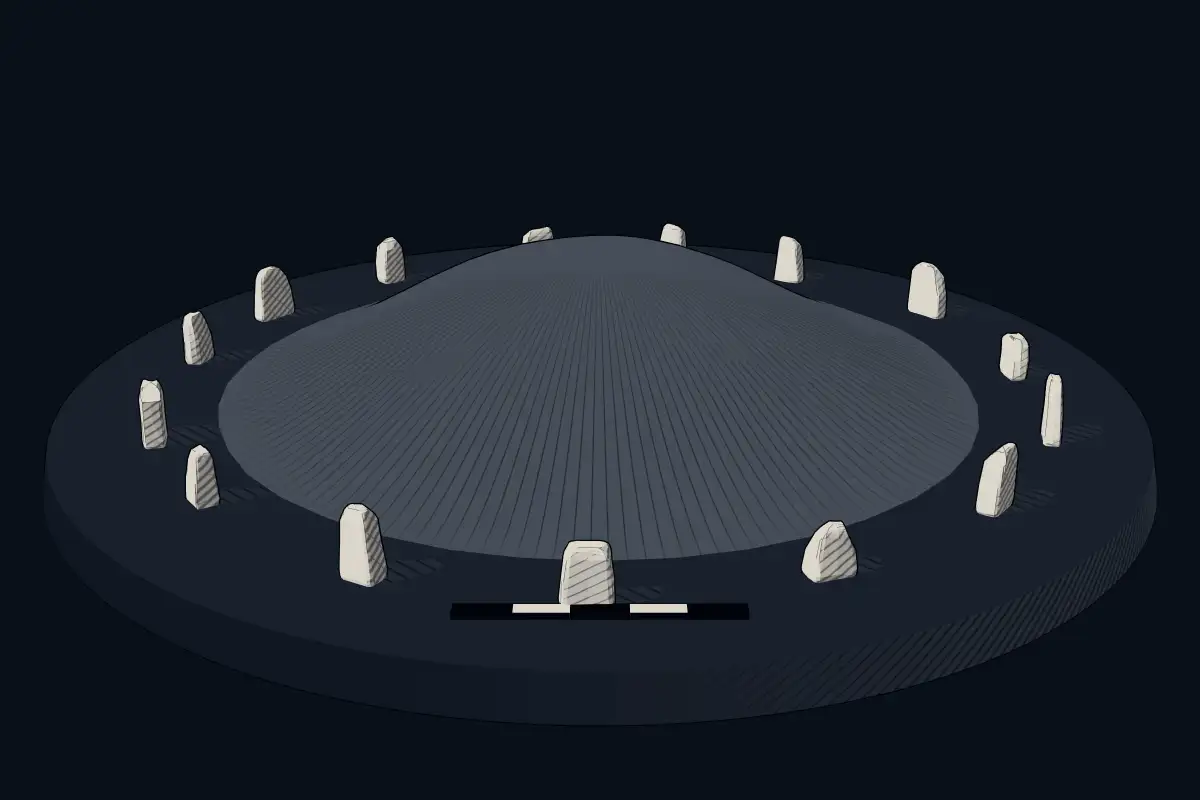
The reconstruction is ours, not a survey: it shows what a monument of this type looks like, at the size the record gives for this one.
Photographs
8 photographs, each with its author and licence
More photographs
Lore
Evidence & Lore
What the sources actually support — and, kept apart, what has been claimed.
What the evidence supports
Dates
Est. 4300–3500 BCEHow this date was established: Type comparisonTypical range for megalithic mounds in Poland; this site has not been dated itself. The Kuyavian pyramids of Poland are megalithic structures dated to c. 4300 BC.Source for this date
Where it stands
Poland
The pin marks the monument itself — its exact point.
- Coordinates
- 50°04′13″ N, 20°04′05″ EFor a GPS or map app: 50.07028, 20.06806
Access is as our sources describe it; we have not visited the site to check.
Nearby
The closest sites in the Atlas, by straight line.


Sources
Every record behind this page, with the link it came from.
3 sources behind this page
- 01Wikidata Q421819wikidata.org
- 02Source for this dateen.wikipedia.org
- 03Wikipedia: Wanda Mounden.wikipedia.org
Image files
- KopiecWandy-Mogiła-POL, Kraków.jpgMach240390CC BY-SA 3.0
- Former village Mogila (view from W), Nowa Huta, Krakow, Poland.jpgZygmunt PutCC BY-SA 4.0
- Wanda Mound, view to E, Nowa Huta, Kraków, Poland.jpgIgor123121CC BY 4.0
- View from Wanda Mound 2020.jpgMateusz GiełczyńskiCC BY-SA 4.0
- KopiecWandy-WidokZPółnocy-POL, Kraków.jpgMach240390CC BY-SA 3.0
- Kopiec Wandy w Krakowie 20140504 2763.jpgJakub HałunCC BY-SA 3.0
- KopiecWandy-WidokZKopcaKraka-POL, Kraków.jpgMach240390CC BY 3.0
- View from Wanda Mound in winter, 2016 I.JPGMateusz GiełczyńskiCC BY-SA 4.0
Report a correctionWrong date, name, photograph or source? Tell us and it will be put right.
Lore, kept apart
Legends and claims
These are stories and claims reported by the sources. They are not evidence, and they never stand in for the dating above.
- Tradition
According to one version of her story, Wanda committed suicide by drowning in the Vistula River to avoid an unwanted marriage to a German.
According to one version of her story, Wanda committed suicide by drowning in the Vistula River to avoid an unwanted marriage to a German. The mound is close to the spot on the riverbank where legend says her body was found. Archaeological studies, conducted in 1913 and in the mid-1960s, provided no conclusive evidence of the mound's age or purpose, so its connection with Wanda rests on tradition rather than proof.
Source - Tradition
Wanda's Mound (Polish: kopiec Wandy) is a tumulus located in Mogiła (since 1949, a neighbourhood of the Nowa Huta district of Kraków, Poland).
Wanda's Mound (Polish: kopiec Wandy) is a tumulus located in Mogiła (since 1949, a neighbourhood of the Nowa Huta district of Kraków, Poland). The mound is the presumptive resting place of Princess Wanda, daughter of the mythical Krakus, or Krak, the founder of Kraków. According to one version of her story, Wanda committed suicide by drowning in the Vistula River to avoid unwanted marriage to a German. The mound is located close to the spot on the riverbank where legend says her body was found. Archaeological studies, conducted in 1913 and mid-1960, provided no conclusive evidence of the mound's age or purpose. The mound base, some 50 metres (164 ft) in diameter, is at 238 metres (781 ft) AMSL, and its height is 14 metres (46 ft). Unlike the other three mounds in Kraków, this one is not located on a natural hill. The first written record of the mound comes from the 13th century. In 1225, within two kilometres (one mile) of the mound's site, Kraków's Bishop Iwo Odrowąż built a monastery called the Mogiła Abbey, which remains active. In 1860 it became part of Austro-Hungarian fortifications that were pulled down only in 1968-70. In 1890 a monument designed by Jan Matejko was erected atop the mound: an eagle on a plinth decorated with a relief of a sword and distaff, and below that, the inscription "Wanda".
Source
Around this place
The ten nearest sites, by compass
Credit
Text, licence and sources
Text from the Wikipedia article "Wanda's Mound" (English), licensed CC BY-SA 4.0; authors are listed in the page history. Reused under CC BY-SA 4.0. Read on Wikipedia · Edit history and authors
- Wikipedia (English): Wanda's MoundCC BY-SA 4.0
- Wikidata Q421819CC0