
Megalithic mound (tumulus with integral stones)
Tallberget
Photo Kjetil Ree · CC BY-SA 3.0Source file on Wikimedia Commons
Overview
About this site
What the sources say
Tallberget er en ås i bydel Østensjø i Oslo. Den ligger vest for Østensjøvannet, ikke langt unna Abildsø og Manglerud. Navnet kommer fra norrønt tall, «furu».
På toppen av åsen, rett syd for Manglerud videregående skole, ligger et gravfelt fra jernalderen. Her finnes fem graver, som bærer tydelig preg av å ha blitt plyndret. Gjennom gravfeltet går en oldtidsvei. Gravfeltet er fredet i henhold til lov om kulturminner.
På østsiden av turveien igjennom åsen sees store flyttblokker.
Article in NorwegianRead on Wikipedia2 min readCC BY-SA 4.0
The full article
Tallberget: the whole story
In briefSources for this section
- Wikipedia (Norwegian): TallbergetCC BY-SA 4.0
Sources for this section
- Wikipedia (Norwegian): TallbergetCC BY-SA 4.0
Tallberget is a ridge in the Østensjø district of Oslo, lying west of Østensjøvannet and not far from Abildsø and Manglerud. It is listed as a megalithic mound, or tumulus with integral stones. Its name comes from Old Norse tall, meaning “pine.”
On the top of the ridge, just south of Manglerud videregående skole, is an Iron Age burial ground. Five graves remain, and they show clear signs of having been plundered. An ancient road passes through the burial ground, which is protected under the law on cultural monuments.
Large moved stones can be seen on the eastern side of the path through the ridge. The available information does not give their dimensions or describe their relationship to the graves in detail.
Monuments of this kind in Norway often belong to the Iron Age and Viking Age, when the dead of the powerful were laid beneath mounds. The Old Norse word for a burial mound is haugr. Much of the wider Norwegian tradition concerns larger named mounds such as Borre, Gokstad and Oseberg, including burials of ships, but no such ship burial or specific legendary association is stated for Tallberget.
No English Wikipedia article exists for it; the full text below is the Norwegian article "Tallberget", shown in the original language.
Summary in EnglishSources for this section
- Wikipedia (Norwegian): TallbergetCC BY-SA 4.0
Sources for this section
- Wikipedia (Norwegian): TallbergetCC BY-SA 4.0
Tallberget is a megalithic mound (tumulus with integral stones) in Oslo Municipality, Norway. Wikidata describes it as: hill in Oslo, Norway. No English Wikipedia article exists for it; the full text below is the Norwegian article "Tallberget", shown in the original language.
Eksterne lenkerSources for this section
- Wikipedia (Norwegian): TallbergetCC BY-SA 4.0
Sources for this section
- Wikipedia (Norwegian): TallbergetCC BY-SA 4.0
(en) Tallberget – kategori av bilder, video eller lyd på Commons
(no) «Tallberget». Kulturminnesøk. Riksantikvaren – Direktoratet for kulturminneforvaltning.
Omtale Arkivert 25. mai 2011 hos Wayback Machine. hos Østensjøvannets venner
How this page was madeSources for this section
- Wikipedia (Norwegian): TallbergetCC BY-SA 4.0
Sources for this section
- Wikipedia (Norwegian): TallbergetCC BY-SA 4.0
The summary at the top of this page was written by MiniMax-M3 (2026-11-08) from the cited Wikipedia article “Tallberget”, translated from Norwegian. The numbers in it were checked automatically against the source text. The rest of the page is the article itself, the structured records and computed distances.
Tradition and region
About this kind of monument
Norwegian burial mounds of the Iron and Viking Ages
Many of Norway's mounds belong to the Iron Age and the Viking Age, when the dead of the powerful were laid beneath mounds. In Old Norse a burial mound is haugr, and many farm names come from it. The large mounds of Vestfold, on the western shore of the Oslo Fjord, include Borre, Gokstad and Oseberg. The Borre mound cemetery, in Borre National Park, has seven large mounds and 21 smaller ones, some more than 45 metres across and up to 6 metres high. Excavations in the 1980s showed that the oldest date from about 600 CE, before the Viking Age, and the site is evidence of a local centre of power from the Merovingian period to the Viking Age.
Ships were buried in several of these mounds. The Gokstad mound in Sandefjord, whose name Kongshaugen means "the king's mound", was opened in 1880 and held a ninth-century longship, the largest preserved Viking ship in Norway. The name had long been dismissed as folklore, but the legends led the owner's sons to dig. The mound had been reduced by ploughing to 5 metres in height, and its measured size was 50 by 43 metres. The Oseberg mound near Tønsberg, also in Vestfold, held another well-preserved ship. At Gokstad the other grave goods were probably plundered in ancient times, and no gold or silver was found.
Not all Norwegian mounds are Viking; many are older. Dating combines typology and radiocarbon dating, and for ship burials the tree rings in the timber.
When visiting, look for a mound beside an old farm, for stone kerbs, and for a flat, ploughed-down top.
Paraphrased from Wikipedia: Borre mound cemetery, Wikipedia: Gokstad ship, Wikipedia: Oseberg ship, Wikipedia: Viking Age, Wikipedia: Burial mound · CC BY-SA 4.0
From the article
Dated moments in the story
- 2011
Omtale Arkivert 25. mai 2011 hos Wayback Machine. hos Østensjøvannets venner
Source
See it in 3D
An interpretive reconstruction of the monument, standing on the real ground at its exact point, under the sun for that place and season. Drag to look around it.
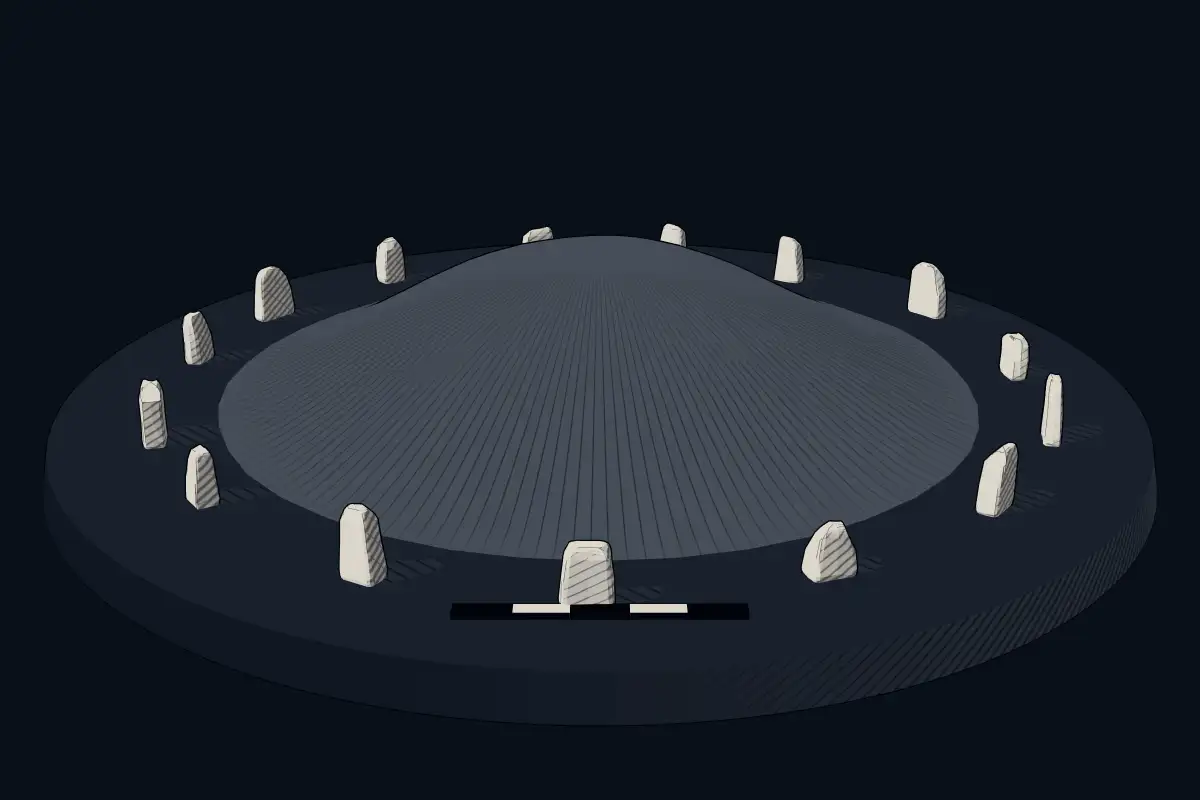
The reconstruction is ours, not a survey: it shows what a monument of this type looks like, at the size the record gives for this one.
Photographs
5 photographs, each with its author and licence
More photographs
Where it stands
Norway
The pin marks the monument itself — its exact point.
- Coordinates
- 59°53′29″ N, 10°49′28″ EFor a GPS or map app: 59.89141, 10.82458
Access is as our sources describe it; we have not visited the site to check.
Nearby
The closest sites in the Atlas, by straight line.


Sources
Every record behind this page, with the link it came from.
1 source behind this page
- 01Wikidata Q12005124wikidata.org
Image files
- Tallberget - 2012-05-19 at 11-49-23.jpgKjetil ReeCC BY-SA 3.0
- Tallberget and Østensjøvannet - Oslo, Norway 2021-05-20.jpgRyan HodnettCC BY-SA 4.0
- Tallberget - 2012-05-19 at 11-48-49.jpgKjetil ReeCC BY-SA 3.0
- Tallberget - 2012-05-19 at 11-49-03.jpgKjetil ReeCC BY-SA 3.0
- Tallberget - 2012-05-27 at 12-31-57.jpgKjetil ReeCC BY-SA 3.0
Report a correctionWrong date, name, photograph or source? Tell us and it will be put right.
Lore, kept apart
Legends and claims
These are stories and claims reported by the sources. They are not evidence, and they never stand in for the dating above.
- Tradition
Monuments of this kind in Norway often belong to the Iron Age and Viking Age, when the dead of the powerful were laid beneath mounds.
Monuments of this kind in Norway often belong to the Iron Age and Viking Age, when the dead of the powerful were laid beneath mounds. The Old Norse word for a burial mound is haugr. Much of the wider Norwegian tradition concerns larger named mounds such as Borre, Gokstad and Oseberg, including burials of ships, but no such ship burial or specific legendary association is stated for Tallberget.
Source
Around this place
The ten nearest sites, by compass
Credit
Text, licence and sources
Text from the Wikipedia article "Tallberget" (Norwegian), licensed CC BY-SA 4.0; authors are listed in the page history. Reused under CC BY-SA 4.0. Read on Wikipedia · Edit history and authors
- Wikipedia (Norwegian): TallbergetCC BY-SA 4.0
- Wikidata Q12005124CC0