Megalithic mound (tumulus with integral stones)
Röse von Børudlo
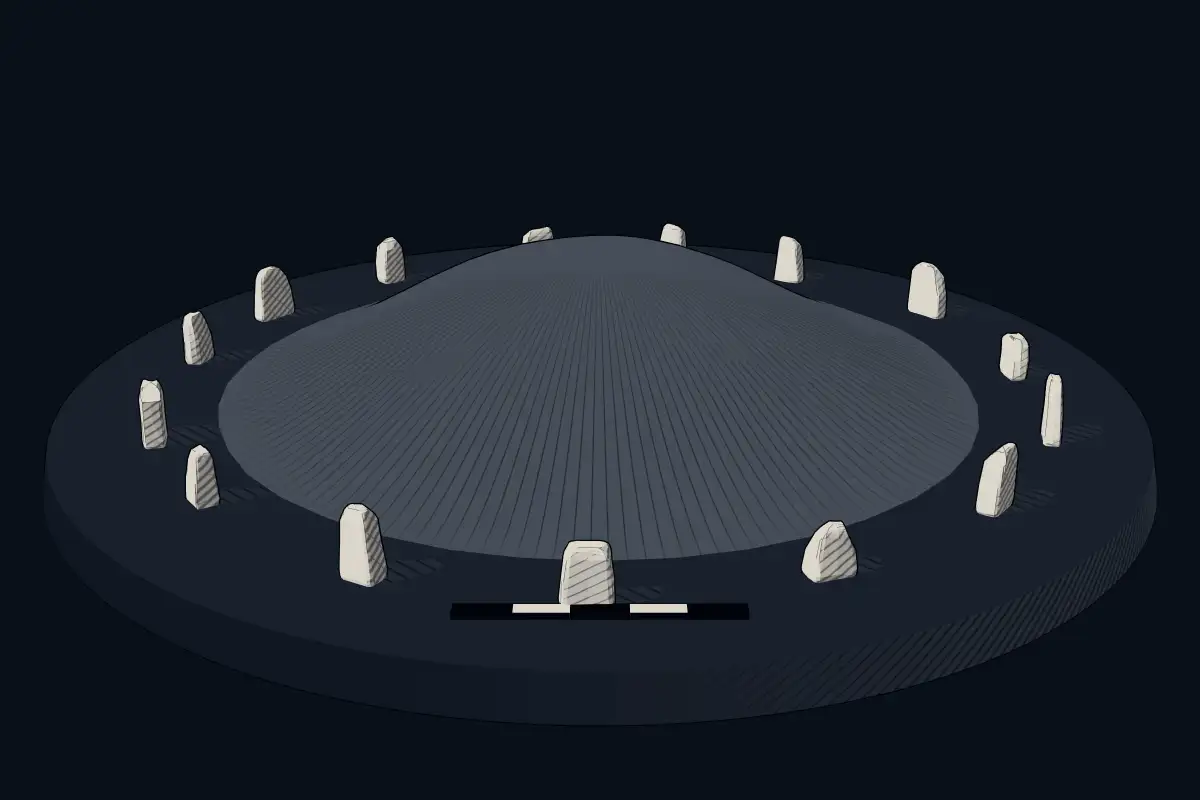
No licensed photograph yetWe have no photograph we may publish for this site, so the interpretive 3D view leads instead.
Overview
About this site
Overview
The Røse von Børudlo (Röse von Børudlo) is a stone-built burial mound on the Bøveien, west of Randaberg near Stavanger, in the county of Rogaland, Norway. It has a diameter of about 26.0 m and stands about 3.5 metres high. It was used as a burial mound from the Late Bronze Age to the Early Iron Age.
Read on Wikipedia1 min readCC BY-SA 4.0
Article
Röse von Børudlo
Its shape has been disturbed on the north side by farming, and roads to the east and west have cut away parts of it.
DescriptionSources for this section
- Wikipedia (German): Röse von BørudloCC BY-SA 4.0
Sources for this section
- Wikipedia (German): Röse von BørudloCC BY-SA 4.0
The cairn (Norwegian gravrøys) was once about 30.0 metres across. Its shape has been disturbed on the north side by farming, and roads to the east and west have cut away parts of it. A small crater can be seen in the top.
SettingSources for this section
- Wikipedia (German): Röse von BørudloCC BY-SA 4.0
Sources for this section
- Wikipedia (German): Röse von BørudloCC BY-SA 4.0
The cairns Grøderøysa and Løndshaug lie nearby.
ContextSources for this section
- Wikipedia (German): Röse von BørudloCC BY-SA 4.0
Sources for this section
- Wikipedia (German): Röse von BørudloCC BY-SA 4.0
Many of Norway's mounds belong to the Iron Age and the Viking Age, when the dead of the powerful were laid beneath mounds. In Old Norse a burial mound is haugr, and many farm names come from it.
Tradition and region
About this kind of monument
Norwegian burial mounds of the Iron and Viking Ages
Many of Norway's mounds belong to the Iron Age and the Viking Age, when the dead of the powerful were laid beneath mounds. In Old Norse a burial mound is haugr, and many farm names come from it. The large mounds of Vestfold, on the western shore of the Oslo Fjord, include Borre, Gokstad and Oseberg. The Borre mound cemetery, in Borre National Park, has seven large mounds and 21 smaller ones, some more than 45 metres across and up to 6 metres high. Excavations in the 1980s showed that the oldest date from about 600 CE, before the Viking Age, and the site is evidence of a local centre of power from the Merovingian period to the Viking Age.
Ships were buried in several of these mounds. The Gokstad mound in Sandefjord, whose name Kongshaugen means "the king's mound", was opened in 1880 and held a ninth-century longship, the largest preserved Viking ship in Norway. The name had long been dismissed as folklore, but the legends led the owner's sons to dig. The mound had been reduced by ploughing to 5 metres in height, and its measured size was 50 by 43 metres. The Oseberg mound near Tønsberg, also in Vestfold, held another well-preserved ship. At Gokstad the other grave goods were probably plundered in ancient times, and no gold or silver was found.
Not all Norwegian mounds are Viking; many are older. Dating combines typology and radiocarbon dating, and for ship burials the tree rings in the timber.
When visiting, look for a mound beside an old farm, for stone kerbs, and for a flat, ploughed-down top.
Paraphrased from Wikipedia: Borre mound cemetery, Wikipedia: Gokstad ship, Wikipedia: Oseberg ship, Wikipedia: Viking Age, Wikipedia: Burial mound · CC BY-SA 4.0
See it in 3D
An interpretive reconstruction of the monument, standing on the real ground at its exact point, under the sun for that place and season. Drag to look around it.
The reconstruction is ours, not a survey: it shows what a monument of this type looks like, at the size the record gives for this one.
Where it stands
Norway
The pin marks the monument itself — its exact point.
- Coordinates
- 59°00′24″ N, 5°34′29″ EFor a GPS or map app: 59.00664, 5.57464
Access is as our sources describe it; we have not visited the site to check.
Nearby
The closest sites in the Atlas, by straight line.


Sources
Every record behind this page, with the link it came from.
1 source behind this page
- 01Wikidata Q55185517wikidata.org
Report a correctionWrong date, name, photograph or source? Tell us and it will be put right.
Around this place
The ten nearest sites, by compass
Credit
Text, licence and sources
Adapted from the Wikipedia article "Röse von Børudlo" (German), licensed CC BY-SA 4.0; authors are listed in the page history. Reused under CC BY-SA 4.0. Read on Wikipedia · Edit history and authors
- Wikipedia (German): Röse von BørudloCC BY-SA 4.0
- Wikidata Q55185517CC0