
Baldersteinen
DatedEst. 2800–1800 BCE
Photo Bjørn Erik Pedersen · CC BY-SA 4.0Source file on Wikimedia Commons
Overview
About this site
Overview
Baldersteinen, also called Fritjofsteinen, is a standing stone of the Scandinavian bauta type at Baldershagen in Husabø, in the municipality of Leikanger, Norway. It stands just below riksvei 13, beside the new cemetery of the locality. The stone is 7,8 metres high and 1,25 metres wide and is reputed to be the tallest bautastein in Norway.
It bears no inscription. It probably dates from the Iron Age, since it stands on the remains of a burial mound from the period 500–800. A typological estimate in the catalogue gives a broader range of 2800 to 1800 BCE.
Read on Wikipedia2 min readCC BY-SA 4.0
Where it sits in time
The site's dated range, placed against world reference points.
The scale is logarithmic: each step to the left is about ten times older than the last.
Article
Baldersteinen
It rises from the remains of a burial mound, which has been partly destroyed by house building and cultivation.
DescriptionSources for this section
- Wikipedia (Norwegian): BaldersteinenCC BY-SA 4.0
Sources for this section
- Wikipedia (Norwegian): BaldersteinenCC BY-SA 4.0
The stone is 7,8 metres high and 1,25 metres wide and carries no inscription. It rises from the remains of a burial mound, which has been partly destroyed by house building and cultivation. The monument is registered with Riksantikvaren, the Norwegian directorate for cultural heritage, and is listed as a protected archaeological site.
DatingSources for this section
- Wikipedia (Norwegian): BaldersteinenCC BY-SA 4.0
Sources for this section
- Wikipedia (Norwegian): BaldersteinenCC BY-SA 4.0
The stone probably originates in the Iron Age, because it stands on the remains of a burial mound from the period 500–800. Local tradition has linked it with a chieftain who fell at the battle of Fimreite in 1184, but the stone must be considerably older than that.
NameSources for this section
- Wikipedia (Norwegian): BaldersteinenCC BY-SA 4.0
Sources for this section
- Wikipedia (Norwegian): BaldersteinenCC BY-SA 4.0
Both names of the stone have a mythological and a historical or literary connection. Baldersteinen refers to the saga of the Norse god Balder, and Fritjofsteinen to the Saga of Fridtjov the Bold, a heroic figure from Sogn. A local microbrewery, Balder Brygg in Leikanger, uses the stone as a motif on its bottle labels.
ContextSources for this section
- Wikipedia (Norwegian): BaldersteinenCC BY-SA 4.0
Sources for this section
- Wikipedia (Norwegian): BaldersteinenCC BY-SA 4.0
In Scandinavia a standing stone is a bauta or bautastein. Overall 1,176 menhirs are registered in Norway, and the stones are often included as part of a tomb. The introduction to the Heimskringla by Snorri Sturluson says that it was the custom to burn the dead and to raise monoliths for them, and that this custom was kept in Norway and Sweden for a long time. As a rule each grave was marked with a single stone.
Tradition and region
About this kind of monument
Scandinavian standing stones (bautastones)
In Scandinavia a standing stone is a bauta or bautastein, and the word Bauta is also used in Germany. Overall 1,176 menhirs are registered in Norway, and the stones are often included as part of a tomb. The introduction to the Heimskringla by Snorri Sturluson says that it was the custom to burn all the dead and raise monoliths for them, and that this custom was kept in Norway and Sweden for a long time. As a rule each grave was marked with a single stone, but sometimes several stones were used, as in the burial site known as De fem dårlige jomfruer at Karmsund.
In Sweden menhirs were erected as markers for the graves of warriors until the thirteenth century. Snorri writes that the Swedes burned the body of their king Vanlade and raised a stone over his ashes by the River Skyt, and the custom is mentioned in the Hávamál as well. Many Scandinavian standing stones are therefore not Neolithic at all but later memorials.
Anundshög near Västerås shows how the stones sit among other graves: of its 42 remains, 14 are standing stones, alongside 12 burial mounds, 10 round stone settings, 5 stone ships and one runestone.
For the Atlas, a Scandinavian stone that has not been excavated receives a broad range and is marked as of uncertain date, since a bauta cannot be dated by shape alone.
When visiting, look near burial mounds and beside old roads.
Paraphrased from Wikipedia: Bautastone, Wikipedia: Menhir, Wikipedia: List of menhirs, Wikipedia: Anundshög · CC BY-SA 4.0
From the article
Dated moments in the story
- 500 CE
Bautaen har ingen inskripsjoner, men har trolig sin opprinnelse fra jernalderen da den står på restene av en gravhaug fra perioden 500–800. Haugen er delvis ødelagt av husbygging og dyrking.
Source - 1184
Steinen har tradisjonelt blitt tilknyttet en lokal høvding som falt ved slaget ved Fimreite i 1184, men den må være atskillig eldre enn som så.
Source
See it in 3D
An interpretive reconstruction of the monument, standing on the real ground at its exact point, under the sun for that place and season. Drag to look around it.
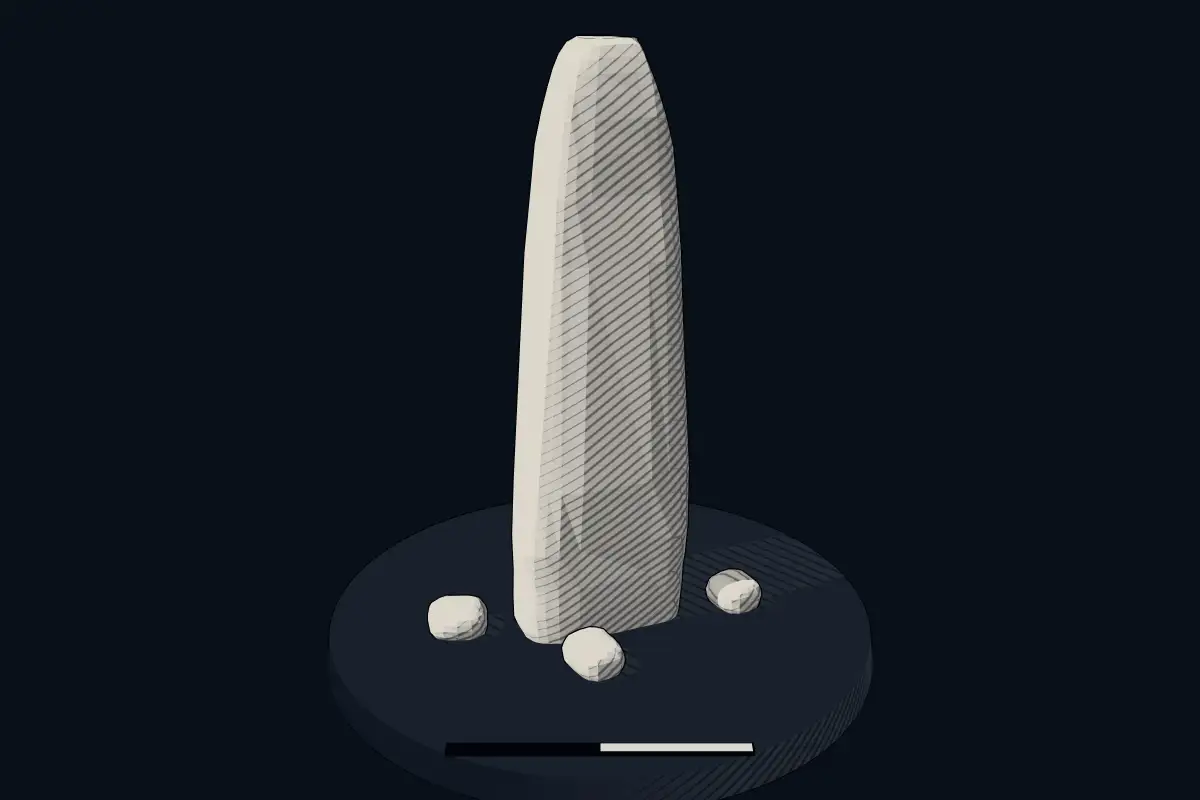
The reconstruction is ours, not a survey: it shows what a monument of this type looks like, at the size the record gives for this one.
Photographs
8 photographs, each with its author and licence
More photographs
Lore
Evidence & Lore
What the sources actually support — and, kept apart, what has been claimed.
What the evidence supports
Dates
Est. 2800–1800 BCEHow this date was established: Type comparisonTypical range for menhirs in Norway; this site has not been dated itself. Standing stones are associated with the Beaker people of the European late Neolithic and early Bronze Age c. 2800-1800 BC.Source for this date
Where it stands
Norway
The pin marks the monument itself — its exact point.
- Coordinates
- 61°11′06″ N, 6°48′18″ EFor a GPS or map app: 61.18500, 6.80510
Access is as our sources describe it; we have not visited the site to check.
Nearby
The closest sites in the Atlas, by straight line.


Sources
Every record behind this page, with the link it came from.
2 sources behind this page
- 01Wikidata Q11960074wikidata.org
- 02Source for this dateen.wikipedia.org
Image files
- Baldersteinen, 2016 - 1.jpgBjørn Erik PedersenCC BY-SA 4.0
- Baldersteinen, 2016 - 2.jpgBjørn Erik PedersenCC BY-SA 4.0
- Meyer’s Universum Bd. 9. 1842 (139851631).jpgJoseph MeyerPublic domain
- Meyers Universum Band 09 29.jpgMeyer’s Universum, oder Abbildung und Beschreibung des Sehenswerthesten und Merkwürdigsten der Natur und Kunst auf der ganzen Erde. 9. Band Bibliographisches Institut, Hildburghausen Zeichner: C. ReissPublic domain
- Baldersteinen.jpgSigrunespeCC BY-SA 3.0 no
- Gravrøys i Baldershagen, bilete 2.jpgSigrunespeCC BY-SA 3.0 no
- Gravrøys i Baldershagen.jpgSigrunespeCC BY-SA 3.0 no
- Baldersteinen, bilete teke frå Baldershagen.jpgSigrunespeCC BY-SA 3.0 no
Report a correctionWrong date, name, photograph or source? Tell us and it will be put right.
Around this place
The ten nearest sites, by compass
Credit
Text, licence and sources
Adapted from the Wikipedia article "Baldersteinen" (Norwegian), licensed CC BY-SA 4.0; authors are listed in the page history. Reused under CC BY-SA 4.0. Read on Wikipedia · Edit history and authors
- Wikipedia (Norwegian): BaldersteinenCC BY-SA 4.0
- Wikidata Q11960074CC0