Schnellert
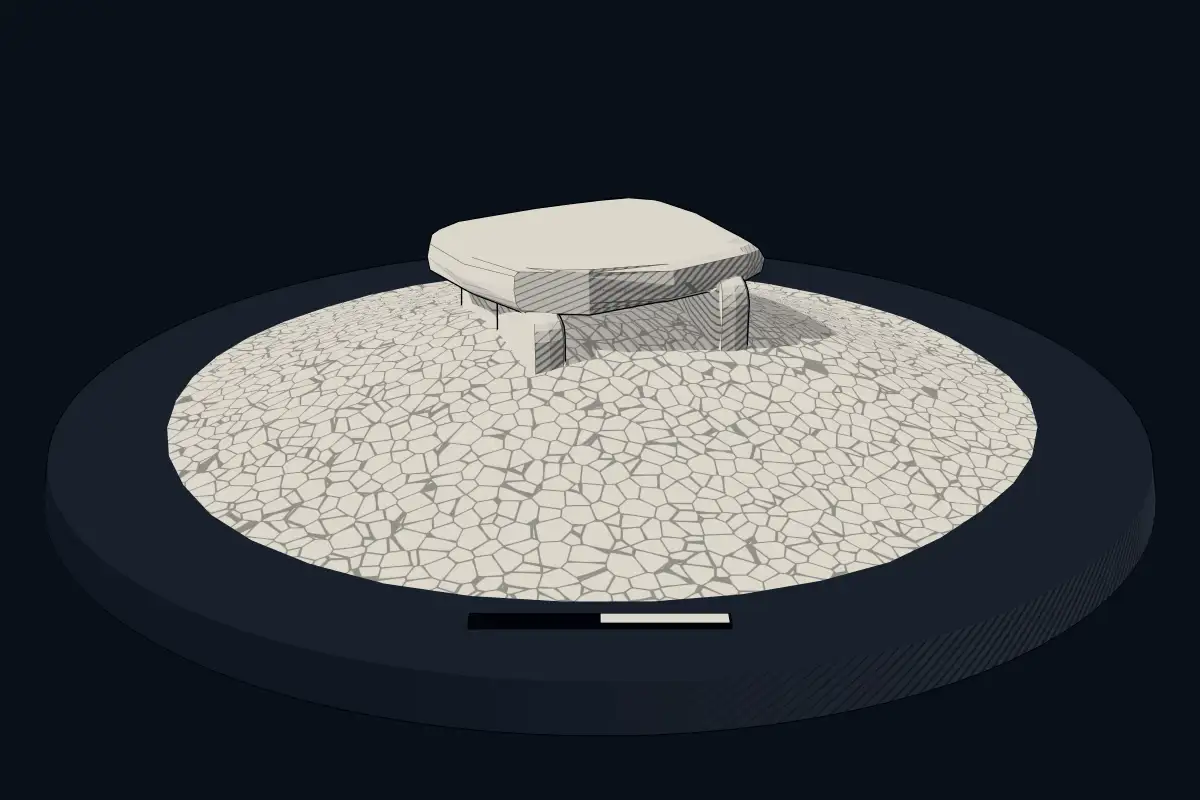
No licensed photograph yetWe have no photograph we may publish for this site, so the interpretive 3D view leads instead.
Overview
About this site
What the sources say
Der Schnellert ist ein Pseudo-Dolmen im gleichnamigen Wald zwischen Berdorf und Müllerthal bei Echternach in Luxemburg.
Bei dem Pseudo-Dolmen handelt es sich um ein natürliches, zufällig entstandenes, an einen Dolmen erinnerndes Gebilde aus Steinblöcken, wie es aus verschiedenen Regionen bekannt ist (Cova d’en Genís, Dolmen von Busnela, Dolmen von Chevresse, Dolmen von Solwaster, Pierre au Rey, La Table des Géants in Reinhardsmunster und L’autel des Druides in Pfaffenheim (beide im Département Haut-Rhin) der Dolmen di Avola auf Sizilien und von Sparossino in Ligurien).
Eine etwa 50 Zentimeter breite, zwei Meter lange und einen Meter hohe rechteckige Nische ist an drei Seiten durch Felsblöcke geschlossen. An der vierten Seite lässt sie einen schmalen Zugang offen. Die Nische wird von einem gewaltigen Stein bedeckt. Bei der ersten Ausgrabung 1908 durch Nicolas van Werveke wurde das Gebilde als Dolmen bezeichnet. Eine zweite Ausgrabung erfolgte 2000. In dem Pseudo-Dolmen wurden um 2700 v. Chr. ein erwachsener Mann und ein Kind von etwa 12 Jahren bestattet. Offenbar hat die Dolmenform die neolithischen Menschen dazu angeregt, den Ort zu nutzen.
Article in GermanRead on Wikipedia3 min readCC BY-SA 4.0
The full article
Schnellert: the whole story
In briefSources for this section
- Wikipedia (German): Schnellert (Pseudodolmen)CC BY-SA 4.0
Sources for this section
- Wikipedia (German): Schnellert (Pseudodolmen)CC BY-SA 4.0
Schnellert is an unclassified megalithic tomb in the Schnellert forest between Berdorf and Müllerthal near Echternach in Luxembourg. Despite its form, it is a pseudo-dolmen: a natural arrangement of stone blocks that came about by chance and resembles a dolmen.
The structure includes a rectangular niche about 50 Zentimeter wide, two Meter long and one Meter high. It is closed on three sides by rock blocks, while the fourth side leaves a narrow entrance. A massive stone covers the niche.
The site was first excavated in 1908 by Nicolas van Werveke, who described the formation as a dolmen. A second excavation took place in 2000. Around 2700 v. Chr., an adult man and a child of about 12 years were buried in the pseudo-dolmen, suggesting that its dolmen-like appearance led Neolithic people to use the place.
Dolmens are generally single-chamber tombs made from upright stones and a capstone, mostly dating to the Late Neolithic. The wider use of the word megalith includes many prehistoric stone structures across Europe, though tombs form the largest class and the best-known megaliths are not always tombs.
Summary in EnglishSources for this section
- Wikipedia (German): Schnellert (Pseudodolmen)CC BY-SA 4.0
Sources for this section
- Wikipedia (German): Schnellert (Pseudodolmen)CC BY-SA 4.0
Schnellert is a megalithic tomb (unclassified) in Berdorf, Luxembourg. No English Wikipedia article exists for it; the full text below is the German article "Schnellert (Pseudodolmen)", shown in the original language.
How this page was madeSources for this section
- Wikipedia (German): Schnellert (Pseudodolmen)CC BY-SA 4.0
Sources for this section
- Wikipedia (German): Schnellert (Pseudodolmen)CC BY-SA 4.0
The summary at the top of this page was written by MiniMax-M3 (2026-11-08) from the cited Wikipedia article “Schnellert (Pseudodolmen)”, translated from German. The numbers in it were checked automatically against the source text. The rest of the page is the article itself, the structured records and computed distances.
Tradition and region
About this kind of monument
Megalithic tombs
A megalith is a large stone used to build a prehistoric structure or monument, alone or with other stones. More than 35,000 megalithic structures have been identified across Europe, from Sweden in the north to the Mediterranean in the south, and the word was first used in 1849 by the British antiquarian Algernon Herbert for Stonehenge. Most were erected between the Neolithic, with some earlier Mesolithic examples, and the Bronze Age. The most widely known megaliths are not tombs, but tombs are the largest class, and they fall into a few families.
The dolmen is a single-chamber tomb of upright stones and a capstone, mostly of the Late Neolithic. The passage grave has one or more chambers covered in earth or stone, reached by a narrow passage of large stones. The gallery grave is entered directly into the gallery without an antechamber. The chambered cairn is a stone cairn over a chamber that is larger than a cist and holds many burials, whether excarnated bones, inhumations or cremations, usually near a settlement and serving as the community's graveyard.
Most of these tombs were collective: many people were buried over generations. Some are decorated with megalithic art, which is carved on the kerbstones, orthostats or capstones, mostly on Neolithic passage graves. The art is highly abstract, with spirals, zig-zags and cup and ring marks, and its meaning is debated.
The Atlas uses this article for tombs that fit none of the regional articles. Dating depends on typology; absolute dates come only from excavated tombs.
When visiting, look for the chamber and the passage, any carving on the stones, and the remains of a mound or cairn that covered the tomb.
Paraphrased from Wikipedia: Megalith, Wikipedia: Passage grave, Wikipedia: Gallery grave, Wikipedia: Dolmen, Wikipedia: Chambered cairn · CC BY-SA 4.0
From the article
Dated moments in the story
Where it stands
Luxembourg
The pin marks the monument itself — its exact point.
- Coordinates
- 49°47′50″ N, 6°19′03″ EFor a GPS or map app: 49.79733, 6.31760
Access is as our sources describe it; we have not visited the site to check.
Nearby
The closest sites in the Atlas, by straight line.


Sources
Every record behind this page, with the link it came from.
1 source behind this page
- 01Wikidata Q15846654wikidata.org
Report a correctionWrong date, name, photograph or source? Tell us and it will be put right.
Around this place
The ten nearest sites, by compass
- Monument Raymond Petit Bäerdref3.4 km NE
- Tumulus op der Schanz5.8 km S
- US-Monument Iechternach7.4 km E
- Fraubillen cross9.4 km NE
- Menhirfragmente von Nusbaum9.4 km N
- Menhir III von Nusbaum9.8 km N
- Menhir II von Nusbaum9.8 km N
- Holsthum Menhir Langenstein11 km NE
- Steinkiste von Holsthum11 km NE
- Menhir II von Holsthum11 km NE
Credit
Text, licence and sources
Text from the Wikipedia article "Schnellert (Pseudodolmen)" (German), licensed CC BY-SA 4.0; authors are listed in the page history. Reused under CC BY-SA 4.0. Read on Wikipedia · Edit history and authors