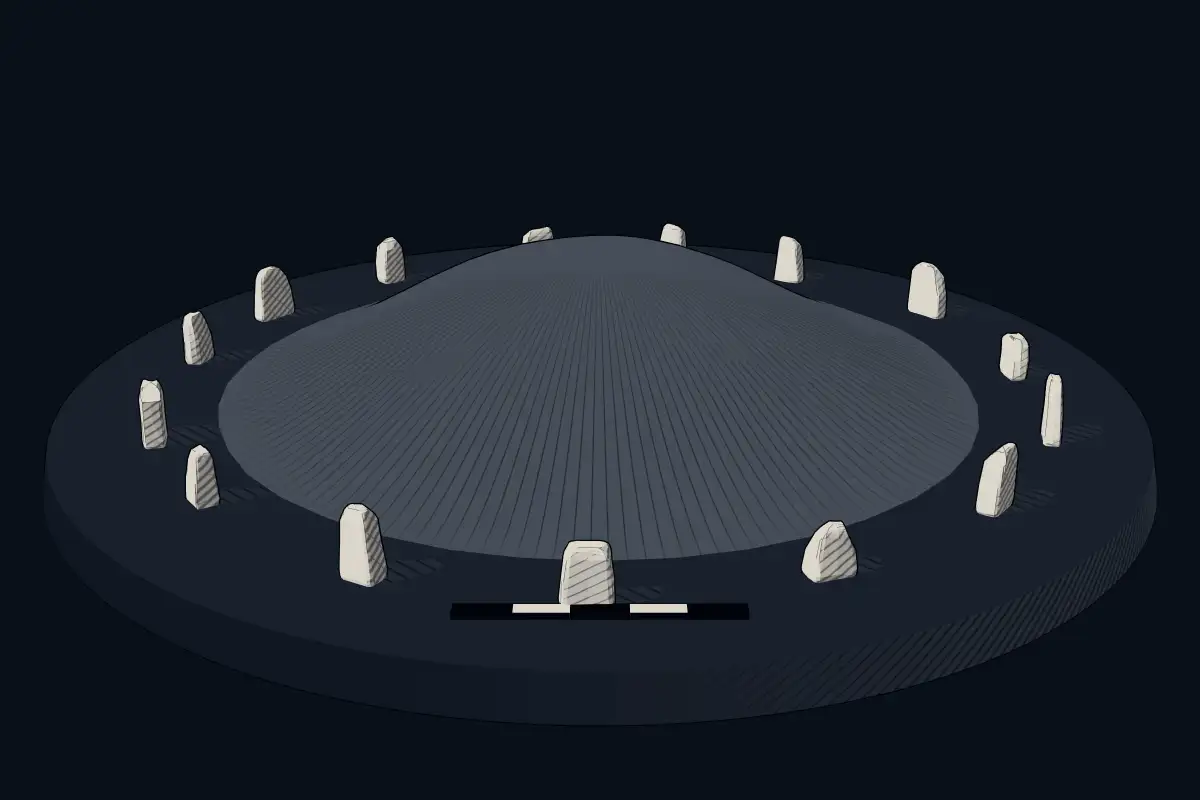
Megalithic mound (tumulus with integral stones)
Migliniškių pilkapynas
No licensed photograph yetWe have no photograph we may publish for this site, so the interpretive 3D view leads instead.
Overview
About this site
Overview
The Migliniškių pilkapynas, also called the Eitulionių pilkapynas, is a barrow cemetery in the Trakai District Municipality of Lithuania, beside the villages of Migliniškės and Eitulionys. It is catalogued as a megalithic mound with integral stones and consists of two groups of mounds with 28 mounds in all. It is thought to have belonged to Yotvingian tribes.
Read on Wikipedia2 min readCC BY-SA 4.0
Article
Migliniškių pilkapynas
The second group lies 0,9 km south-east of Lake Švenčius and 0,4 km north-west of Lake Asonas.
DescriptionSources for this section
- Wikipedia (Lithuanian): Migliniškių pilkapynasCC BY-SA 4.0
Sources for this section
- Wikipedia (Lithuanian): Migliniškių pilkapynasCC BY-SA 4.0
The first group lies 1 km south-east of Lake Švenčius and 0,35 km west of Lake Asonas (Liaukiškių), and 0,25 km south of the second group. The second group lies 0,9 km south-east of Lake Švenčius and 0,4 km north-west of Lake Asonas. The mounds are 3–12 m in diameter and 0,3–1,5 m high, heaped up from earth and covered with stones. The graves were damaged by robbers.
ExcavationsSources for this section
- Wikipedia (Lithuanian): Migliniškių pilkapynasCC BY-SA 4.0
Sources for this section
- Wikipedia (Lithuanian): Migliniškių pilkapynasCC BY-SA 4.0
The Trakai History Museum, led by Algimantas Bliujus, investigated the cemetery from 1978 to 1981. Graves of cremated dead and of unburnt dead were found. One grave was symbolic, containing only grave goods, and one was a group grave in which 3 dead were buried.
FindsSources for this section
- Wikipedia (Lithuanian): Migliniškių pilkapynasCC BY-SA 4.0
Sources for this section
- Wikipedia (Lithuanian): Migliniškių pilkapynasCC BY-SA 4.0
The goods of the unburnt dead include a warrior's equipment of iron spearheads and spurs, knives, bronze rings and buckles, and beads of white stone. A cremation grave of a noblewoman stands out, with ornaments including a bronze horseshoe brooch decorated with red enamel. Between the mounds were found remains of a settlement from the beginning of the first millennium, with hand-formed pottery, burnt remains and an iron axe. The finds are kept in the Trakai History Museum.
ContextSources for this section
- Wikipedia (Lithuanian): Migliniškių pilkapynasCC BY-SA 4.0
Sources for this section
- Wikipedia (Lithuanian): Migliniškių pilkapynasCC BY-SA 4.0
Along the southern and eastern shores of the Baltic, burial mounds mark the territories of the Baltic peoples. In Lithuanian they are called pilkapiai, and monuments of this kind are mostly cemeteries of small mounds. They are barrow cemeteries and not megaliths.
Tradition and region
About this kind of monument
Baltic barrow cemeteries
Along the southern and eastern shores of the Baltic, burial mounds mark the territories of the Baltic peoples. In Lithuanian they are called pilkapiai, and the Atlas's Lithuanian and Belarusian records are mostly cemeteries of small mounds recorded in national registers. They are barrow cemeteries and not megaliths.
The deepest root of the tradition is the West Baltic barrow culture of the early Iron Age, from which most of the Western Baltic culture arose. That culture, of the Bronze Age and Iron Age along the southern coast of the Baltic, was ethnically Baltic and shared similar monuments and funeral rites; its tribes included the Old Prussians, Galindians, Yotvingians and Skalvians. Further north, the Curonians, a medieval Baltic tribe of the fifth to sixteenth centuries CE, lived on the coast of what are now western Latvia and Lithuania, and their neighbours the Samogitians lived inland to the east. Mounds of the broader barrow tradition, the kurgans, had spread into eastern and northern Europe as early as the third millennium BCE.
Because a cemetery is made up of many small mounds, it records an ordinary community and not a single ruler. Many of these mounds have not been excavated, so the Atlas gives them a broad range and does not claim a date.
When visiting, look for a group of small round mounds under trees or on a river terrace, and note how the mounds are laid out along the terrace or ridge.
Paraphrased from Wikipedia: Western Baltic culture, Wikipedia: Curonians, Wikipedia: Samogitians, Wikipedia: Kurgan, Wikipedia: Tumulus · CC BY-SA 4.0
From the article
Dated moments in the story
- 1978
1978–1981 m. pilkapyną tyrė Trakų istorijos muziejus (vadovas Algimantas Bliujus).
Source
See it in 3D
An interpretive reconstruction of the monument, standing on the real ground at its exact point, under the sun for that place and season. Drag to look around it.
The reconstruction is ours, not a survey: it shows what a monument of this type looks like, at the size the record gives for this one.
Where it stands
Lithuania
The pin marks the monument itself — its exact point.
- Coordinates
- 54°38′35″ N, 24°28′24″ EFor a GPS or map app: 54.64305, 24.47325
Access is as our sources describe it; we have not visited the site to check.
Nearby
The closest sites in the Atlas, by straight line.
- Megalithic mound (tumulus with integral stones)Migonių pilkapynas
- Megalithic mound (tumulus with integral stones)Alinkos pilkapynas
 Maisiejūnų pilkapiai
- Megalithic mound (tumulus with integral stones)Kapitoniškių pilkapynas
 Grabijolų pilkapynas
- Megalithic mound (tumulus with integral stones)Ardiškių pilkapynas ir gyvenvietė
 Sausių pilkapynas
- Megalithic mound (tumulus with integral stones)Kernavės pilkapynas


Sources
Every record behind this page, with the link it came from.
1 source behind this page
- 01Wikidata Q12665381wikidata.org
Report a correctionWrong date, name, photograph or source? Tell us and it will be put right.
Around this place
The ten nearest sites, by compass
Credit
Text, licence and sources
Adapted from the Wikipedia article "Migliniškių pilkapynas" (Lithuanian), licensed CC BY-SA 4.0; authors are listed in the page history. Reused under CC BY-SA 4.0. Read on Wikipedia · Edit history and authors