Megalithic mound (tumulus with integral stones)
駒岡堂の前古墳
DatedEst. 250–650 CE
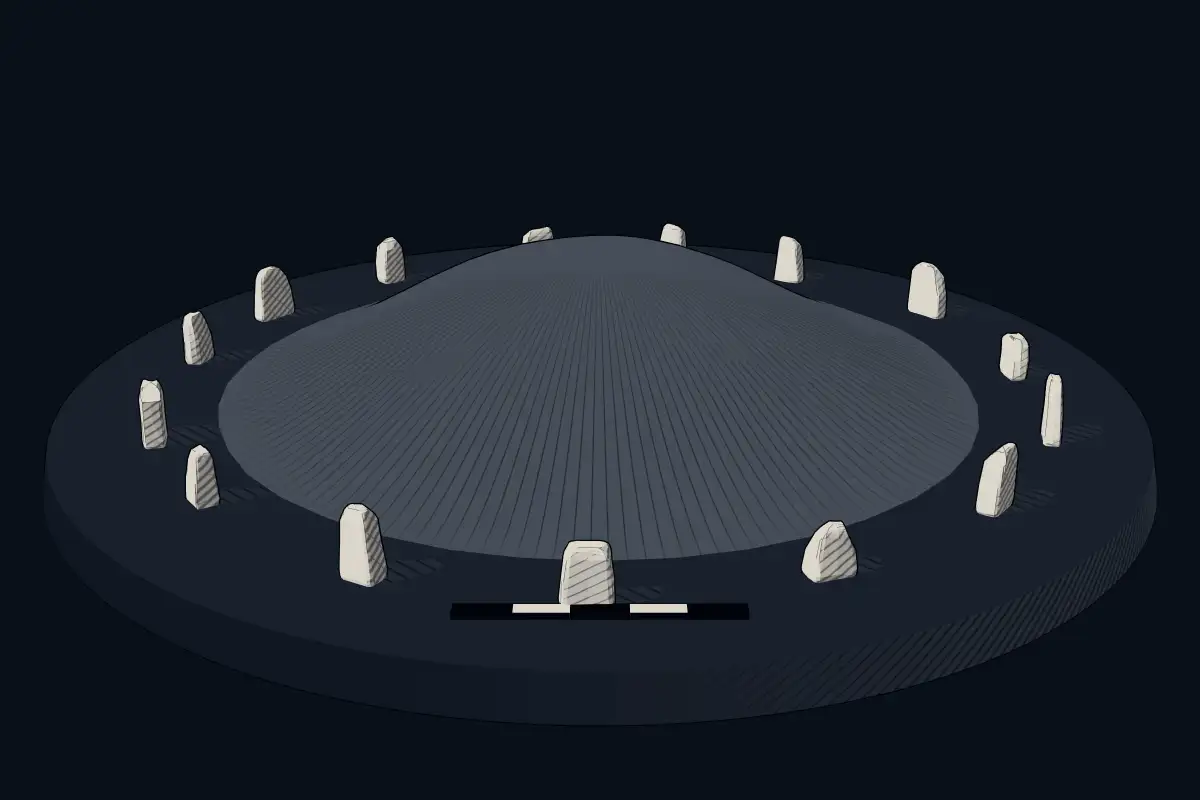
No licensed photograph yetWe have no photograph we may publish for this site, so the interpretive 3D view leads instead.
Overview
About this site
What the sources say
駒岡堂の前古墳(こまおかどうのまえこふん)、または駒岡堂ノ前古墳は、かつて神奈川県横浜市鶴見区駒岡に所在した古墳時代後期(6世紀代)の古墳。駒岡古墳群の1つ。墳形は前方後円墳であったと考えられている。
Article in JapaneseRead on Wikipedia2 min readCC BY-SA 4.0
Where it sits in time
The site's dated range, placed against world reference points.
The scale is logarithmic: each step to the left is about ten times older than the last.
The full article
駒岡堂の前古墳: the whole story
In briefSources for this section
- Wikipedia (Japanese): 駒岡堂の前古墳CC BY-SA 4.0
Sources for this section
- Wikipedia (Japanese): 駒岡堂の前古墳CC BY-SA 4.0
駒岡堂の前古墳, also called 駒岡堂ノ前古墳, was a late Kofun-period burial mound in 駒岡, 鶴見区, 横浜市, and one of the 駒岡古墳群. It stood on a ridge running southwest from the hill that contains 駒岡瓢箪山古墳, on the northern edge of the 下末吉台地 along the south bank of 鶴見川.
The mound was about 25 meters long and is thought to have been a 前方後円墳, with its square front pointing north. It was largely levelled away around 1968 (昭和43年), so its detailed form is now unknown. The hill itself remains, and one mound is said to survive just northeast of the former site, but many other mounds and 横穴墓群 were also cut away.
Earthenware 埴輪 found at 駒岡堂の前古墳 included cylindrical pieces and 器財埴輪 in the shapes of 翳, 靫, 大刀 and a house. Their dating places the mound's construction in the 6th century. Nearby 横穴墓 were also reported. The finds, now mostly lost, are kept by the 熊野郷土博物館 at 師岡熊野神社, together with material from 山野古墳 in the same group.
Monuments of this kind in Japan are the great burial mounds of the Kofun period, built mainly between the middle of the third century and the early seventh century CE, a period named after them. Many had a keyhole-shaped plan, but plain round mounds, double-rectangle mounds and square mounds also existed, and their orientation was not fixed.
No English Wikipedia article exists for it; the full text below is the Japanese article "駒岡堂の前古墳", shown in the original language.
Summary in EnglishSources for this section
- Wikipedia (Japanese): 駒岡堂の前古墳CC BY-SA 4.0
Sources for this section
- Wikipedia (Japanese): 駒岡堂の前古墳CC BY-SA 4.0
駒岡堂の前古墳 is a megalithic mound (tumulus with integral stones) in Japan. A typological estimate: 250 CE to 650 CE. No English Wikipedia article exists for it; the full text below is the Japanese article "駒岡堂の前古墳", shown in the original language.
立地と概要Sources for this section
- Wikipedia (Japanese): 駒岡堂の前古墳CC BY-SA 4.0
Sources for this section
- Wikipedia (Japanese): 駒岡堂の前古墳CC BY-SA 4.0
鶴見区西部に広がる下末吉台地(標高40-50メートル)の、鶴見川南岸に面した台地北端部(地域名では鶴見区駒岡・梶山・三ツ池公園・上末吉・下末吉・諏訪坂にかけて)には、かつて複数の古墳群や横穴墓群が分布しており、同区駒岡に集中域をもつ古墳群は「駒岡古墳群」と呼ばれている。
1907年(明治40年)4月4日に駒岡北端の丘陵斜面で土取工事中に横穴墓が開口し、1908年(明治41年)10月9日に東京帝国大学の坪井正五郎が招聘され、横穴墓と山頂の古墳を発掘調査したことで、岩瀬山横穴墓群と駒岡瓢箪山古墳が知られるようになった(駒岡古墳群)。
駒岡堂の前古墳は、駒岡瓢箪山古墳の位置する丘陵から南西に続く稜線上に所在し、前方部を北に向けた25メートルのほどの前方後円墳だったとされる。堂の前古墳の近くには横穴墓も存在したとされる。しかし1968年(昭和43年)頃に削平されてしまい、詳しい墳形は不明である。堂の前古墳のあった丘陵自体は現存しており、堂の前古墳所在地点の北東側に1基の古墳が現存しているとされるものの、多くの古墳や横穴墓群は後の時代に丘陵ごと削平されてしまい、駒岡古墳群はほぼ消滅状態にある。
堂の前古墳からの出土遺物として、埴輪が知られており、円筒埴輪のほか、翳(さしば)形や靫(ゆぎ)形・大刀形・家形などの器財埴輪(形象埴輪)が存在する。埴輪の年代から、堂の前古墳の築造年代は6世紀代であったと推定されている。これらは、今日ほとんどが失われてしまった鶴見川流域の古墳の様相を伝える貴重なものとして、同じ駒岡古墳群に属する山野古墳の出土遺物とともに師岡熊野神社(横浜市港北区)の熊野郷土博物館が所蔵している。
参考文献Sources for this section
- Wikipedia (Japanese): 駒岡堂の前古墳CC BY-SA 4.0
Sources for this section
- Wikipedia (Japanese): 駒岡堂の前古墳CC BY-SA 4.0
横浜市歴史博物館「駒岡堂の前古墳 他」『横浜の古墳と副葬品』横浜市ふるさと歴史財団、2001年1月27日、40頁。 NCID BA52381705。
横浜市教育委員会事務局生涯学習部文化財課「鶴見区」『横浜市文化財地図』横浜市教育委員会、2004年3月31日、7頁。 NCID BB23262051。
松崎, 元樹 著「多摩川流域および周辺における後・終末期古墳群の特性と地域構造」、佐々木憲一 編『関東の後期古墳群』六一書房〈考古学リーダー12〉、2007年12月25日、103-122頁。
埋蔵文化財センター「駒岡周辺の古墳群」『埋文よこはま』第29号、公益財団法人横浜市ふるさと歴史財団埋蔵文化財センター、2014年3月10日、1-4頁。
How this page was madeSources for this section
- Wikipedia (Japanese): 駒岡堂の前古墳CC BY-SA 4.0
Sources for this section
- Wikipedia (Japanese): 駒岡堂の前古墳CC BY-SA 4.0
The summary at the top of this page was written by MiniMax-M3 (2026-11-08) from the cited Wikipedia article “駒岡堂の前古墳”, translated from Japanese. The numbers in it were checked automatically against the source text. The rest of the page is the article itself, the structured records and computed distances.
Tradition and region
About this kind of monument
Japanese kofun tumuli
Kofun are the great burial mounds of ancient Japan, built mainly between the middle of the third century and the early seventh century CE. The period takes its name from them. The most distinctive form is the keyhole-shaped mound (zempō-kōen-fun), with one square end and one round end seen from above, but there are also plain round mounds, double-rectangle mounds and square mounds. Orientation is not fixed: in the Mozu group at Sakai, some round parts face north and others east.
The largest is Daisenryō kofun at Sakai in Osaka, the biggest kofun in Japan, thought to have been built over some twenty years in the middle of the fifth century. By common acceptance it is the tomb of Emperor Nintoku, and the Imperial Household Agency treats it as such, but this cannot be confirmed because the mound has not been excavated. It stands in the Mozu group, which once had more than a hundred tombs of which fewer than half remain; the group and the neighbouring Furuichi cluster were inscribed on the UNESCO World Heritage List in 2019. The mounds were built on a plateau overlooking Osaka Bay, near the ancient coastline.
Dating rests on mound shape, pottery and grave goods. Haniwa, which means "clay circle", are terracotta cylinders and figures of houses, animals and people that were arranged in rings and rows around and on top of the mounds. Smaller kofun are very numerous and sit in groups in every region of Japan.
When visiting, look for the moat that surrounds the larger mounds, for the stepped outline of terraces, and for reconstructed haniwa in museums and parks beside the tombs.
Paraphrased from Wikipedia: Kofun, Wikipedia: Daisen Kofun, Wikipedia: Haniwa, Wikipedia: Mozu Tombs · CC BY-SA 4.0
See it in 3D
An interpretive reconstruction of the monument, standing on the real ground at its exact point, under the sun for that place and season. Drag to look around it.
The reconstruction is ours, not a survey: it shows what a monument of this type looks like, at the size the record gives for this one.
Lore
Evidence & Lore
What the sources actually support — and, kept apart, what has been claimed.
What the evidence supports
Dates
Est. 250–650 CEHow this date was established: Type comparisonTypical range for megalithic mounds in Japan; this site has not been dated itself. Japanese kofun burial mounds were mainly constructed between the middle of the 3rd century and the early 7th century AD.Source for this date
Where it stands
Japan
The pin marks the monument itself — its exact point.
- Coordinates
- 35°32′00″ N, 139°39′20″ EFor a GPS or map app: 35.53344, 139.65553
Access is as our sources describe it; we have not visited the site to check.
Nearby
The closest sites in the Atlas, by straight line.
- Megalithic mound (tumulus with integral stones)Komaoka Hyōtan-yama Kofun250–650 CE
- Megalithic mound (tumulus with integral stones)Kabutozuka Kofun (Yokohama)250–650 CE
- Megalithic mound (tumulus with integral stones)三ツ池古墳250–650 CE
- Megalithic mound (tumulus with integral stones)Dairokuten Kofun250–650 CE
- Megalithic mound (tumulus with integral stones)Hakusan Kofun250–650 CE
 Tsunashima Kofun250–650 CE
 Kasedai Kofun Cluster250–650 CE
- Megalithic mound (tumulus with integral stones)Hiyoshidai Tomb Cluster250–650 CE


Sources
Every record behind this page, with the link it came from.
2 sources behind this page
- 01Wikidata Q119218105wikidata.org
- 02Source for this dateen.wikipedia.org
Report a correctionWrong date, name, photograph or source? Tell us and it will be put right.
Around this place
The ten nearest sites, by compass
Credit
Text, licence and sources
Text from the Wikipedia article "駒岡堂の前古墳" (Japanese), licensed CC BY-SA 4.0; authors are listed in the page history. Reused under CC BY-SA 4.0. Read on Wikipedia · Edit history and authors
- Wikipedia (Japanese): 駒岡堂の前古墳CC BY-SA 4.0
- Wikidata Q119218105CC0