Central Chamber
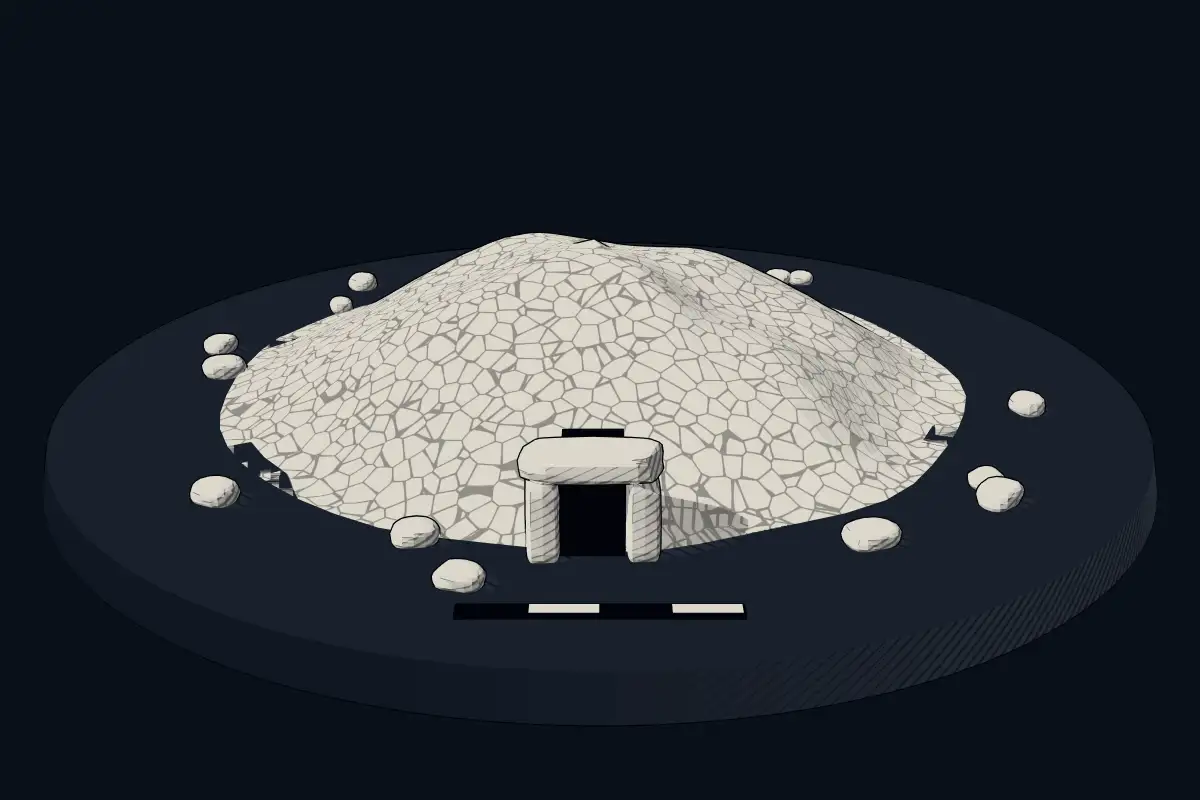
No licensed photograph yetWe have no photograph we may publish for this site, so the interpretive 3D view leads instead.
Overview
About this site
Overview
Central Chamber is a chambered cairn in Naha, Japan. It lies at 26.2182° N, 127.7146° E.
Catalogue recordSources and licences
Article
Central Chamber
ContextSources for this section
- en.wikipedia.orgCC BY-SA 4.0
- en.wikipedia.orgCC BY-SA 4.0
- en.wikipedia.orgCC BY-SA 4.0
- en.wikipedia.orgCC BY-SA 4.0
Sources for this section
- en.wikipedia.orgCC BY-SA 4.0
- en.wikipedia.orgCC BY-SA 4.0
- en.wikipedia.orgCC BY-SA 4.0
- en.wikipedia.orgCC BY-SA 4.0
A chambered cairn is a burial monument, usually constructed in the Neolithic, consisting of a sizeable chamber, usually of stone, around and over which a cairn of stones was built. Some chambered cairns are also passage graves. They are found throughout Britain and Ireland, with the largest number in Scotland. Typically the chamber is larger than a cist and holds a larger number of interments, either excarnated bones or inhumations or cremations. Most were situated near a settlement and served as the community's graveyard. The regional background, “Chambered cairns beyond Britain”, is given below.
Dating
No date has been published for this site.
Setting
2 other recorded monuments lie within 10 km (2 within 1 km, 2 within 5 km), 2 of them of the same type. In Naha, Japan, 3 of the 3 recorded monuments are of this type.
The nearest recorded monuments are Western Chamber (0.0 km west, chambered cairn); Eastern Chamber (0.0 km east, chambered cairn).
ProtectionSources for this section
Sources for this section
Heritage status: National Treasure of Japan; Important Cultural Property of Japan.
Tradition and region
About this kind of monument
Chambered cairns beyond Britain
A chambered cairn is a burial monument, usually constructed in the Neolithic, consisting of a sizeable chamber, usually of stone, around and over which a cairn of stones was built. Some chambered cairns are also passage graves. They are found throughout Britain and Ireland, with the largest number in Scotland. Typically the chamber is larger than a cist and holds a larger number of interments, either excarnated bones or inhumations or cremations. Most were situated near a settlement and served as the community's graveyard.
In Ireland, the Clyde-Carlingford or court cairns are found principally in the north and west, and more than 390 court cairns were built in Ireland in the period 3900 to 3500 BCE. Some chambered cairns are also passage graves, and a cairn itself is simply a pile of stones raised as a landmark or memorial, which can cover a grave or stand alone.
In Scotland different regional types developed, including the Clyde, Orkney-Cromarty, Hebridean and Shetland types. They differ in the plan of the chamber and the layout of the forecourt. In the Hebridean group, which appears relatively late in the Neolithic, the passage graves are usually larger than the Shetland type and are round or have funnel-shaped forecourts.
The Atlas has a few records outside Britain and Ireland labelled with this term, and they may differ in age and form from the British type; most are dated only by form.
Folklore: cairns across Ireland and Britain are the subject of legends and folklore. In Ireland it is traditional to carry a stone up from the bottom of a hill and add it to a cairn.
When visiting, look for the kerb, the entrance and the passage.
Paraphrased from Wikipedia: Chambered cairn, Wikipedia: Cairn, Wikipedia: Passage grave, Wikipedia: Court cairn · CC BY-SA 4.0
Where it stands
Japan
The pin marks the monument itself — its exact point.
- Coordinates
- 26°13′05″ N, 127°42′53″ EFor a GPS or map app: 26.21817, 127.71460
Access is as our sources describe it; we have not visited the site to check.
Nearby
The closest sites in the Atlas, by straight line.


Sources
Every record behind this page, with the link it came from.
1 source behind this page
- 01Wikidata Q107020674wikidata.org
Report a correctionWrong date, name, photograph or source? Tell us and it will be put right.
Around this place
The ten nearest sites, by compass
Credit
Text, licence and sources
Compiled from open records (Wikidata, CC0; OpenStreetMap, ODbL) and a regional background article based on Wikipedia (CC BY-SA 4.0).
- Wikidata Q107020674CC0
- en.wikipedia.orgCC BY-SA 4.0
- en.wikipedia.orgCC BY-SA 4.0
- en.wikipedia.orgCC BY-SA 4.0
- en.wikipedia.orgCC BY-SA 4.0