
Megalithic mound (tumulus with integral stones)
Bokeyama Kofun
Also known asHanyū no Sakamoto no Misasagi · Nonaka Bokeyama Kofun
Datedc. 600 CE
Photo Saigen Jiro · CC0Source file on Wikimedia Commons

Overview
About this site
Overview
Bokeyama Kofun (also Nonaka Bokeyama Kofun) is a keyhole-shaped burial mound at Aoyama 3-chome, Fujiidera, Osaka Prefecture, Japan. It is one of the tombs of the Furuichi group and is designated by the Imperial Household Agency as the Hanyū no Sakamoto no Misasagi, the tomb of the 24th emperor, Ninken.
The mound is 122 metres long and is surrounded by a moat. From the form of its cylindrical haniwa it is thought to have been built in the first half of the 6th century. Its actual occupant is not known.
Read on Wikipedia2 min readCC BY-SA 4.0
Where it sits in time
The site's dated range, placed against world reference points.
The scale is logarithmic: each step to the left is about ten times older than the last.
Article
Bokeyama Kofun
DescriptionSources for this section
- Wikipedia (Japanese): ボケ山古墳CC BY-SA 4.0
Sources for this section
- Wikipedia (Japanese): ボケ山古墳CC BY-SA 4.0
The front part of the mound is 107 metres wide and 13 metres high. The round rear part has a diameter of 65 metres and is 11.5 metres high. A projecting platform (tsukuridashi) lies at the south-eastern constriction between the two parts, and a moat runs around the whole mound.
In 1981 an investigation of the outer bank by the Habikino City Board of Education found two haniwa kilns on the slope adjoining the bank at the north-west of the front part.
ExcavationsSources for this section
- Wikipedia (Japanese): ボケ山古墳CC BY-SA 4.0
Sources for this section
- Wikipedia (Japanese): ボケ山古墳CC BY-SA 4.0
Investigations of the outer bank by the Osaka Prefectural Board of Education in 1975 and 1979 found rows of cylindrical haniwa on the bank at the north-east of the rear part and on the bank at the north-west of the front part. In 1981 an investigation of the outer bank by the Habikino City Board of Education found two haniwa kilns on the slope adjoining the bank at the north-west of the front part.
DatingSources for this section
- Wikipedia (Japanese): ボケ山古墳CC BY-SA 4.0
Sources for this section
- Wikipedia (Japanese): ボケ山古墳CC BY-SA 4.0
The characteristics of the excavated cylindrical haniwa and other finds indicate construction in the first half of the 6th century.
Later historySources for this section
- Wikipedia (Japanese): ボケ山古墳CC BY-SA 4.0
Sources for this section
- Wikipedia (Japanese): ボケ山古墳CC BY-SA 4.0
The Imperial Household Agency treats the mound as the tomb of Emperor Ninken, although the actual occupant is not clear. The place of worship stands outside the moat, in front of the front part.
ContextSources for this section
- Wikipedia (Japanese): ボケ山古墳CC BY-SA 4.0
Sources for this section
- Wikipedia (Japanese): ボケ山古墳CC BY-SA 4.0
Kofun are the great burial mounds of ancient Japan, built mainly between the middle of the third century and the early seventh century CE. The most distinctive form is the keyhole-shaped mound, with one square end and one round end seen from above.
Tradition and region
About this kind of monument
Japanese kofun tumuli
Kofun are the great burial mounds of ancient Japan, built mainly between the middle of the third century and the early seventh century CE. The period takes its name from them. The most distinctive form is the keyhole-shaped mound (zempō-kōen-fun), with one square end and one round end seen from above, but there are also plain round mounds, double-rectangle mounds and square mounds. Orientation is not fixed: in the Mozu group at Sakai, some round parts face north and others east.
The largest is Daisenryō kofun at Sakai in Osaka, the biggest kofun in Japan, thought to have been built over some twenty years in the middle of the fifth century. By common acceptance it is the tomb of Emperor Nintoku, and the Imperial Household Agency treats it as such, but this cannot be confirmed because the mound has not been excavated. It stands in the Mozu group, which once had more than a hundred tombs of which fewer than half remain; the group and the neighbouring Furuichi cluster were inscribed on the UNESCO World Heritage List in 2019. The mounds were built on a plateau overlooking Osaka Bay, near the ancient coastline.
Dating rests on mound shape, pottery and grave goods. Haniwa, which means "clay circle", are terracotta cylinders and figures of houses, animals and people that were arranged in rings and rows around and on top of the mounds. Smaller kofun are very numerous and sit in groups in every region of Japan.
When visiting, look for the moat that surrounds the larger mounds, for the stepped outline of terraces, and for reconstructed haniwa in museums and parks beside the tombs.
Paraphrased from Wikipedia: Kofun, Wikipedia: Daisen Kofun, Wikipedia: Haniwa, Wikipedia: Mozu Tombs · CC BY-SA 4.0
See it in 3D
An interpretive reconstruction of the monument, standing on the real ground at its exact point, under the sun for that place and season. Drag to look around it.
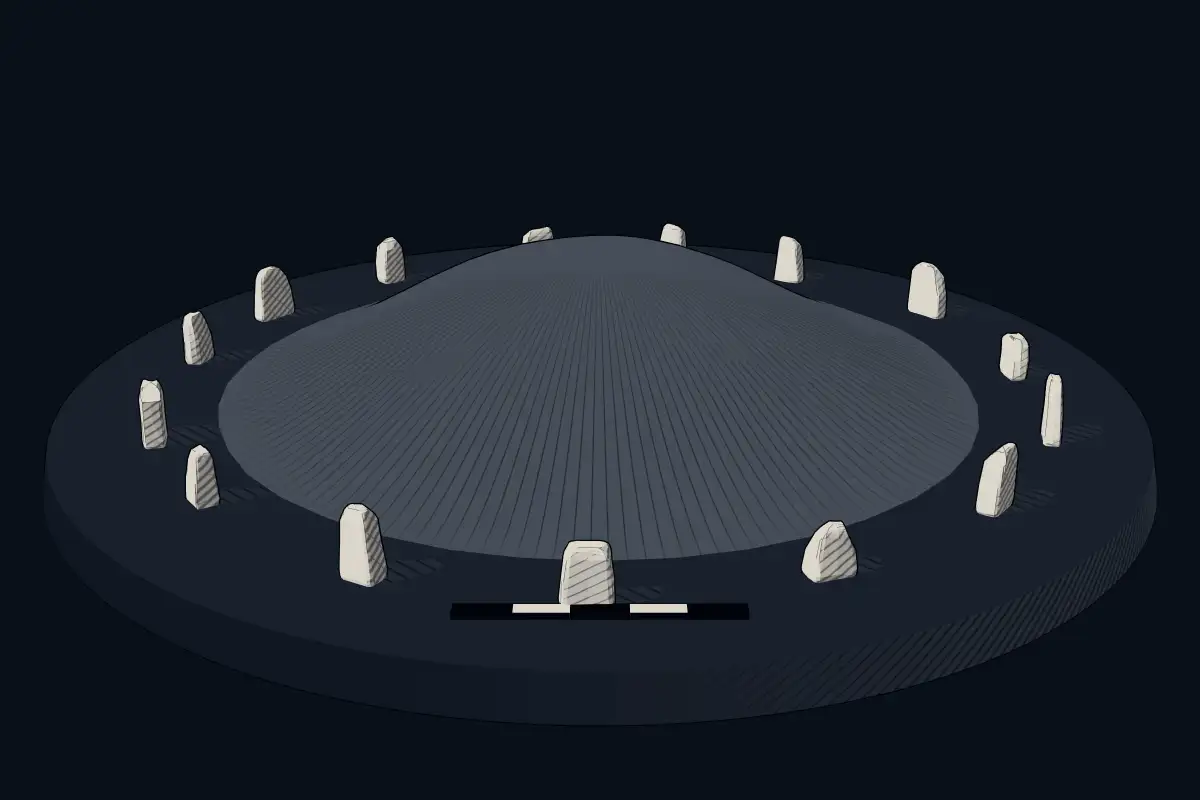
The reconstruction is ours, not a survey: it shows what a monument of this type looks like, at the size the record gives for this one.
Photographs
3 photographs, each with its author and licence
More photographs


Lore
Evidence & Lore
What the sources actually support — and, kept apart, what has been claimed.
What the evidence supports
Dates
Est. 250–650 CEHow this date was established: Type comparisonTypical range for megalithic mounds in Japan; this site has not been dated itself. Japanese kofun burial mounds were mainly constructed between the middle of the 3rd century and the early 7th century AD.Source for this date
Where it stands
Japan
The pin marks the monument itself — its exact point.
- Coordinates
- 34°33′23″ N, 135°35′47″ EFor a GPS or map app: 34.55643, 135.59650
Access is as our sources describe it; we have not visited the site to check.
Nearby
The closest sites in the Atlas, by straight line.
- Megalithic mound (tumulus with integral stones)Aoyama Kofun4000–1200 BCE
 Minegazuka Kofun
- Megalithic mound (tumulus with integral stones)Jōganjiyama Kofun4000–1200 BCE
- Megalithic mound (tumulus with integral stones)Nonaka Miyama Kofun250–650 CE
 Nonaka Kofun
 Hakayama Kofun
 Tsukaana Kofun250–650 CE
 Hazamiyama Kofun4000–1200 BCE


Sources
Every record behind this page, with the link it came from.
2 sources behind this page
- 01Wikidata Q11338602wikidata.org
- 02Source for this dateen.wikipedia.org
Image files
- Bokeyama Kofun, funkyu.jpgSaigen JiroCC0
- Mausoleum of Emperor Ninken.jpgTakanukaCC BY 3.0
- Bokeyama Kofun, haisho.jpgSaigen JiroCC0
Report a correctionWrong date, name, photograph or source? Tell us and it will be put right.
Around this place
The ten nearest sites, by compass
Credit
Text, licence and sources
Adapted from the Wikipedia article "ボケ山古墳" (Japanese), licensed CC BY-SA 4.0; authors are listed in the page history. Reused under CC BY-SA 4.0. Read on Wikipedia · Edit history and authors
- Wikipedia (Japanese): ボケ山古墳CC BY-SA 4.0
- Wikidata Q11338602CC0