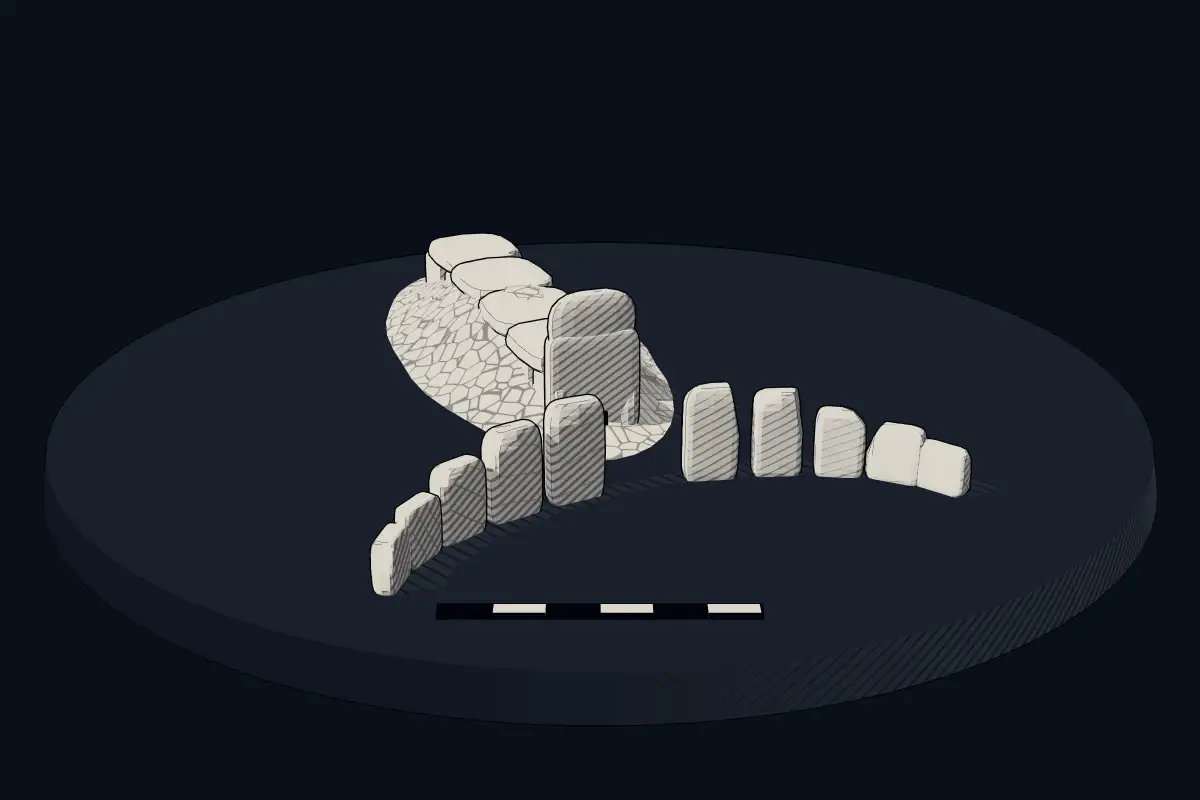
Giants' tomb (tomba di giganti)
Tomba dei giganti Santa Barbara
DatedEst. 1900–730 BCE
No licensed photograph yetWe have no photograph we may publish for this site, so the interpretive 3D view leads instead.
Overview
About this site
Overview
Tomba dei giganti Santa Barbara is a giants' tomb in Macomer, Italy. It lies at 40.2776° N, 8.7830° E.
Catalogue recordSources and licences
Where it sits in time
The site's dated range, placed against world reference points.
The scale is logarithmic: each step to the left is about ten times older than the last.
Article
Tomba dei giganti Santa Barbara
ContextSources for this section
- en.wikipedia.orgCC BY-SA 4.0
- en.wikipedia.orgCC BY-SA 4.0
- en.wikipedia.orgCC BY-SA 4.0
Sources for this section
- en.wikipedia.orgCC BY-SA 4.0
- en.wikipedia.orgCC BY-SA 4.0
- en.wikipedia.orgCC BY-SA 4.0
"Giants' grave", tomba dei giganti in Italian, is the name given by local people and archaeologists to a type of Sardinian megalithic gallery grave built in the Bronze Age by the Nuragic civilization. They were collective tombs, and about 800 have been found throughout Sardinia. A stone cairn lies over the burial chambers, and some examples have a cup-shaped entrance forecourt like that of the court cairns of Ireland. The regional background, “Sardinian giants' graves (tombe di giganti)”, is given below.
DatingSources for this section
- en.wikipedia.orgCC BY-SA 4.0
Sources for this section
- en.wikipedia.orgCC BY-SA 4.0
No scientific date has been published for this site. Monuments of this type in Italy are generally dated 1900 BCE to 730 BCE; the site itself may fall inside or outside that range.
The Sardinian giant's graves are collective funerary structures of the whole Nuragic era and were replaced by pit graves in the Iron Age.
Setting
210 other recorded monuments lie within 10 km (2 within 1 km, 72 within 5 km), 21 of them of the same type. The site belongs to a dense concentration of monuments. In Macomer, Italy, 5 of the 96 recorded monuments are of this type.
The nearest recorded monuments are Nuraghe Santa Barbara (0.2 km south, nuraghe); Nuraghe Basones (0.6 km west, nuraghe); Nuraghe Sa Maddalena (1.0 km south-east, nuraghe); Nuraghe Ruggiu (1.2 km west, nuraghe).
ProtectionSources for this section
Sources for this section
No heritage designation is recorded for the site.
Tradition and region
About this kind of monument
Sardinian giants' graves (tombe di giganti)
"Giants' grave", tomba dei giganti in Italian, is the name given by local people and archaeologists to a type of Sardinian megalithic gallery grave built in the Bronze Age by the Nuragic civilization. They were collective tombs, and about 800 have been found throughout Sardinia. A stone cairn lies over the burial chambers, and some examples have a cup-shaped entrance forecourt like that of the court cairns of Ireland.
There are two general types. In the "slab type", uncut slabs are set on end in the ground and arranged side by side; there is usually a central stele, the largest slab and up to 4 metres high, with a doorway cut through it. A second type has a stele and walls built of shaped blocks.
Coddu Vecchiu, near Arzachena in northern Sardinia, is one of the larger giants' graves, with a stele, megaliths and a gallery grave, and the Nuraghe La Prisgiona nearby. It was excavated in 1966 by Editta Castaldi, who recovered pans, bowls and plates with comb decoration, and vases with bent necks, of the early Nuragic Bonnanaro culture. This suggests that it was built early in the Nuragic period, about 1800 to 1600 BCE. It appears to have begun as a cist that was expanded in the Middle Bronze Age and covered by a gallery grave with the ornate stele portal stone.
The name "giants' grave" was given by local people, and archaeologists have kept it; it is a popular label, not evidence of who was buried.
Dating is by the pottery found inside, which can show that a tomb was used over a long time.
When visiting, look for the curved forecourt, the tall central stele with its doorway, and the long mound behind it.
Paraphrased from Wikipedia: Giants' grave, Wikipedia: Coddu Vecchiu, Wikipedia: Nuragic civilization · CC BY-SA 4.0
Lore
Evidence & Lore
What the sources actually support — and, kept apart, what has been claimed.
What the evidence supports
Dates
Est. 1900–730 BCEHow this date was established: Type comparisonTypical range for giants' tombs in Italy; this site has not been dated itself. The Sardinian giant's graves are collective funerary structures of the whole Nuragic era and were replaced by pit graves in the Iron Age.Source for this date
Where it stands
Italy
The pin marks the monument itself — its exact point.
- Coordinates
- 40°16′39″ N, 8°46′59″ EFor a GPS or map app: 40.27760, 8.78295
Access is as our sources describe it; we have not visited the site to check.
Nearby
The closest sites in the Atlas, by straight line.


Sources
Every record behind this page, with the link it came from.
2 sources behind this page
- 01Wikidata Q122205206wikidata.org
- 02Source for this dateen.wikipedia.org
Report a correctionWrong date, name, photograph or source? Tell us and it will be put right.
Around this place
The ten nearest sites, by compass
Credit
Text, licence and sources
Compiled from open records (Wikidata, CC0; OpenStreetMap, ODbL) and a regional background article based on Wikipedia (CC BY-SA 4.0).
- Wikidata Q122205206CC0
- en.wikipedia.orgCC BY-SA 4.0
- en.wikipedia.orgCC BY-SA 4.0
- en.wikipedia.orgCC BY-SA 4.0
- en.wikipedia.orgCC BY-SA 4.0