Giants' tomb (tomba di giganti)
Pedras Doladas
DatedEst. 1900–730 BCE
Photo acrissantu · CC BY-SA 4.0Source file on Wikimedia Commons
Overview
About this site
What the sources say
Das Gigantengrab Pedras Doladas liegt auf dem namengebenden Hügel, etwa 1,5 km östlich von Scano di Montiferro in der Provinz Oristano auf Sardinien. Unmittelbar südlich liegt die erst 1966 errichtete Kapelle „Tutti i Santi“ (Allerheiligen).
Das Gigantengrab ist seit den 1850er Jahren bekannt. Die in Sardu „Tumbas de los zigantes“ und (italienisch Tombe dei Giganti – plur.) genannten Bauten sind die größten pränuraghischen Kultanlagen Sardiniens und zählen europaweit zu den spätesten Megalithanlagen. Die 321 bekannten Gigantengräber sind Monumente der bronzezeitlichen Bonnanaro-Kultur (2.200–1.600 v. Chr.), die Vorläuferkultur der Nuraghenkultur ist.
Article in GermanRead on Wikipedia4 min readCC BY-SA 4.0
Where it sits in time
The site's dated range, placed against world reference points.
The scale is logarithmic: each step to the left is about ten times older than the last.
The full article
Pedras Doladas: the whole story
In briefSources for this section
- Wikipedia (German): Pedras DoladasCC BY-SA 4.0
Sources for this section
- Wikipedia (German): Pedras DoladasCC BY-SA 4.0
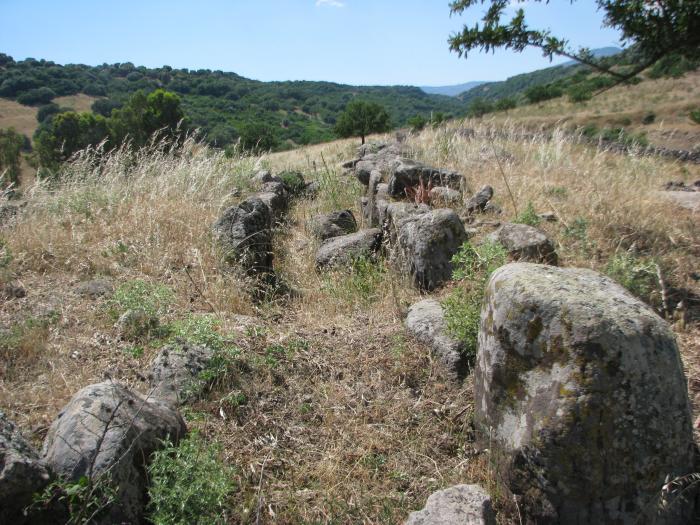
Pedras Doladas is a Bronze Age giants’ grave on a hill of the same name, about 1.5 km east of Scano di Montiferro in the province of Oristano, Sardinia, Italy. The chapel Tutti i Santi, built in 1966, stands immediately to the south. The monument has been known since the 1850s and is called Tumbas de los zigantes in Sardu and Tomba dei Giganti in Italian.
The grave is a symmetrical structure built with dry-stone masonry from local basalt. Its axial body encloses a gallery and measures 8.40 m long. The width is 5.6 m where it joins the semicircular forecourt and narrows to 4.20 m at the apse. The double walls are 1.9 m thick at the sides and 2.9 m thick in the middle of the apse.
The slightly trapezoidal gallery is 5.4 m long inside and 0.85 to 0.8 m wide. Six orthostats and a tall end stone line it. The upper covering, which may have been a corbelled vault or horizontal slabs, is missing, as are the sides of the forecourt. At its base are traces of an added bench. Two aligned uprights mark the axial entrance and have broad grooves that appear to have held a portal stele, probably supporting a lintel.
Three squat, conical baityloi belong to the monument. Two were incorporated into a modern boundary wall, while the third, a small cone with one flat elliptical section and one convex section, lies among the blocks of the apse. The nearby nuraghi Porcos and Altoriu lie a few hundred metres away, and other giants’ graves near the village include Amenta, Pedriscudu, Sas serras and Su crastu iscrittu.
No English Wikipedia article exists for it; the full text below is the German article "Pedras Doladas", shown in the original language.
Summary in EnglishSources for this section
- Wikipedia (German): Pedras DoladasCC BY-SA 4.0
Sources for this section
- Wikipedia (German): Pedras DoladasCC BY-SA 4.0
Pedras Doladas is a giants' tomb (tomba di giganti) in Scano di Montiferro, Italy. A typological estimate: 1900 BCE to 730 BCE. No English Wikipedia article exists for it; the full text below is the German article "Pedras Doladas", shown in the original language.
TypenfolgeSources for this section
- Wikipedia (German): Pedras DoladasCC BY-SA 4.0
Sources for this section
- Wikipedia (German): Pedras DoladasCC BY-SA 4.0
Baulich treten Gigantengräber in zwei Varianten auf. Die Anlagen mit Portalstelen und Exedra gehören zum älteren Typ. Bei späteren Anlagen besteht die Exedra aus einer in der Mitte deutlich erhöhten Quaderfassade aus bearbeiteten und geschichteten Steinblöcken. Das Gigantengrab Pedras Doladas ist ein Übergangstyp mit Elementen des jüngeren (mit Quaderfassade) und älteren Typs (Portalstele).
BeschreibungSources for this section
- Wikipedia (German): Pedras DoladasCC BY-SA 4.0
Sources for this section
- Wikipedia (German): Pedras DoladasCC BY-SA 4.0
Die symmetrische Anlage ist mit Trockenmauerwerk aus lokalem Basalt errichtet. Der axiale Körper, der die Galerie einschließt, ist 8,40 m lang. Seine Breite beträgt im Bereich der Verbindung mit der Exedra 5,6 m und verjüngt sich zur nur im Außenmauerbereich gerundeten Apsis hin auf 4,20 m. Die Dicke der doppelten Wände beträgt an den Seiten 1,9 und in der Mitte der Apsis 2,9 m. Die leicht trapezförmige Galerie ist innen 5,4 m lang und 0,85 bis 0,8 m breit. Sie wird seitlich durch sechs Orthostaten und einen hohen Endstein begrenzt. Die ggf. aus einem Kraggewölbe oder einer horizontalen Plattenabdeckung bestehende Oberkonstruktion fehlt ebenso wie die Seiten der Exedra. An ihrer Basis sind jedoch Spuren einer vorgesetzten Bank erhalten. Der axiale Zugang wird durch zwei ausgerichtete Ständer dargestellt, auf denen ggf. ein Sturz ruhte. Sie haben allerdings innen breite Nuten, in die offenbar eine Portalstele eingeschoben war.
Zum Denkmal gehören drei konische, untersetzte Baityloi, von denen zwei in die moderne Begrenzungswand aufgenommen wurden. Der dritte, eine kleine konische Form mit einem flachen elliptischen und einem konvexen Abschnitt, liegt zwischen den Blöcken der Apsis.
In der NäheSources for this section
- Wikipedia (German): Pedras DoladasCC BY-SA 4.0
Sources for this section
- Wikipedia (German): Pedras DoladasCC BY-SA 4.0
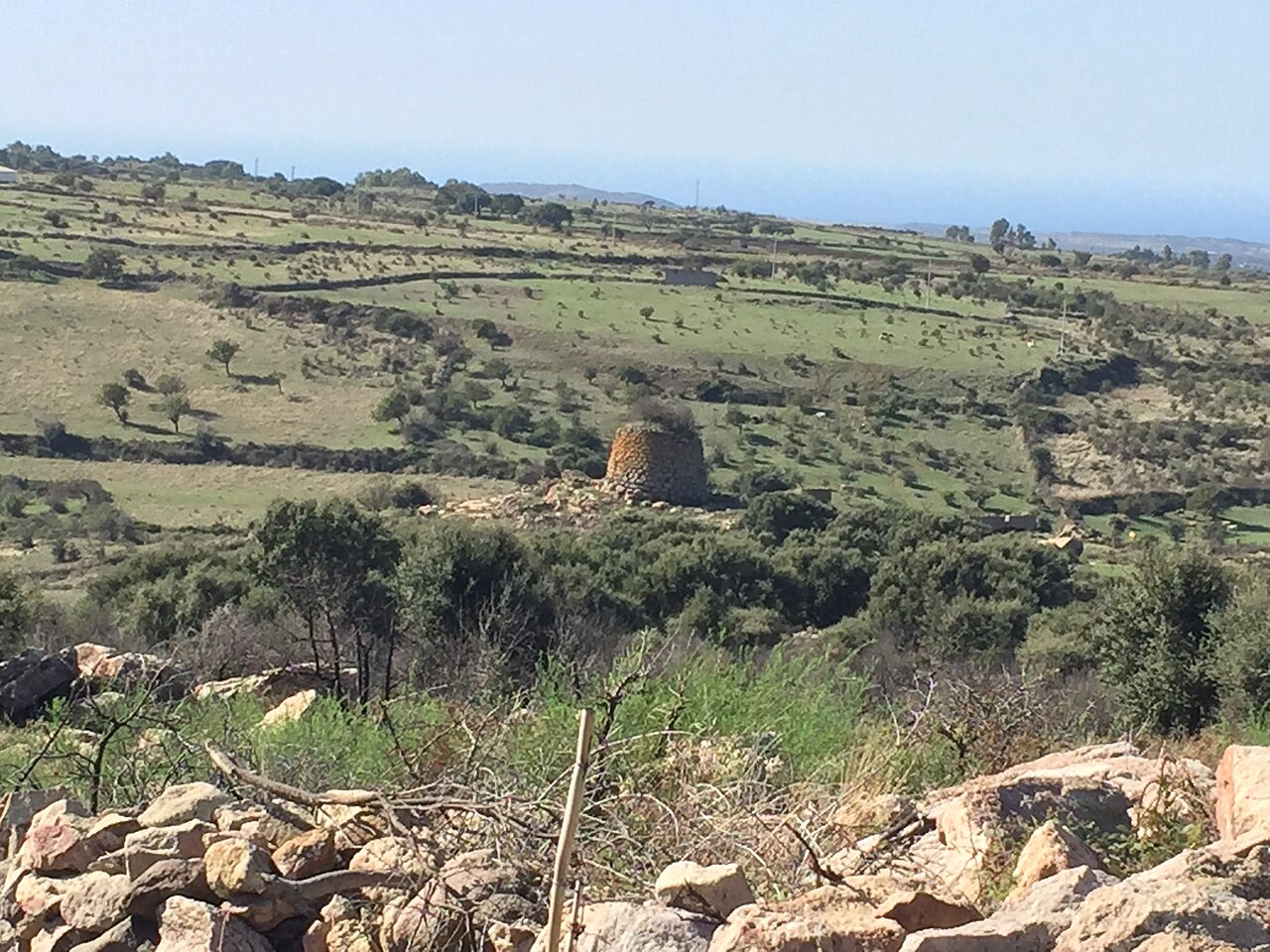
Wenige hundert Meter entfernt liegen die Nuraghen Porcos und Altoriu. Nahe dem Ort liegen die Gigantengräber Amenta, Pedriscudu, Sas serras und Su crastu iscrittu.
How this page was madeSources for this section
- Wikipedia (German): Pedras DoladasCC BY-SA 4.0
Sources for this section
- Wikipedia (German): Pedras DoladasCC BY-SA 4.0
The summary at the top of this page was written by MiniMax-M3 (2026-11-07) from the cited Wikipedia article “Pedras Doladas”, translated from German. The numbers in it were checked automatically against the source text. The rest of the page is the article itself, the structured records and computed distances.
Tradition and region
About this kind of monument
Sardinian giants' graves (tombe di giganti)
"Giants' grave", tomba dei giganti in Italian, is the name given by local people and archaeologists to a type of Sardinian megalithic gallery grave built in the Bronze Age by the Nuragic civilization. They were collective tombs, and about 800 have been found throughout Sardinia. A stone cairn lies over the burial chambers, and some examples have a cup-shaped entrance forecourt like that of the court cairns of Ireland.
There are two general types. In the "slab type", uncut slabs are set on end in the ground and arranged side by side; there is usually a central stele, the largest slab and up to 4 metres high, with a doorway cut through it. A second type has a stele and walls built of shaped blocks.
Coddu Vecchiu, near Arzachena in northern Sardinia, is one of the larger giants' graves, with a stele, megaliths and a gallery grave, and the Nuraghe La Prisgiona nearby. It was excavated in 1966 by Editta Castaldi, who recovered pans, bowls and plates with comb decoration, and vases with bent necks, of the early Nuragic Bonnanaro culture. This suggests that it was built early in the Nuragic period, about 1800 to 1600 BCE. It appears to have begun as a cist that was expanded in the Middle Bronze Age and covered by a gallery grave with the ornate stele portal stone.
The name "giants' grave" was given by local people, and archaeologists have kept it; it is a popular label, not evidence of who was buried.
Dating is by the pottery found inside, which can show that a tomb was used over a long time.
When visiting, look for the curved forecourt, the tall central stele with its doorway, and the long mound behind it.
Paraphrased from Wikipedia: Giants' grave, Wikipedia: Coddu Vecchiu, Wikipedia: Nuragic civilization · CC BY-SA 4.0
From the article
Dated moments in the story
Photographs
1 photograph, each with its author and licence
Lore
Evidence & Lore
What the sources actually support — and, kept apart, what has been claimed.
What the evidence supports
Dates
Est. 1900–730 BCEHow this date was established: Type comparisonTypical range for giants' tombs in Italy; this site has not been dated itself. The Sardinian giant's graves are collective funerary structures of the whole Nuragic era and were replaced by pit graves in the Iron Age.Source for this date
Where it stands
Italy
The pin marks the monument itself — its exact point.
- Coordinates
- 40°12′59″ N, 8°36′50″ EFor a GPS or map app: 40.21633, 8.61397
Access is as our sources describe it; we have not visited the site to check.
Nearby
The closest sites in the Atlas, by straight line.


Sources
Every record behind this page, with the link it came from.
2 sources behind this page
- 01Wikidata Q1699553wikidata.org
- 02Source for this dateen.wikipedia.org
Image files
Report a correctionWrong date, name, photograph or source? Tell us and it will be put right.
Around this place
The ten nearest sites, by compass
Credit
Text, licence and sources
Text from the Wikipedia article "Pedras Doladas" (German), licensed CC BY-SA 4.0; authors are listed in the page history. Reused under CC BY-SA 4.0. Read on Wikipedia · Edit history and authors
- Wikipedia (German): Pedras DoladasCC BY-SA 4.0
- Wikidata Q1699553CC0