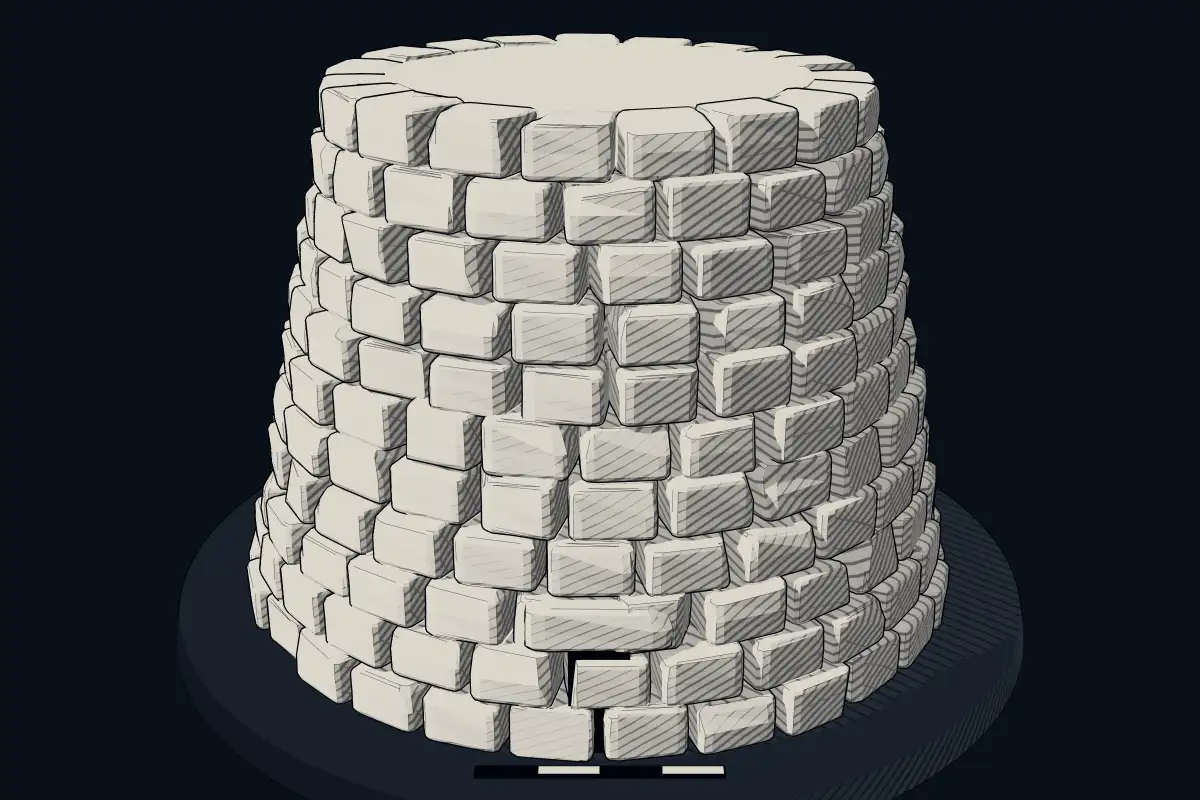
nuraghe S'Iscala Ruja
DatedEst. 1900–730 BCE
No licensed photograph yetWe have no photograph we may publish for this site, so the interpretive 3D view leads instead.
Overview
About this site
Overview
The nuraghe S'Iscala Ruja (Sardinian: Nuraghe La scala rossa) is a complex nuraghe in the territory of Siligo, Sardinia, Italy. It belongs to the Nuragic civilization, whose nuraghi were built between 1900 and 730 BCE.
It stands at the northern end of the s'Aspru plateau and dominates the valley that extends to the west.
Read on Wikipedia2 min readCC BY-SA 4.0
Where it sits in time
The site's dated range, placed against world reference points.
The scale is logarithmic: each step to the left is about ten times older than the last.
Article
nuraghe S'Iscala Ruja
To the north, at a slightly lower elevation, the Nuraghe Morette and the Nuraghe Santu Filighe can be made out.
SettingSources for this section
- Wikipedia (Italian): Nuraghe S'Iscala RujaCC BY-SA 4.0
Sources for this section
- Wikipedia (Italian): Nuraghe S'Iscala RujaCC BY-SA 4.0
On the same plateau, about 600 metres to the south, lies the Nuraghe Ponte Molinu. To the north, at a slightly lower elevation, the Nuraghe Morette and the Nuraghe Santu Filighe can be made out.
DescriptionSources for this section
- Wikipedia (Italian): Nuraghe S'Iscala RujaCC BY-SA 4.0
Sources for this section
- Wikipedia (Italian): Nuraghe S'Iscala RujaCC BY-SA 4.0
The nuraghe is of the complex type, and its plan cannot be fully determined because of collapses and dense scrub. The remains of the circular keep are visible, with a diameter of 13.50 m along the north-south axis and 14.00 m along the west-east axis. The masonry is polygonal, made of large irregular blocks of basalt. The wall reaches a maximum height of 3.47 m in eight courses on the north and east sides.
The surviving elements are insufficient to define the structure precisely. There was probably a chamber with a tholos (corbelled) vault and a second, rectangular room roofed with large slabs set as lintels. On the southern side, a little way from the nuraghe, some large boulders lie in a line 3.60 m long; they belong to structures that cannot be defined. About 7.50 from the main body, the outline of another tower, built in the same technique, can be seen.
ContextSources for this section
- Wikipedia (Italian): Nuraghe S'Iscala RujaCC BY-SA 4.0
Sources for this section
- Wikipedia (Italian): Nuraghe S'Iscala RujaCC BY-SA 4.0
The nuraghe is the main type of ancient megalithic building in Sardinia. More than 7,000 have been found, and it is believed that originally there were more than 10,000. A nuraghe has the outer shape of a truncated conical tower, with a tholos-like vault inside.
Tradition and region
About this kind of monument
Sardinian nuraghi
The nuraghe is the main type of ancient megalithic building in Sardinia, and it has become the symbol of the island and of its Nuragic civilization. They were built during the Nuragic Age, between 1900 and 730 BCE. More than 7,000 have been found, and archaeologists believe that originally there were more than 10,000. A nuraghe has the outer shape of a truncated conical tower, rather like a medieval tower, with a tholos-like vault inside.
The finest is Su Nuraxi at Barumini, a UNESCO World Heritage Site since 1997. Its oldest part is a central tower with three superposed chambers, 18.6 metres high, built of basalt blocks between the seventeenth and thirteenth centuries BCE. In the Late Bronze Age four corner towers joined by a curtain wall were added, and a village grew around it, inhabited from the thirteenth to the sixth century BCE. Scholars consider it the most impressive expression of the Nuragic civilization.
There is no consensus on what the nuraghi were for: rulers' residences, military strongholds, meeting halls, temples and ordinary dwellings have all been proposed. The Nuragic civilization lasted from the eighteenth century BCE until the Iron Age or the beginning of Roman colonisation in 238 BCE, and building of nuraghi had stopped by the twelfth or eleventh century BCE. Its origins are disputed: the traditional theory of Giovanni Lilliu, from 1966, saw migrants related to the Beaker culture, while others argue for local development. Even the word nuraghe has an uncertain and disputed etymology.
Many nuraghi have never been excavated, and their dates are inferred from their form.
When visiting, look for the stone courses, the entrance corridor, and the village of huts that often surrounds the tower.
Paraphrased from Wikipedia: Nuraghe, Wikipedia: Nuragic civilization, Wikipedia: Su Nuraxi · CC BY-SA 4.0
From the article
Dated moments in the story
- 600 CE
Sempre sullo stesso altopiano a circa 600 metri, in direzione sud, si trova il Nuraghe Ponte Molinu; mentre a nord, a quota leggermente inferiore, si intravedono il Nuraghe Morette e il Nuraghe Santu Filighe.
Source
Lore
Evidence & Lore
What the sources actually support — and, kept apart, what has been claimed.
What the evidence supports
Dates
Est. 1900–730 BCEHow this date was established: Type comparisonTypical range for nuraghes in Italy; this site has not been dated itself. The nuraghe is the main type of ancient megalithic edifice of Sardinia developed during the Nuragic Age between 1900 and 730 BC.Source for this date
Where it stands
Italy
The pin marks the monument itself — its exact point.
- Coordinates
- 40°35′44″ N, 8°44′36″ EFor a GPS or map app: 40.59561, 8.74342
Access is as our sources describe it; we have not visited the site to check.
Nearby
The closest sites in the Atlas, by straight line.


Sources
Every record behind this page, with the link it came from.
2 sources behind this page
- 01Wikidata Q106766802wikidata.org
- 02Source for this dateen.wikipedia.org
Report a correctionWrong date, name, photograph or source? Tell us and it will be put right.
Around this place
The ten nearest sites, by compass
Credit
Text, licence and sources
Adapted from the Wikipedia article "Nuraghe S'Iscala Ruja" (Italian), licensed CC BY-SA 4.0; authors are listed in the page history. Reused under CC BY-SA 4.0. Read on Wikipedia · Edit history and authors