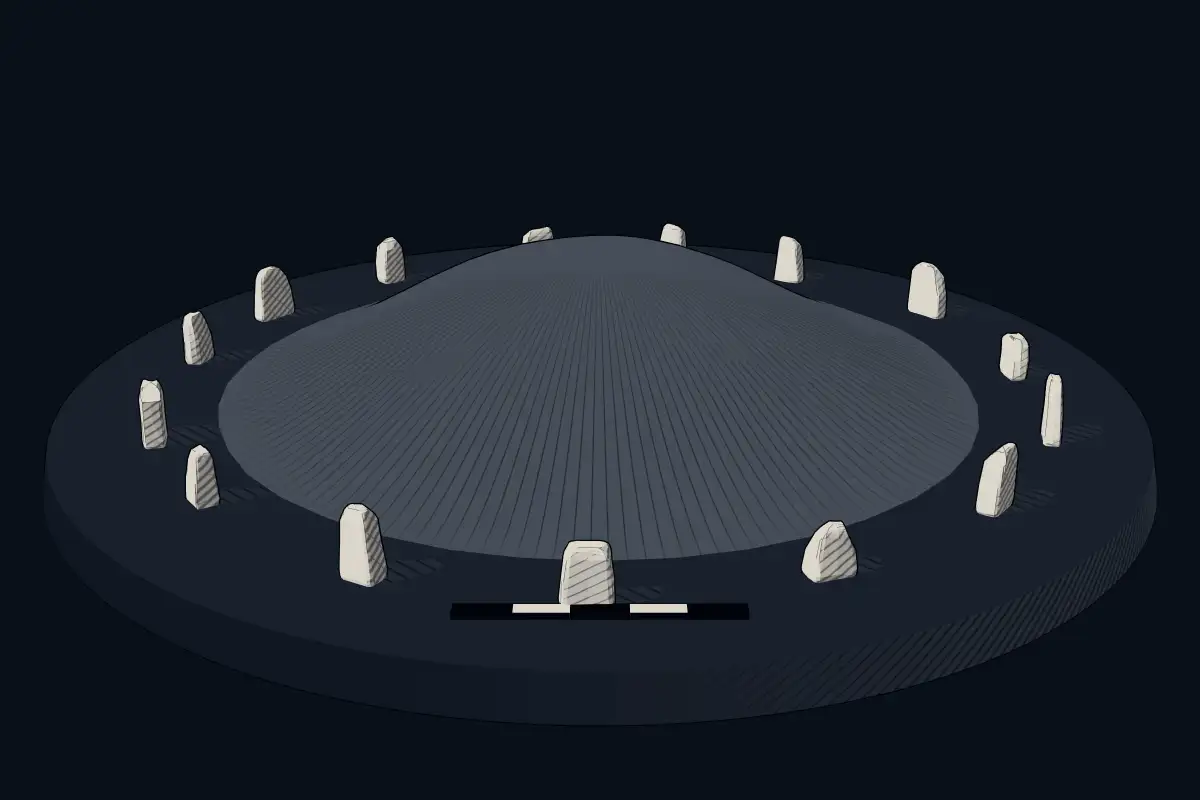
Megalithic mound (tumulus with integral stones)
Melone Sodo I
No licensed photograph yetWe have no photograph we may publish for this site, so the interpretive 3D view leads instead.
Overview
About this site
Overview
Melone Sodo I is an Etruscan tumulus tomb of the late sixth century BCE, near Cortona in the province of Arezzo, Tuscany, Italy. It belongs to the archaic Etruscan period and has a diameter of about 60 m and a height of 10 m.
The tomb was discovered in 1909 and has been open to the public since 26 March 2009.
Read on Wikipedia2 min readCC BY-SA 4.0
Article
Melone Sodo I
A short uncovered dromos leads to a square vestibule, which gives access to two further square chambers in a row that serve as a corridor.
DescriptionSources for this section
- Wikipedia (French): Melone Sodo ICC BY-SA 4.0
Sources for this section
- Wikipedia (French): Melone Sodo ICC BY-SA 4.0
The tumulus is oriented to the south-west. A short uncovered dromos leads to a square vestibule, which gives access to two further square chambers in a row that serve as a corridor. From these one reaches five burial chambers, all with tholos vaults. The largest chamber lies at the back, and each side leads to two others. An inscription, 'Here are Arnt Mefanates and Velia Hapisnei', datable to the fourth century BCE, can be seen in the passage joining the two left-hand side burial chambers.
FindsSources for this section
- Wikipedia (French): Melone Sodo ICC BY-SA 4.0
Sources for this section
- Wikipedia (French): Melone Sodo ICC BY-SA 4.0
The tomb held a rich funerary assemblage, comprising a bronze patera, a small ivory palm, sets of cosmetic equipment, bucchero ware and vases of Corinthian pottery. The whole assemblage is displayed in the National Archaeological Museum of Florence.
NameSources for this section
- Wikipedia (French): Melone Sodo ICC BY-SA 4.0
Sources for this section
- Wikipedia (French): Melone Sodo ICC BY-SA 4.0
The name comes from the local word Melone (melon), whose shape recalls the structure, and from Sodo I, after the locality of Il Sodo, to distinguish it from Sodo II, another tomb on the road SS71, just after Camucia towards Castiglion Fiorentino. Sodo I lies on the left bank of the rio Loreto.
ConservationSources for this section
- Wikipedia (French): Melone Sodo ICC BY-SA 4.0
Sources for this section
- Wikipedia (French): Melone Sodo ICC BY-SA 4.0
The tomb remained closed for many years while it was restored. It has been open to the public since 26 March 2009.
ContextSources for this section
- Wikipedia (French): Melone Sodo ICC BY-SA 4.0
Sources for this section
- Wikipedia (French): Melone Sodo ICC BY-SA 4.0
Many of Italy's tumuli are the mounded tombs of the Etruscans, the people of Etruria in central Italy. At Cerveteri, ancient Caere, the Banditaccia Necropolis contains the most important tumulus tombs and chambers known, cut from the soft volcanic rock, tufa.
Tradition and region
About this kind of monument
Etruscan tumuli of Italy
Many of Italy's tumuli are the mounded tombs of the Etruscans, the people of Etruria in central Italy. At Cerveteri, ancient Caere, the Banditaccia Necropolis contains the most important tumulus tombs and chambers known. They are cut from the soft volcanic rock, tufa, and most echo Greek architecture in their carved details. Caere was one of the city-states of the Etruscan League; at its height, around 600 BCE, its population was perhaps 25,000 to 40,000, and the size of its graves reflects the wealth of its leading families.
The Regolini-Galassi tomb at Cerveteri, dated to about 680 to 650 BCE, is one of the wealthiest Etruscan family tombs. It has two burial chambers on either side of a corridor 37 metres long; the lower part is cut into tufa and the upper part is built of square stone blocks, each course overhanging the one below to make a rough vault. At Populonia, on the coast, monumental tumuli with a cylindrical base (crepidines) and a false dome were built from the second half of the ninth century BCE; their wealth is thought to reflect the exploitation of inland mineral resources, and by the late seventh century their size became more uniform, which has been read as a reorganisation of the community. At Tarquinia the Monterozzi necropolis has some 6,000 tombs, at least 200 with painted walls, and many were tumulus tombs with chambers carved in the rock below.
Dating comes from the objects in the tombs and from the architecture itself. Many tombs were looted in antiquity or in later centuries.
When visiting, walk the Banditaccia necropolis, where many of the tombs are visible at close range, and compare the round tumulus with the rock-cut chamber beneath.
Paraphrased from Wikipedia: Cerveteri, Wikipedia: Regolini-Galassi tomb, Wikipedia: Tarquinia, Wikipedia: Populonia, Wikipedia: Etruscan civilization, Wikipedia: Tumulus · CC BY-SA 4.0
From the article
Dated moments in the story
- 1909
La tombe du Melone Sodo I, qui date de la période archaïque étrusque, a été découverte en 1909. Elle contenait un riche trousseau funéraire composé d'une patère en bronze, une petite palme en ivoire, des nécessaires de maquillage, des buccheri et des vases en céramique corinthienne.
Source - 1980
Mario Torelli, Etruria, Guide Archéologique Laterza, Rome-Bari, 1980.
Source - 2009
La tombe, restée fermée pendant de nombreuses années afin de la restaurer, est ouverte au public depuis le 26 mars 2009.
Source
See it in 3D
An interpretive reconstruction of the monument, standing on the real ground at its exact point, under the sun for that place and season. Drag to look around it.
The reconstruction is ours, not a survey: it shows what a monument of this type looks like, at the size the record gives for this one.
Where it stands
Italy
The pin marks the monument itself — its exact point.
- Coordinates
- 43°16′49″ N, 11°58′08″ EFor a GPS or map app: 43.28026, 11.96882
Access is as our sources describe it; we have not visited the site to check.
Nearby
The closest sites in the Atlas, by straight line.
- Megalithic mound (tumulus with integral stones)Melone Sodo II
 Tumulo di Camucia
 Hypogeum of the Volumnus family
- Megalithic mound (tumulus with integral stones)Mucellena Etruscan tumulus
 cippo in ricordo di Cesare Cecchini
- Hypogeum (rock-cut)Grotta di Riello
 Suggestum Caesaris
- Hypogeum (rock-cut)Tomba Lattanzi, Norchia


Sources
Every record behind this page, with the link it came from.
1 source behind this page
- 01Wikidata Q3305262wikidata.org
Report a correctionWrong date, name, photograph or source? Tell us and it will be put right.
Around this place
The ten nearest sites, by compass
Credit
Text, licence and sources
Adapted from the Wikipedia article "Melone Sodo I" (French), licensed CC BY-SA 4.0; authors are listed in the page history. Reused under CC BY-SA 4.0. Read on Wikipedia · Edit history and authors
- Wikipedia (French): Melone Sodo ICC BY-SA 4.0
- Wikidata Q3305262CC0