
Lapis Longus
Also known asLapis Longus of Chivasso
DatedEst. 2800–1800 BCE
Photo Ambra75 · CC BY-SA 4.0Source file on Wikimedia Commons
Overview
About this site
What the sources say
Le menhir de Chivasso (en italien : menhir di Chivasso), connu également sous le nom de « Lapis Longus » (« Longue Pierre » en latin), est un mégalithe datant de l'Âge du bronze ou de l'Âge du fer situé à Chivasso, commune de la ville métropolitaine de Turin, dans le Piémont.
Article in FrenchRead on Wikipedia3 min readCC BY-SA 4.0
Where it sits in time
The site's dated range, placed against world reference points.
The scale is logarithmic: each step to the left is about ten times older than the last.
The full article
Lapis Longus: the whole story
In briefSources for this section
- Wikipedia (French): Menhir de ChivassoCC BY-SA 4.0
Sources for this section
- Wikipedia (French): Menhir de ChivassoCC BY-SA 4.0
Lapis Longus, also known as Lapis Longus of Chivasso, stands in the centre of Chivasso, in the metropolitan city of Turin, Piedmont, Italy. It is situated on Lungo Piazza d'Armi, between Via Orti and Via Torino. Although recorded as a standing stone, the monument may have been a funerary monument rather than a true menhir.
The monolith was carved from gneiss and resembles a column. It measures 4 m in height and weighs 1,500 kg. Its precise origin and purpose remain uncertain, and it is now enclosed beneath a protective glass “cloche.” The available information does not establish when the stone was originally raised.
Later, the pseudo-menhir was used as a pillory during the XVIe and XVIIe centuries. Its catalogue dating is 2800 BCE to 1800 BCE, based on a typological estimate, while the monument is described as belonging to the Bronze Age or Iron Age. These broad dates do not provide a secure date for its erection or original use.
The stone’s alternative name comes from the Latin meaning “Longue Pierre.” Standing stones are found across central and southern Europe outside the Atlantic fringe. In Italy, the best-known examples are in Sardinia, where at least 332 standing stones have been recorded, including statue-menhirs with human faces and gendered symbols. These broader traditions provide context for the later history and uncertain status of Lapis Longus.
No English Wikipedia article exists for it; the full text below is the French article "Menhir de Chivasso", shown in the original language.
Summary in EnglishSources for this section
- Wikipedia (French): Menhir de ChivassoCC BY-SA 4.0
Sources for this section
- Wikipedia (French): Menhir de ChivassoCC BY-SA 4.0
Lapis Longus is a menhir (standing stone) in Chivasso, Italy. A typological estimate: 2800 BCE to 1800 BCE. No English Wikipedia article exists for it; the full text below is the French article "Menhir de Chivasso", shown in the original language.
SituationSources for this section
- Wikipedia (French): Menhir de ChivassoCC BY-SA 4.0
Sources for this section
- Wikipedia (French): Menhir de ChivassoCC BY-SA 4.0
Le menhir se dresse sur la Lungo Piazza d'Armi, entre la Via Orti et la Via Torino, dans le centre de Chivasso.
DescriptionSources for this section
- Wikipedia (French): Menhir de ChivassoCC BY-SA 4.0
Sources for this section
- Wikipedia (French): Menhir de ChivassoCC BY-SA 4.0
Le monolithe, taillé dans le gneiss, se présente comme une sorte de colonne mesurant 4 m de hauteur pour un poids de 1 500 kg ; il pourrait s'agir d'un monument funéraire datant de l'Âge du bronze ou de l'Âge du fer, et non d'un véritable menhir.
HistoireSources for this section
- Wikipedia (French): Menhir de ChivassoCC BY-SA 4.0
Sources for this section
- Wikipedia (French): Menhir de ChivassoCC BY-SA 4.0
Le pseudo-menhir sera utilisé comme pilori autour des XVIe et XVIIe siècles.
Il se trouve actuellement sous une « cloche » de protection en cristal.
How this page was madeSources for this section
- Wikipedia (French): Menhir de ChivassoCC BY-SA 4.0
Sources for this section
- Wikipedia (French): Menhir de ChivassoCC BY-SA 4.0
The summary at the top of this page was written by MiniMax-M3 (2026-11-08) from the cited Wikipedia article “Menhir de Chivasso”, translated from French. The numbers in it were checked automatically against the source text. The rest of the page is the article itself, the structured records and computed distances.
Tradition and region
About this kind of monument
Central and southern European menhirs
Outside the Atlantic fringe, menhirs also occur across central and southern Europe. In the Czech Republic there are about 40 real menhirs and dozens of stones that could also be menhirs, and others have been erected recently. The largest real menhir is Kamenný pastýř, the "stony shepherd", near Klobuky, 3.3 metres high; the Czech menhirs are probably the last outcrop of a tradition that ran across northern Germany. Some of the Czech stones in the Atlas may be natural boulders.
Italy has its most famous menhirs in Sardinia, where at least 332 standing stones can be seen. They include elaborate "statue-menhirs" that show a human face at the top and gendered symbols on the flat front; over a hundred of this standardised type have been found, mostly around the village of Laconi. In the Sardinian language they are called perdas fittas or perdas lungas. In Switzerland, in the canton of Vaud, several menhirs form linear patterns at Clendy in Yverdon-les-Bains, and date back to the third millennium BCE.
A statue menhir is a carved standing stone of the later European Neolithic, in which a slab or pillar has a stylised human figure cut into it, sometimes with hints of clothing or weapons. They are most commonly found in southern and western France, Catalonia, Corsica, Sardinia, Italy and the Alps.
Menhirs are usually difficult to date, and those without excavation can only be given a broad range. A stone's present position is not always its original one.
When visiting, check whether a stone stands in its original position and look for signs of shaping.
Paraphrased from Wikipedia: Menhir, Wikipedia: List of menhirs, Wikipedia: Statue menhir · CC BY-SA 4.0
See it in 3D
An interpretive reconstruction of the monument, standing on the real ground at its exact point, under the sun for that place and season. Drag to look around it.
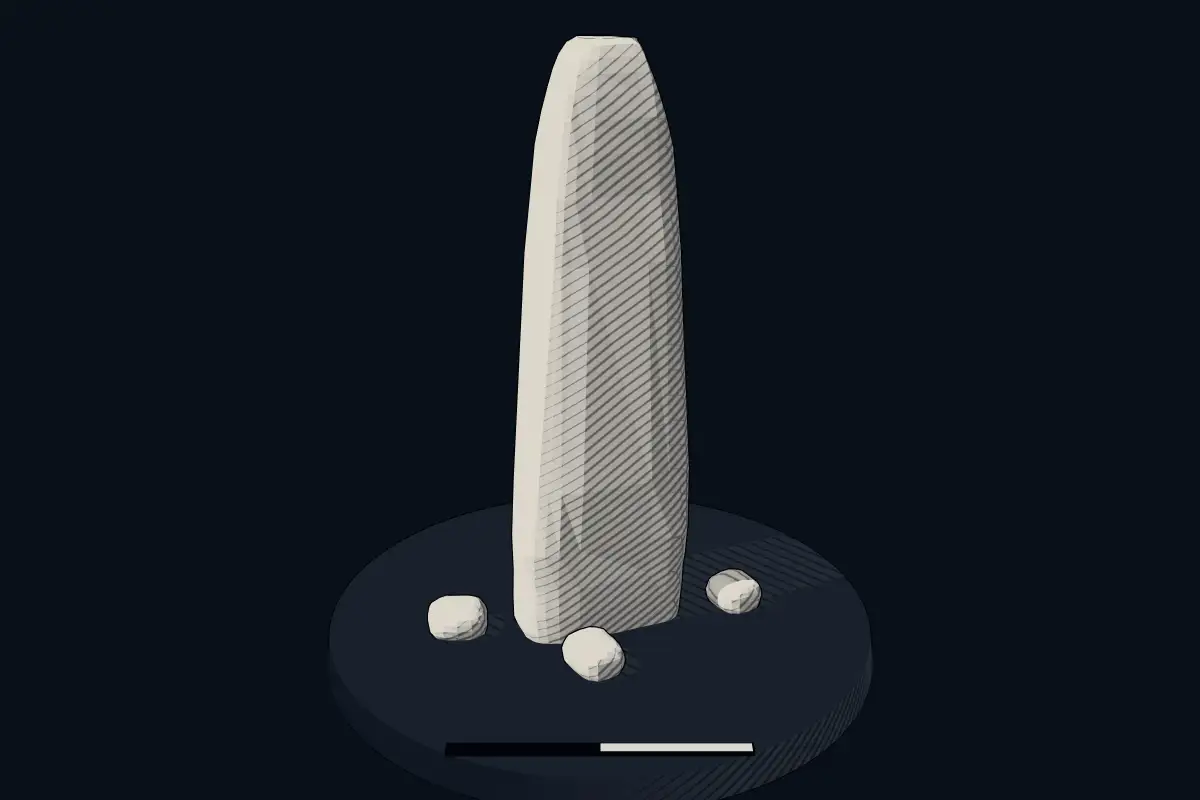
The reconstruction is ours, not a survey: it shows what a monument of this type looks like, at the size the record gives for this one.
Photographs
1 photograph, each with its author and licence
Lore
Evidence & Lore
What the sources actually support — and, kept apart, what has been claimed.
What the evidence supports
Dates
Est. 2800–1800 BCEHow this date was established: Type comparisonTypical range for menhirs in Italy; this site has not been dated itself. Standing stones are associated with the Beaker people of the European late Neolithic and early Bronze Age c. 2800-1800 BC.Source for this date
Where it stands
Italy
The pin marks the monument itself — its exact point.
- Coordinates
- 45°11′22″ N, 7°53′05″ EFor a GPS or map app: 45.18956, 7.88473
Access is as our sources describe it; we have not visited the site to check.
Nearby
The closest sites in the Atlas, by straight line.


Sources
Every record behind this page, with the link it came from.
2 sources behind this page
- 01Wikidata Q48753223wikidata.org
- 02Source for this dateen.wikipedia.org
Image files
Report a correctionWrong date, name, photograph or source? Tell us and it will be put right.
Around this place
The ten nearest sites, by compass
Credit
Text, licence and sources
Text from the Wikipedia article "Menhir de Chivasso" (French), licensed CC BY-SA 4.0; authors are listed in the page history. Reused under CC BY-SA 4.0. Read on Wikipedia · Edit history and authors
- Wikipedia (French): Menhir de ChivassoCC BY-SA 4.0
- Wikidata Q48753223CC0