.jpg/1920px-Dolmen_Stabile_(Giuggianello).jpg 1920w)
Dolmen Stabile
DatedEst. 4000–3000 BCE
Photo Patrice78500 · CC BY-SA 4.0Source file on Wikimedia Commons
Overview
About this site
What the sources say
Le dolmen Stabile est un monument mégalithique préhistorique, datant de l'âge du bronze, entre 2300 et 1750 av. J.-C. Il se situe sur le territoire de Giurdignano, Province de Lecce dans les Pouilles.
Article in FrenchRead on Wikipedia3 min readCC BY-SA 4.0
Where it sits in time
The site's dated range, placed against world reference points.
The scale is logarithmic: each step to the left is about ten times older than the last.
The full article
Dolmen Stabile: the whole story
In briefSources for this section
- Wikipedia (French): Dolmen StabileCC BY-SA 4.0
Sources for this section
- Wikipedia (French): Dolmen StabileCC BY-SA 4.0
Dolmen Stabile is a prehistoric megalithic monument on the territory of Giurdignano, Province of Lecce, in Apulia, Italy. It belongs to the Otrante group of dolmens and menhirs, beside a megalithic limestone outcrop.
The dolmen has a low chamber with an oval, round or polygonal form, typical of the Otrante group. Its irregularly rectangular roof slab measures 1,80 m wide and 2,60 m, with an average thickness of 0,20 m. It rests on seven stacked orthostats and two monolithic pillars, while the corridor is no more than 1,05 m high.
The monument is also known as Letto della Vecchia, Quattromacine or Dolmen di Giuggianello. It was discovered in 1893 by Maggiulli. Its catalogue dating places it between 4000 BCE and 3000 BCE, based on a typological estimate, while the monument is described as dating from the Bronze Age, between 2300 and 1750 av. J.-C.
Together with Dolmen Li Scusi, Stabile forms part of the Giardino megalitico d'Italia at Giurdignano on the Salento peninsula. More generally, monuments of this kind in Apulia often have long passages leading to burial chambers, unlike the simple three-stone tables suggested by the word “dolmen”.
No English Wikipedia article exists for it; the full text below is the French article "Dolmen Stabile", shown in the original language.
Summary in EnglishSources for this section
- Wikipedia (French): Dolmen StabileCC BY-SA 4.0
Sources for this section
- Wikipedia (French): Dolmen StabileCC BY-SA 4.0
Dolmen Stabile is a dolmen in Giuggianello, Italy. A typological estimate: 4000 BCE to 3000 BCE. No English Wikipedia article exists for it; the full text below is the French article "Dolmen Stabile", shown in the original language.
HistoriqueSources for this section
- Wikipedia (French): Dolmen StabileCC BY-SA 4.0
Sources for this section
- Wikipedia (French): Dolmen StabileCC BY-SA 4.0
Il porte aussi les noms de Letto della Vecchia, Quattromacine ou Dolmen di Giuggianello. Il a été découvert en 1893 par Maggiulli.
Avec le Dolmen Li Scusi, fait partie du "Giardino megalitico d'Italia" (jardin mégalithique italien) à Giurdignano sur la péninsule du Salento.
DescriptionSources for this section
- Wikipedia (French): Dolmen StabileCC BY-SA 4.0
Sources for this section
- Wikipedia (French): Dolmen StabileCC BY-SA 4.0
Le dolmen se trouve à côté d'un affleurement mégalithique de roche calcaire. Il fait partie d'un groupe de dolmens et de menhirs, dit « groupe d'Otrante ». Les chambres des dolmens de ce groupe, qui ne mesurent qu'un mètre de haut environ, sont ovales, rondes ou polygonales.
La dalle du plafond est de forme irrégulièrement rectangulaire (1,80 m de large et 2,60 m) avec une épaisseur moyenne de 0,20 m et repose sur sept orthostates superposés et deux piliers monolithiques. La hauteur du couloir ne dépasse pas plus de 1,05 m.
How this page was madeSources for this section
- Wikipedia (French): Dolmen StabileCC BY-SA 4.0
Sources for this section
- Wikipedia (French): Dolmen StabileCC BY-SA 4.0
The summary at the top of this page was written by MiniMax-M3 (2026-11-08) from the cited Wikipedia article “Dolmen Stabile”, translated from French. The numbers in it were checked automatically against the source text. The rest of the page is the article itself, the structured records and computed distances.
Tradition and region
About this kind of monument
Dolmens of Apulia and southern Italy
Italy's dolmens are found in the south, in Apulia, Sardinia and Sicily. In Sicily there are small examples at Mura Pregne near Palermo, at Sciacca, at Monte Bubbonia and at Butera. The most celebrated group lies near Bisceglie, on the Adriatic coast of Apulia, where impressive grave-altars called dolmens were built in the Bronze Age.
The Dolmen della Chianca takes its name from the local dialect word chienghe, meaning stone slab. It has a passage 10 metres long leading to a burial cell of 2 by 1.6 metres. The Italian physiologist and antiquarian Angelo Posso claimed to be the first scientist to describe it, having been directed to it by a local farmer in August 1901, and he called it the largest and best preserved of all Italian dolmens. The long passage makes these Apulian monuments quite different from the simple three-stone tables the word suggests.
A dolmen is a single-chamber megalithic tomb, with upright stones carrying a capstone, and it was often covered by a mound that has since eroded away. The Italian examples are therefore stone skeletons. Their placement in the Bronze Age rests on the form of the monuments and on comparison with similar tombs; it is not tied to radiocarbon dates from the Italian examples themselves, and the Atlas gives a typological range.
Dolmens are only one strand of megalithic building in southern Italy. Sardinia has its own distinct traditions, the domus de janas and the tombs of the giants, which are described in separate articles.
When visiting, look for the long passage and which way it faces, for the roof slabs, and for the way the monument sits in the Apulian countryside close to the coast.
Paraphrased from Wikipedia: Dolmen, Wikipedia: Bisceglie, Wikipedia: List of dolmens · CC BY-SA 4.0
See it in 3D
An interpretive reconstruction of the monument, standing on the real ground at its exact point, under the sun for that place and season. Drag to look around it.
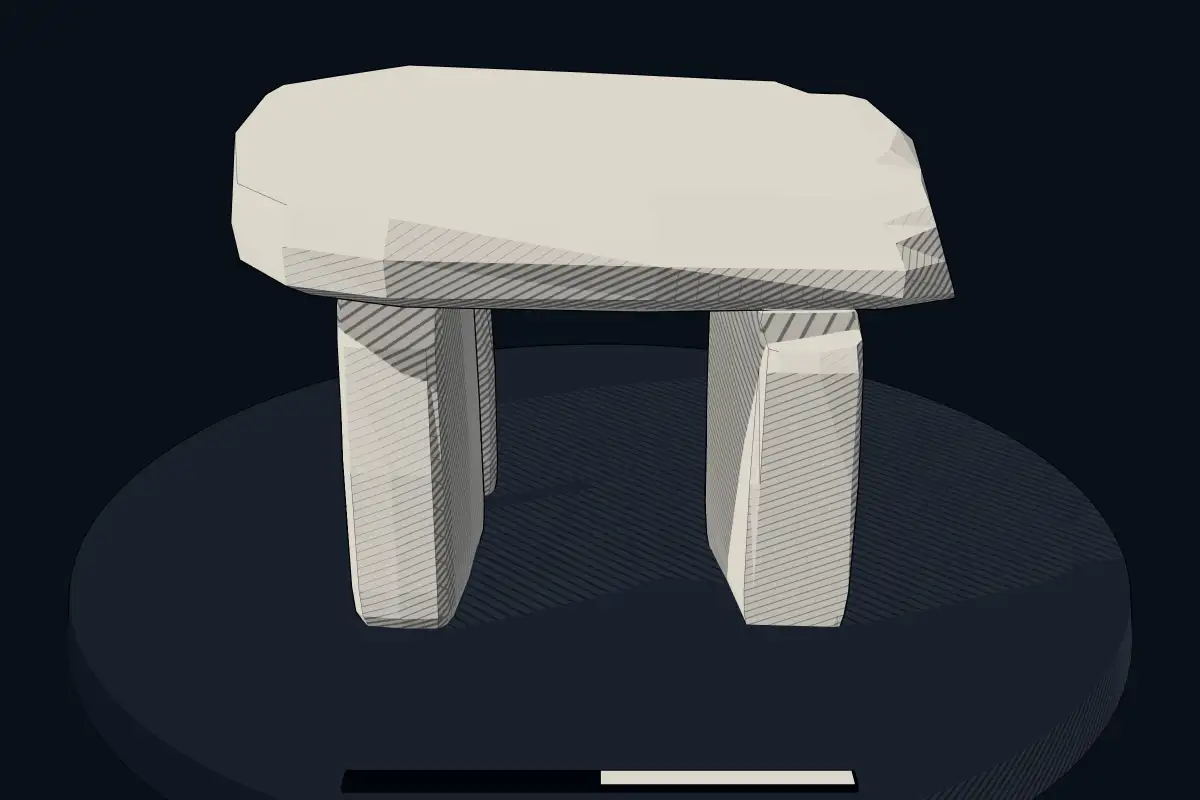
The reconstruction is ours, not a survey: it shows what a monument of this type looks like, at the size the record gives for this one.
Photographs
6 photographs, each with its author and licence
More photographs
Lore
Evidence & Lore
What the sources actually support — and, kept apart, what has been claimed.
What the evidence supports
Dates
Est. 4000–3000 BCEHow this date was established: Type comparisonTypical range for dolmens in Italy; this site has not been dated itself. Most dolmens date from the Late Neolithic period (4000-3000 BCE); the Sardinian stazzoni are a local form of dolmen.Source for this date
Where it stands
Italy
The pin marks the monument itself — its exact point.
- Coordinates
- 40°07′19″ N, 18°24′35″ EFor a GPS or map app: 40.12181, 18.40969
Access is as our sources describe it; we have not visited the site to check.
Nearby
The closest sites in the Atlas, by straight line.




Sources
Every record behind this page, with the link it came from.
2 sources behind this page
- 01Wikidata Q21037351wikidata.org
- 02Source for this dateen.wikipedia.org
Image files
- Dolmen Stabile (Giuggianello).jpgPatrice78500CC BY-SA 4.0
- Dolmen Stabile Giuggianello.jpgThe original uploader was Colar at Italian Wikipedia .CC BY-SA 3.0
- 10- Dolmen Stabile a Giuggianello -FG01.jpgFabrizio GarrisiCC BY-SA 4.0
- 10- Dolmen Stabile a Giuggianello -FG02.jpgFabrizio GarrisiCC BY-SA 4.0
- Dolmen Stabile (Giuggianello) - détail d'une inscription sur le site.jpgPatrice78500CC BY-SA 4.0
- Dolmen Stabile (Giuggianello) - détail d'une pierre gravée sur le site.jpgPatrice78500CC BY-SA 4.0
Report a correctionWrong date, name, photograph or source? Tell us and it will be put right.
Around this place
The ten nearest sites, by compass
- menhir Vicinanze 21.0 km E
- menhir Vicinanze 11.2 km E
- underground oil mill in via Borgo1.4 km E
- Menhir San Vicenzo (Giurdignano)1.5 km E
- Menhir San Paolo (Giurdignano)1.5 km E
- Dolmen Li Scusi3.5 km SE
- menhir Croce di Sant'Antonio3.8 km SW
- menhir Spruno6.3 km W
- menhir Bagnolo6.5 km NW
- Torre Pinta hypogeum6.8 km E
Credit
Text, licence and sources
Text from the Wikipedia article "Dolmen Stabile" (French), licensed CC BY-SA 4.0; authors are listed in the page history. Reused under CC BY-SA 4.0. Read on Wikipedia · Edit history and authors
- Wikipedia (French): Dolmen StabileCC BY-SA 4.0
- Wikidata Q21037351CC0