.jpg/1920px-Torralba%2C_dolmen_di_Prunaiola_(04).jpg 1920w)
dolmen of Prunaiola
DatedEst. 4000–3000 BCE
Photo Gianni Careddu · CC BY-SA 4.0Source file on Wikimedia Commons
Overview
About this site
What the sources say
Il dolmen di Prunaiola è un monumento archeologico funerario situato su un piccolo pianoro in territorio di Torralba, nella Sardegna nord-occidentale. È ubicato poco distante della strada statale 131 Carlo Felice e nelle immediate vicinanze della tomba dei giganti di Cabu Abbas e di due domus de janas, in un'area ricca di testimonianze archeologiche che documentano la continuità dell'insediamento umano fin dalla preistoria.
Article in ItalianRead on Wikipedia3 min readCC BY-SA 4.0
Where it sits in time
The site's dated range, placed against world reference points.
The scale is logarithmic: each step to the left is about ten times older than the last.
The full article
dolmen of Prunaiola: the whole story
In briefSources for this section
- Wikipedia (Italian): Dolmen di PrunaiolaCC BY-SA 4.0
Sources for this section
- Wikipedia (Italian): Dolmen di PrunaiolaCC BY-SA 4.0
The Dolmen of Prunaiola is a prehistoric funerary monument on a small plateau near Torralba in north-western Sardinia, Italy. It stands close to the Carlo Felice state road, the nearby Giants’ Tomb of Cabu Abbas, and two rock-cut tombs known as domus de janas. The surrounding area contains evidence of human occupation extending back into prehistory.
Built from trachite blocks, the monument served as a collective burial place and a place of worship during the Copper Age. It follows a trilithic design, with two upright stones supporting a horizontal slab. The large covering slab remains in place, resting on two natural rock outcrops.
A small female clay figurine measuring 3.15 by 2.2 centimetres was found nearby and is held by the G. A. Sanna National Archaeological and Ethnographic Museum in Sassari. The monument is associated with the Ozieri culture of the Late Neolithic, broadly dated to between 3500/3300 and 2900 BCE.
The site is generally dated by typological comparison to about 4000–3000 BCE. It is part of the megalithic tradition found across Europe and especially prominent in Sardinia during the Copper Age.
No English Wikipedia article exists for it; the full text below is the Italian article "Dolmen di Prunaiola", shown in the original language.
Summary in EnglishSources for this section
- Wikipedia (Italian): Dolmen di PrunaiolaCC BY-SA 4.0
Sources for this section
- Wikipedia (Italian): Dolmen di PrunaiolaCC BY-SA 4.0
dolmen of Prunaiola is a dolmen in Torralba, Italy. Wikidata describes it as: ancient tomb in Torralba, Sardinia, Italy. A typological estimate: 4000 BCE to 3000 BCE. Elevation: 370 m. No English Wikipedia article exists for it; the full text below is the Italian article "Dolmen di Prunaiola", shown in the original language.
DescrizioneSources for this section
- Wikipedia (Italian): Dolmen di PrunaiolaCC BY-SA 4.0
Sources for this section
- Wikipedia (Italian): Dolmen di PrunaiolaCC BY-SA 4.0
Realizzato in blocchi di trachite con funzione di sepoltura collettiva e, insieme, di luogo di culto è un classico esempio della cultura del megalitismo che ha caratterizzato l'Europa, e l'Isola in particolare, durante l'età del rame (III millennio a.C.). Il dolmen è eseguito secondo il sistema trilitico (dal greco tri, tre, e lithos, pietra) - il più antico schema architettonico conosciuto - caratterizzato da elementi portanti disposti in verticale che ne sorreggono degli altri poggiati di piatto.
Allo stato attuale il sepolcro conserva il grosso lastrone di copertura che risulta posizionato su due affioramenti rocciosi.
In prossimità del dolmen venne ritrovata una statuina femminile in argilla di 3,15 x 2,2 cm di altezza conservata al Museo nazionale archeologico ed etnografico G. A. Sanna di Sassari.
Il monumento può essere ascritto alla cultura di Ozieri, nel Neolitico recente (3500/3300-2900 a.C.).
Altri progettiSources for this section
- Wikipedia (Italian): Dolmen di PrunaiolaCC BY-SA 4.0
Sources for this section
- Wikipedia (Italian): Dolmen di PrunaiolaCC BY-SA 4.0
Wikimedia Commons contiene immagini o altri file sul dolmen di Prunaiola
How this page was madeSources for this section
- Wikipedia (Italian): Dolmen di PrunaiolaCC BY-SA 4.0
Sources for this section
- Wikipedia (Italian): Dolmen di PrunaiolaCC BY-SA 4.0
The summary at the top of this page was written by MiniMax-M3 (2026-11-08) from the cited Wikipedia article “Dolmen di Prunaiola”, translated from Italian. The numbers in it were checked automatically against the source text. The rest of the page is the article itself, the structured records and computed distances.
Tradition and region
About this kind of monument
Dolmens of Apulia and southern Italy
Italy's dolmens are found in the south, in Apulia, Sardinia and Sicily. In Sicily there are small examples at Mura Pregne near Palermo, at Sciacca, at Monte Bubbonia and at Butera. The most celebrated group lies near Bisceglie, on the Adriatic coast of Apulia, where impressive grave-altars called dolmens were built in the Bronze Age.
The Dolmen della Chianca takes its name from the local dialect word chienghe, meaning stone slab. It has a passage 10 metres long leading to a burial cell of 2 by 1.6 metres. The Italian physiologist and antiquarian Angelo Posso claimed to be the first scientist to describe it, having been directed to it by a local farmer in August 1901, and he called it the largest and best preserved of all Italian dolmens. The long passage makes these Apulian monuments quite different from the simple three-stone tables the word suggests.
A dolmen is a single-chamber megalithic tomb, with upright stones carrying a capstone, and it was often covered by a mound that has since eroded away. The Italian examples are therefore stone skeletons. Their placement in the Bronze Age rests on the form of the monuments and on comparison with similar tombs; it is not tied to radiocarbon dates from the Italian examples themselves, and the Atlas gives a typological range.
Dolmens are only one strand of megalithic building in southern Italy. Sardinia has its own distinct traditions, the domus de janas and the tombs of the giants, which are described in separate articles.
When visiting, look for the long passage and which way it faces, for the roof slabs, and for the way the monument sits in the Apulian countryside close to the coast.
Paraphrased from Wikipedia: Dolmen, Wikipedia: Bisceglie, Wikipedia: List of dolmens · CC BY-SA 4.0
From the article
Dated moments in the story
- 2900 BCE
Il monumento può essere ascritto alla cultura di Ozieri, nel Neolitico recente (3500/3300-2900 a.C.).
Source
See it in 3D
An interpretive reconstruction of the monument, standing on the real ground at its exact point, under the sun for that place and season. Drag to look around it.
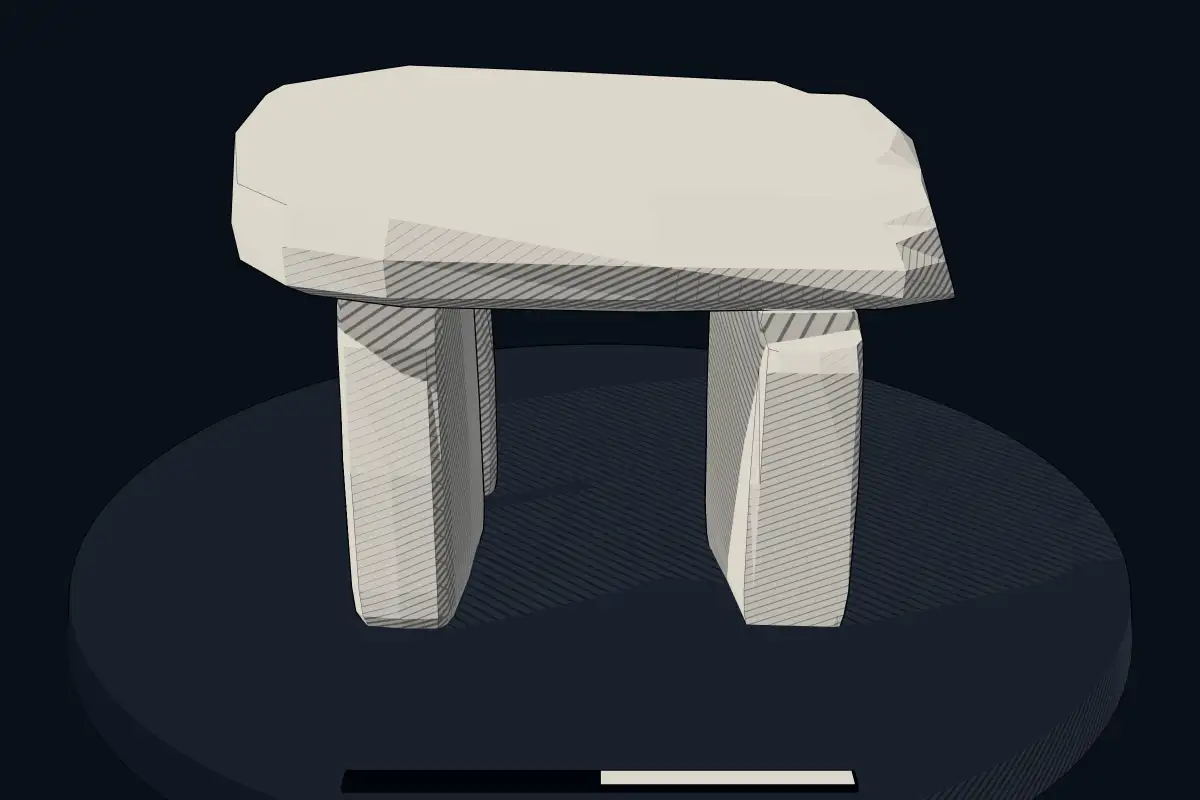
The reconstruction is ours, not a survey: it shows what a monument of this type looks like, at the size the record gives for this one.
Photographs
6 photographs, each with its author and licence
More photographs
Lore
Evidence & Lore
What the sources actually support — and, kept apart, what has been claimed.
What the evidence supports
Dates
Est. 4000–3000 BCEHow this date was established: Type comparisonTypical range for dolmens in Italy; this site has not been dated itself. Most dolmens date from the Late Neolithic period (4000-3000 BCE); the Sardinian stazzoni are a local form of dolmen.Source for this date
Where it stands
Italy
The pin marks the monument itself — its exact point.
- Coordinates
- 40°29′22″ N, 8°45′09″ EFor a GPS or map app: 40.48946, 8.75252
Access is as our sources describe it; we have not visited the site to check.
Nearby
The closest sites in the Atlas, by straight line.


Sources
Every record behind this page, with the link it came from.
2 sources behind this page
- 01Wikidata Q30302894wikidata.org
- 02Source for this dateen.wikipedia.org
Image files
- Torralba, dolmen di Prunaiola (04).jpgGianni CaredduCC BY-SA 4.0
- Torralba, dolmen di Prunaiola (01).jpgGianni CaredduCC BY-SA 4.0
- Torralba, dolmen di Prunaiola (02).jpgGianni CaredduCC BY-SA 4.0
- Torralba, dolmen di Prunaiola (03).jpgGianni CaredduCC BY-SA 4.0
- Torralba, dolmen di Prunaiola (05).jpgGianni CaredduCC BY-SA 4.0
- Torralba, dolmen di Prunaiola (08).jpgGianni CaredduCC BY-SA 4.0
Report a correctionWrong date, name, photograph or source? Tell us and it will be put right.
Around this place
The ten nearest sites, by compass
Credit
Text, licence and sources
Text from the Wikipedia article "Dolmen di Prunaiola" (Italian), licensed CC BY-SA 4.0; authors are listed in the page history. Reused under CC BY-SA 4.0. Read on Wikipedia · Edit history and authors
- Wikipedia (Italian): Dolmen di PrunaiolaCC BY-SA 4.0
- Wikidata Q30302894CC0