
Dolmen di Albarosa
DatedEst. 4000–3000 BCE
Photo Geppi Simone · CC BY-SA 3.0Source file on Wikimedia Commons
Overview
About this site
Overview
The Dolmen di Albarosa is a prehistoric megalithic monument of the Bronze Age at Bisceglie, in Apulia, Italy, 109 m above sea level. It is a corridor dolmen set in an elliptical tumulus 19 m long and 16 m wide.
It was discovered in 1909 inside a large stone cairn (specchione). Excavation in 1961 to 1965 dated the tumulus to the end of the Middle Bronze Age and the beginning of the Recent Bronze Age, the fourteenth to thirteenth century BCE.
Read on Wikipedia3 min readCC BY-SA 4.0
Where it sits in time
The site's dated range, placed against world reference points.
The scale is logarithmic: each step to the left is about ten times older than the last.
Article
Dolmen di Albarosa
The dolmen is of the corridor type within an elliptical tumulus 19 m long and 16 m wide, with the dromos oriented along an east-west axis.
DescriptionSources for this section
- Wikipedia (Italian): Dolmen di AlbarosaCC BY-SA 4.0
Sources for this section
- Wikipedia (Italian): Dolmen di AlbarosaCC BY-SA 4.0
The dolmen is of the corridor type within an elliptical tumulus 19 m long and 16 m wide, with the dromos oriented along an east-west axis. The corridor walls are formed of a series of stone slabs. The corridor has an average height of 1.80 m and is about 7 m long, and it is divided into compartments by transverse slabs of local limestone. The covering of the dromos is missing. The burial structure is set on an artificial platform of earth and stones about 0.50 m high.
The monument is reached by following the S.P. 86 Bisceglie-Ruvo di Puglia for about 4.7 km towards Ruvo di Puglia and taking a rural road on the right towards Lama Santa Croce. It lies a little over 1 km from the Dolmen della Chianca and about 1.2 km from the Dolmen Frisari.
Research historySources for this section
- Wikipedia (Italian): Dolmen di AlbarosaCC BY-SA 4.0
Sources for this section
- Wikipedia (Italian): Dolmen di AlbarosaCC BY-SA 4.0
The megalith was discovered in 1909 by the archaeologist Francesco Samarelli, at the same time as the investigations of the nearby Dolmen della Chianca and Dolmen Frisari. At the time a huge heap of stones, known as the specchione of Albarosa, was visible, and the tomb was found inside it. The specchione was originally elliptical in plan and was altered over time because its stone was used to build adjoining trulli. It was about 19 m long, 16 m wide and about 5 m high.
ExcavationsSources for this section
- Wikipedia (Italian): Dolmen di AlbarosaCC BY-SA 4.0
Sources for this section
- Wikipedia (Italian): Dolmen di AlbarosaCC BY-SA 4.0
During Gervasio's excavations fragments of pottery, a jug in coarse fabric, hut plaster and stone tools were found, belonging to an earlier Neolithic settlement.
Further investigations between 1961 and 1965, directed by Francesco Biancofiore, showed that the gallery, after receiving the burials and their grave goods, was entirely covered by the tumulus. Fragments of pottery and human bone were found in the dromos and the burial cell. From these finds Biancofiore concluded that the tomb had been plundered over time, and he dated the tumulus to the end of the Middle Bronze Age and the beginning of the Recent Bronze Age (fourteenth to thirteenth century BCE).
ConservationSources for this section
- Wikipedia (Italian): Dolmen di AlbarosaCC BY-SA 4.0
Sources for this section
- Wikipedia (Italian): Dolmen di AlbarosaCC BY-SA 4.0
In 1987 works were carried out to stabilise the gallery, which was in a precarious condition. They were overseen by Francesca Radina of the Soprintendenza Archeologica della Puglia.
NameSources for this section
- Wikipedia (Italian): Dolmen di AlbarosaCC BY-SA 4.0
Sources for this section
- Wikipedia (Italian): Dolmen di AlbarosaCC BY-SA 4.0
The name Albarosa comes from the casale of Albarosa and the plateau of the same name, close to the ravine of the Lama di Santa Croce and owned by the Berarducci family, where the enormous specchione stood in which the dolmen was found.
Tradition and region
About this kind of monument
Dolmens of Apulia and southern Italy
Italy's dolmens are found in the south, in Apulia, Sardinia and Sicily. In Sicily there are small examples at Mura Pregne near Palermo, at Sciacca, at Monte Bubbonia and at Butera. The most celebrated group lies near Bisceglie, on the Adriatic coast of Apulia, where impressive grave-altars called dolmens were built in the Bronze Age.
The Dolmen della Chianca takes its name from the local dialect word chienghe, meaning stone slab. It has a passage 10 metres long leading to a burial cell of 2 by 1.6 metres. The Italian physiologist and antiquarian Angelo Posso claimed to be the first scientist to describe it, having been directed to it by a local farmer in August 1901, and he called it the largest and best preserved of all Italian dolmens. The long passage makes these Apulian monuments quite different from the simple three-stone tables the word suggests.
A dolmen is a single-chamber megalithic tomb, with upright stones carrying a capstone, and it was often covered by a mound that has since eroded away. The Italian examples are therefore stone skeletons. Their placement in the Bronze Age rests on the form of the monuments and on comparison with similar tombs; it is not tied to radiocarbon dates from the Italian examples themselves, and the Atlas gives a typological range.
Dolmens are only one strand of megalithic building in southern Italy. Sardinia has its own distinct traditions, the domus de janas and the tombs of the giants, which are described in separate articles.
When visiting, look for the long passage and which way it faces, for the roof slabs, and for the way the monument sits in the Apulian countryside close to the coast.
Paraphrased from Wikipedia: Dolmen, Wikipedia: Bisceglie, Wikipedia: List of dolmens · CC BY-SA 4.0
From the article
Dated moments in the story
- 1909
Il megalite fu scoperto nel 1909 dall'archeologo Francesco Samarelli, nello stesso periodo in cui si svolsero le indagini archeologiche degli altri due dolmen ad esso vicini: il Dolmen della Chianca ed il Dolmen Frisari.
Source - 1961
Tra il 1961 ed il 1965 si svolsero ulteriori indagini archeologiche curate da Francesco Biancofiore, il quale poté affermare che la galleria, dopo aver accolto le deposizioni umane ed i relativi corredi, venne integralmente ricoperta dal tumulo.
Source - 1987
Nel 1987 furono effettuati interventi di sistemazione della galleria, che versava in condizioni precarie, seguiti da Francesca Radina della soprintendenza Archeologica della Puglia.
Source
See it in 3D
An interpretive reconstruction of the monument, standing on the real ground at its exact point, under the sun for that place and season. Drag to look around it.
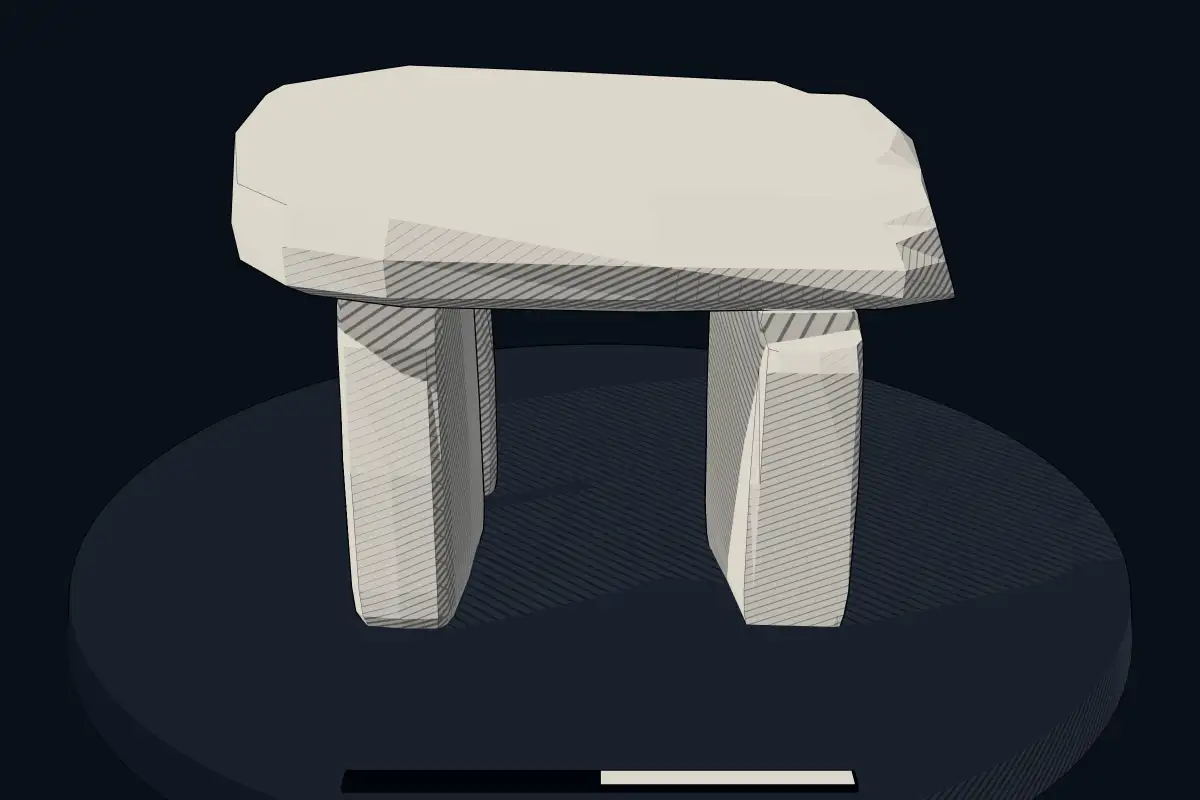
The reconstruction is ours, not a survey: it shows what a monument of this type looks like, at the size the record gives for this one.
Photographs
4 photographs, each with its author and licence
More photographs
Lore
Evidence & Lore
What the sources actually support — and, kept apart, what has been claimed.
What the evidence supports
Dates
Est. 4000–3000 BCEHow this date was established: Type comparisonTypical range for dolmens in Italy; this site has not been dated itself. Most dolmens date from the Late Neolithic period (4000-3000 BCE); the Sardinian stazzoni are a local form of dolmen.Source for this date
Where it stands
Italy
The pin marks the monument itself — its exact point.
- Coordinates
- 41°11′08″ N, 16°29′06″ EFor a GPS or map app: 41.18563, 16.48497
Access is as our sources describe it; we have not visited the site to check.
Nearby
The closest sites in the Atlas, by straight line.


Sources
Every record behind this page, with the link it came from.
2 sources behind this page
- 01Wikidata Q3712687wikidata.org
- 02Source for this dateen.wikipedia.org
Image files
- Bisceglie dolmen Albarosa 2.JPGGeppi SimoneCC BY-SA 3.0
- Bisceglie dolmen Albarosa 3.JPGGeppi SimoneCC BY-SA 3.0
- Bisceglie dolmen Albarosa 6.jpgGeppi SimoneCC BY-SA 3.0
- Bisceglie dolmen Albarosa 5.jpgGeppi SimoneCC BY-SA 3.0
Report a correctionWrong date, name, photograph or source? Tell us and it will be put right.
Around this place
The ten nearest sites, by compass
Credit
Text, licence and sources
Adapted from the Wikipedia article "Dolmen di Albarosa" (Italian), licensed CC BY-SA 4.0; authors are listed in the page history. Reused under CC BY-SA 4.0. Read on Wikipedia · Edit history and authors
- Wikipedia (Italian): Dolmen di AlbarosaCC BY-SA 4.0
- Wikidata Q3712687CC0