
dolmen Chianca
DatedEst. 4000–3000 BCE
Photo Carlotoma16 · CC BY-SA 4.0Source file on Wikimedia Commons
Overview
About this site
Overview
Dolmen Chianca is a dolmen in Maglie, Italy. It lies at 40.1103° N, 18.2941° E.
Catalogue recordSources and licences
Where it sits in time
The site's dated range, placed against world reference points.
The scale is logarithmic: each step to the left is about ten times older than the last.
Article
dolmen Chianca
ContextSources for this section
- en.wikipedia.orgCC BY-SA 4.0
- en.wikipedia.orgCC BY-SA 4.0
- en.wikipedia.orgCC BY-SA 4.0
Sources for this section
- en.wikipedia.orgCC BY-SA 4.0
- en.wikipedia.orgCC BY-SA 4.0
- en.wikipedia.orgCC BY-SA 4.0
Italy's dolmens are found in the south, in Apulia, Sardinia and Sicily. In Sicily there are small examples at Mura Pregne near Palermo, at Sciacca, at Monte Bubbonia and at Butera. The most celebrated group lies near Bisceglie, on the Adriatic coast of Apulia, where impressive grave-altars called dolmens were built in the Bronze Age.
The Dolmen della Chianca takes its name from the local dialect word chienghe, meaning stone slab. It has a passage 10 metres long leading to a burial cell of 2 by 1.6 metres. The Italian physiologist and antiquarian Angelo Posso claimed to be the first scientist to describe it, having been directed to it by a local farmer in August 1901, and he called it the largest and best preserved of all Italian dolmens. The long passage makes these Apulian monuments quite different from the simple three-stone tables the word suggests. The regional background, “Dolmens of Apulia and southern Italy”, is given below.
DatingSources for this section
- en.wikipedia.orgCC BY-SA 4.0
Sources for this section
- en.wikipedia.orgCC BY-SA 4.0
No scientific date has been published for this site. Monuments of this type in Italy are generally dated 4000 BCE to 3000 BCE; the site itself may fall inside or outside that range.
Most dolmens date from the Late Neolithic period (4000-3000 BCE); the Sardinian stazzoni are a local form of dolmen.
Setting
12 other recorded monuments lie within 10 km (1 within 1 km, 7 within 5 km), 6 of them of the same type. In Maglie, Italy, 5 of the 8 recorded monuments are of this type.
The nearest recorded monuments are Dolmen Canali (0.5 km west, dolmen); menhir delle Franite (1.4 km east, menhir); dolmen Muntarrune (1.7 km north-west, dolmen); Dolmen Grotta Fronte (2.5 km north-west, dolmen).
ProtectionSources for this section
Sources for this section
Heritage status: Italian national heritage.
Tradition and region
About this kind of monument
Dolmens of Apulia and southern Italy
Italy's dolmens are found in the south, in Apulia, Sardinia and Sicily. In Sicily there are small examples at Mura Pregne near Palermo, at Sciacca, at Monte Bubbonia and at Butera. The most celebrated group lies near Bisceglie, on the Adriatic coast of Apulia, where impressive grave-altars called dolmens were built in the Bronze Age.
The Dolmen della Chianca takes its name from the local dialect word chienghe, meaning stone slab. It has a passage 10 metres long leading to a burial cell of 2 by 1.6 metres. The Italian physiologist and antiquarian Angelo Posso claimed to be the first scientist to describe it, having been directed to it by a local farmer in August 1901, and he called it the largest and best preserved of all Italian dolmens. The long passage makes these Apulian monuments quite different from the simple three-stone tables the word suggests.
A dolmen is a single-chamber megalithic tomb, with upright stones carrying a capstone, and it was often covered by a mound that has since eroded away. The Italian examples are therefore stone skeletons. Their placement in the Bronze Age rests on the form of the monuments and on comparison with similar tombs; it is not tied to radiocarbon dates from the Italian examples themselves, and the Atlas gives a typological range.
Dolmens are only one strand of megalithic building in southern Italy. Sardinia has its own distinct traditions, the domus de janas and the tombs of the giants, which are described in separate articles.
When visiting, look for the long passage and which way it faces, for the roof slabs, and for the way the monument sits in the Apulian countryside close to the coast.
Paraphrased from Wikipedia: Dolmen, Wikipedia: Bisceglie, Wikipedia: List of dolmens · CC BY-SA 4.0
See it in 3D
An interpretive reconstruction of the monument, standing on the real ground at its exact point, under the sun for that place and season. Drag to look around it.
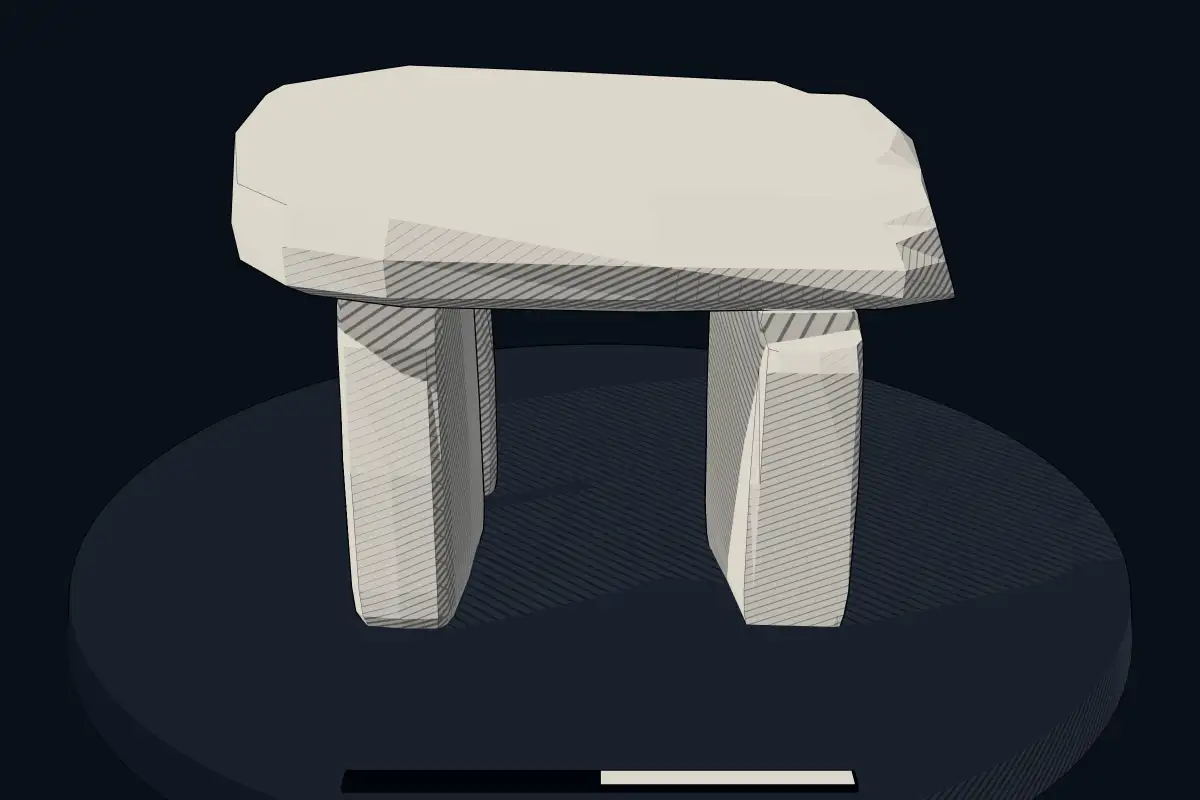
The reconstruction is ours, not a survey: it shows what a monument of this type looks like, at the size the record gives for this one.
Photographs
3 photographs, each with its author and licence
More photographs
Lore
Evidence & Lore
What the sources actually support — and, kept apart, what has been claimed.
What the evidence supports
Dates
Est. 4000–3000 BCEHow this date was established: Type comparisonTypical range for dolmens in Italy; this site has not been dated itself. Most dolmens date from the Late Neolithic period (4000-3000 BCE); the Sardinian stazzoni are a local form of dolmen.Source for this date
Where it stands
Italy
The pin marks the monument itself — its exact point.
- Coordinates
- 40°06′37″ N, 18°17′39″ EFor a GPS or map app: 40.11029, 18.29409
Access is as our sources describe it; we have not visited the site to check.
Nearby
The closest sites in the Atlas, by straight line.


Sources
Every record behind this page, with the link it came from.
2 sources behind this page
- 01Wikidata Q29896697wikidata.org
- 02Source for this dateen.wikipedia.org
Image files
- Dolmen Chianca 1.jpgCarlotoma16CC BY-SA 4.0
- Dolmen Chianca 2.jpgCarlotoma16CC BY-SA 4.0
- Dolmen Chianca 3.jpgCarlotoma16CC BY-SA 4.0
Report a correctionWrong date, name, photograph or source? Tell us and it will be put right.
Around this place
The ten nearest sites, by compass
Credit
Text, licence and sources
Compiled from open records (Wikidata, CC0; OpenStreetMap, ODbL) and a regional background article based on Wikipedia (CC BY-SA 4.0).
- Wikidata Q29896697CC0
- en.wikipedia.orgCC BY-SA 4.0
- en.wikipedia.orgCC BY-SA 4.0
- en.wikipedia.orgCC BY-SA 4.0