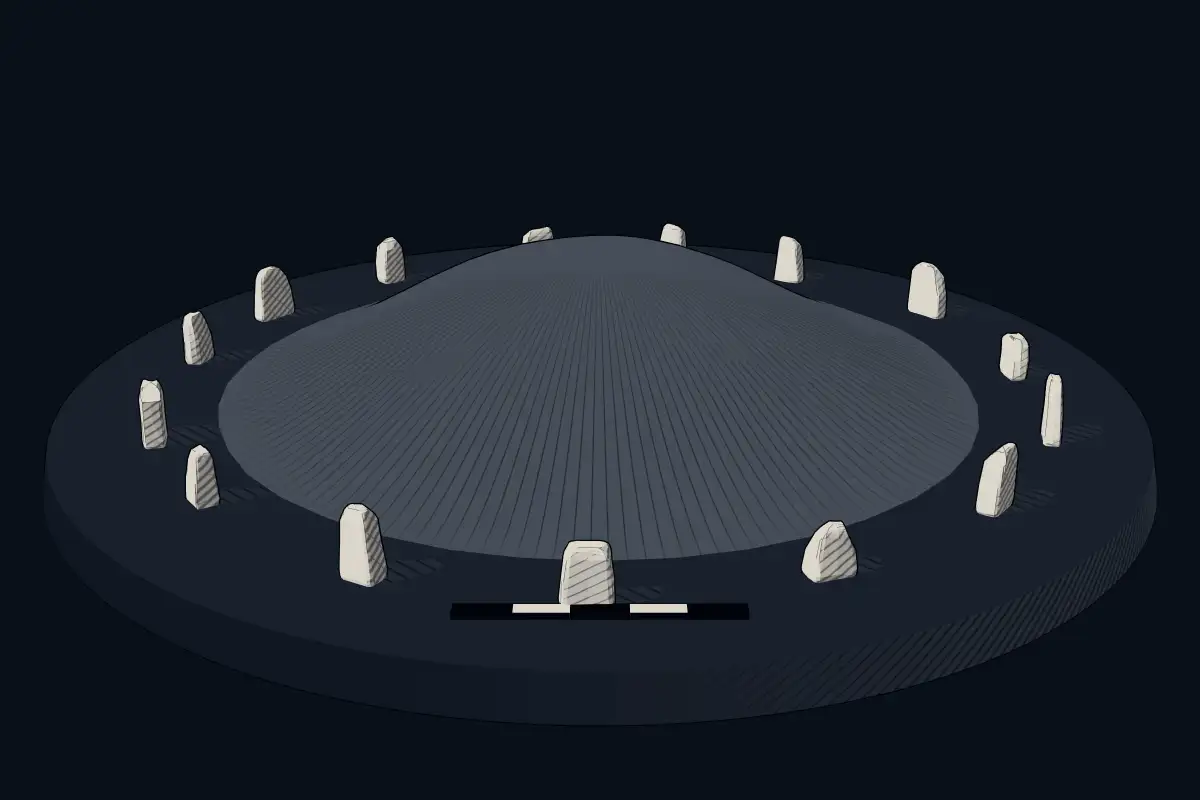
Megalithic mound (tumulus with integral stones)
Corvaro tumulus
No licensed photograph yetWe have no photograph we may publish for this site, so the interpretive 3D view leads instead.
Overview
About this site
What the sources say
Corvaro tumulus is a megalithic mound in Corvaro, Italy. Its entries are Wikidata item Q127667481; the position in the catalogue is 42.1928° N, 13.2612° E.
Built from structured records, not from an articleSources and licences
The full article
About Corvaro tumulus
This kind of monument hereSources for this section
- en.wikipedia.orgCC BY-SA 4.0
- en.wikipedia.orgCC BY-SA 4.0
- en.wikipedia.orgCC BY-SA 4.0
- en.wikipedia.orgCC BY-SA 4.0
- en.wikipedia.orgCC BY-SA 4.0
- en.wikipedia.orgCC BY-SA 4.0
Sources for this section
- en.wikipedia.orgCC BY-SA 4.0
- en.wikipedia.orgCC BY-SA 4.0
- en.wikipedia.orgCC BY-SA 4.0
- en.wikipedia.orgCC BY-SA 4.0
- en.wikipedia.orgCC BY-SA 4.0
- en.wikipedia.orgCC BY-SA 4.0
Many of Italy's tumuli are the mounded tombs of the Etruscans, the people of Etruria in central Italy. At Cerveteri, ancient Caere, the Banditaccia Necropolis contains the most important tumulus tombs and chambers known. They are cut from the soft volcanic rock, tufa, and most echo Greek architecture in their carved details. Caere was one of the city-states of the Etruscan League; at its height, around 600 BCE, its population was perhaps 25,000 to 40,000, and the size of its graves reflects the wealth of its leading families. The full article, “Etruscan tumuli of Italy”, follows below under About this kind of monument.
Dating
No date has been recorded for this site, and the Atlas does not guess one. Where a regional range exists for this kind of monument it is given in the notes on this page, as background and not as a date for this site.
Landscape and neighbours
No other catalogued site lies within 10 km of it. The nearest is Lu Termine, 22.0 km to the east. It is one of 1 megalithic mound records among the 1 sites catalogued in Corvaro, Italy.
The closest catalogued sites are Lu Termine (22.0 km east, menhir); Mura (55.7 km south, cyclopean masonry); Sala Ipogea (63.3 km north-east, hypogeum); Hypogeum of the Garlands (67.3 km south-west, hypogeum). The catalogue is assembled from open records and is not complete, so unrecorded monuments may lie closer.
Records and protectionSources for this section
Sources for this section
The open records used here carry no heritage designation for the site, which says nothing either way about its legal status. The open records for it are Wikidata (Q127667481), where corrections and further identifiers can be added. Access varies from open common land to private fields; check local access rules, ask where needed, and take care not to damage the monument.
How this page was madeSources for this section
Sources for this section
Nothing on this page was written by an AI model: it is assembled by program from Wikidata (CC0) and the regional article “Etruscan tumuli of Italy”, written for the Atlas from the Wikipedia articles it cites (CC BY-SA 4.0), with distances and counts calculated from the catalogue coordinates.
Tradition and region
About this kind of monument
Etruscan tumuli of Italy
Many of Italy's tumuli are the mounded tombs of the Etruscans, the people of Etruria in central Italy. At Cerveteri, ancient Caere, the Banditaccia Necropolis contains the most important tumulus tombs and chambers known. They are cut from the soft volcanic rock, tufa, and most echo Greek architecture in their carved details. Caere was one of the city-states of the Etruscan League; at its height, around 600 BCE, its population was perhaps 25,000 to 40,000, and the size of its graves reflects the wealth of its leading families.
The Regolini-Galassi tomb at Cerveteri, dated to about 680 to 650 BCE, is one of the wealthiest Etruscan family tombs. It has two burial chambers on either side of a corridor 37 metres long; the lower part is cut into tufa and the upper part is built of square stone blocks, each course overhanging the one below to make a rough vault. At Populonia, on the coast, monumental tumuli with a cylindrical base (crepidines) and a false dome were built from the second half of the ninth century BCE; their wealth is thought to reflect the exploitation of inland mineral resources, and by the late seventh century their size became more uniform, which has been read as a reorganisation of the community. At Tarquinia the Monterozzi necropolis has some 6,000 tombs, at least 200 with painted walls, and many were tumulus tombs with chambers carved in the rock below.
Dating comes from the objects in the tombs and from the architecture itself. Many tombs were looted in antiquity or in later centuries.
When visiting, walk the Banditaccia necropolis, where many of the tombs are visible at close range, and compare the round tumulus with the rock-cut chamber beneath.
Paraphrased from Wikipedia: Cerveteri, Wikipedia: Regolini-Galassi tomb, Wikipedia: Tarquinia, Wikipedia: Populonia, Wikipedia: Etruscan civilization, Wikipedia: Tumulus · CC BY-SA 4.0
See it in 3D
An interpretive reconstruction of the monument, standing on the real ground at its exact point, under the sun for that place and season. Drag to look around it.
The reconstruction is ours, not a survey: it shows what a monument of this type looks like, at the size the record gives for this one.
Where it stands
Italy
The pin marks the monument itself — its exact point.
- Coordinates
- 42°11′34″ N, 13°15′40″ EFor a GPS or map app: 42.19276, 13.26121
Access is as our sources describe it; we have not visited the site to check.
Nearby
The closest sites in the Atlas, by straight line.


Sources
Every record behind this page, with the link it came from.
1 source behind this page
- 01Wikidata Q127667481wikidata.org
Report a correctionWrong date, name, photograph or source? Tell us and it will be put right.
Around this place
The ten nearest sites, by compass
Credit
Text, licence and sources
This page is assembled from open records (Wikidata, CC0; OpenStreetMap, ODbL) and a tradition article paraphrasing Wikipedia (CC BY-SA 4.0). No article exists for this site, and nothing here is written by a model.
- Wikidata Q127667481CC0
- en.wikipedia.orgCC BY-SA 4.0
- en.wikipedia.orgCC BY-SA 4.0
- en.wikipedia.orgCC BY-SA 4.0
- en.wikipedia.orgCC BY-SA 4.0
- en.wikipedia.orgCC BY-SA 4.0
- en.wikipedia.orgCC BY-SA 4.0