.jpg/1920px-DoorusDemesne_(3).jpg 1920w)
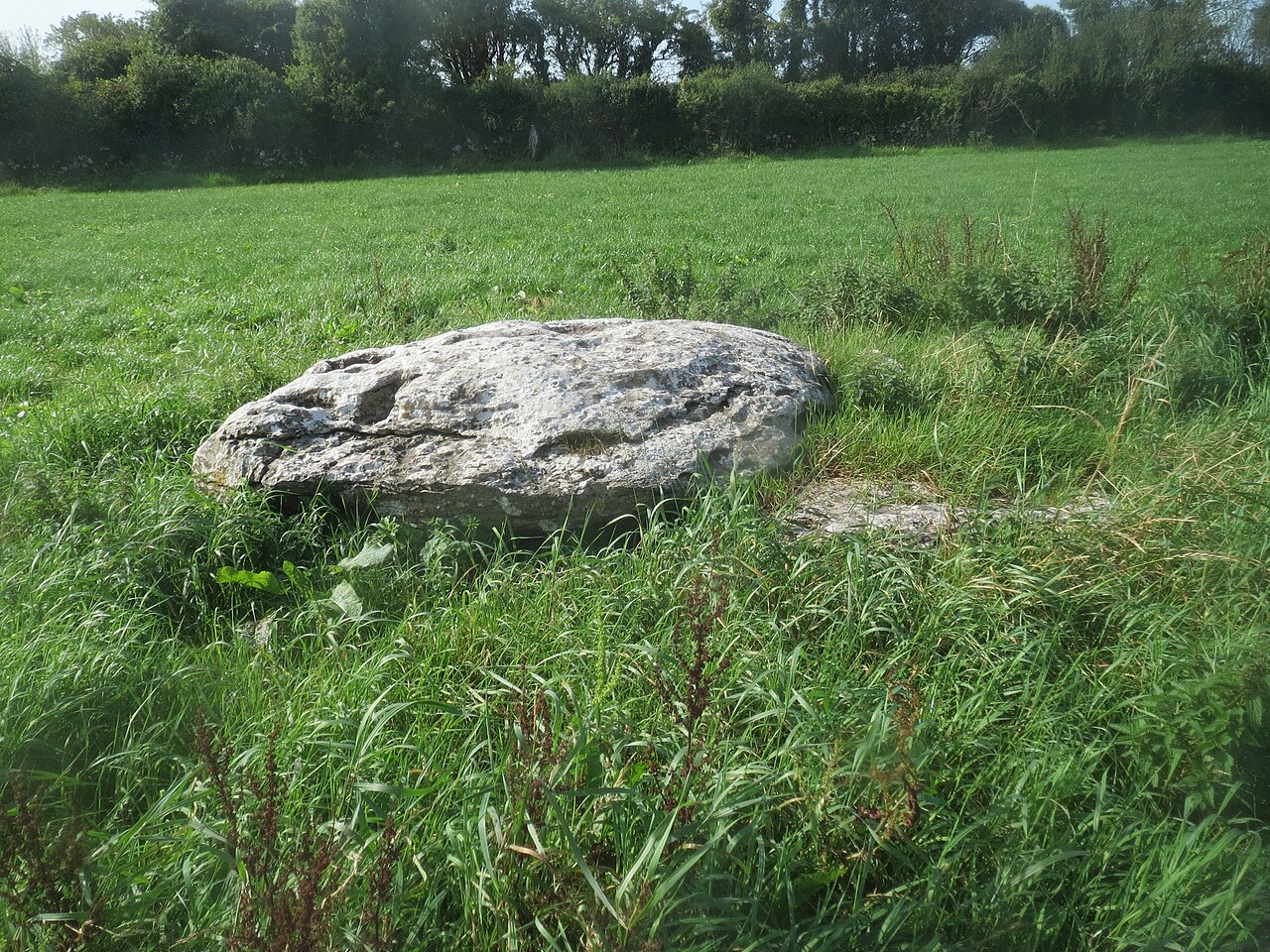
Doorus Demesne wedge tomb
Datedc. 2250 BCE
Photo Wanfried-Dublin · CC BY 4.0Photo taken at this location (Wikimedia Commons)Source file on Wikimedia Commons
Overview
About this site
Overview
The Doorus Demesne wedge tomb is a wedge-shaped gallery grave and National Monument in County Galway, Ireland. It lies 2.9 km northwest of Kinvara on the Doorus Peninsula.
Read on Wikipedia2 min readCC BY-SA 4.0
Where it sits in time
The site's dated range, placed against world reference points.
The scale is logarithmic: each step to the left is about ten times older than the last.
Article
Doorus Demesne wedge tomb
A large quantity of cairn material, nearly 1 meter in depth, lies on top of the roof-stone.
DescriptionSources for this section
- Wikipedia (English): Doorus Demesne wedge tombCC BY-SA 4.0
Sources for this section
- Wikipedia (English): Doorus Demesne wedge tombCC BY-SA 4.0
The chamber, measuring 2.5 meters × 1.3 meters, is covered by an enormous roof-stone 2.4 meters in length, 2.1 meters in width and 30 cm in depth. A large quantity of cairn material, nearly 1 meter in depth, lies on top of the roof-stone. The roof-stone is supported by two large side-stones, one on each side, and an equally large back-stone at the north-east.
There is some evidence of a gallery in front of the north-west side-stone but none on the south-west side. The monument consists of a simple chamber with sides and back formed of single stones. Above the roofstone is built a stack of field stones.
ContextSources for this section
- Wikipedia (English): Doorus Demesne wedge tombCC BY-SA 4.0
Sources for this section
- Wikipedia (English): Doorus Demesne wedge tombCC BY-SA 4.0
A wedge tomb takes its name from the way the burial chamber narrows at one end, usually decreasing both in height and in width from west to east. An antechamber is separated from the burial area by a simple stone slab. Wedge tombs are one of the four categories of Irish megalithic tomb described by Seán Ó Nualláin and Rúaidhrí de Valera in their survey of 1961, the others being court cairns, portal dolmens and passage tombs.
Tradition and region
About this kind of monument
Irish wedge tombs
A wedge tomb, or wedge-shaped gallery grave, is a type of Irish chamber tomb. It takes its name from the way the burial chamber narrows at one end, usually decreasing both in height and in width from west to east, which gives it a wedge shape in profile. An antechamber is separated from the burial area by a simple stone slab. Wedge tombs are one of the four categories of megalithic tomb described by the Irish scholars Seán Ó Nualláin and Rúaidhrí de Valera in their survey of 1961: court cairns, portal dolmens, wedge-shaped gallery graves and passage tombs.
A gallery grave is a megalithic tomb in which the main gallery is entered without first passing through an antechamber or hallway. The gallery graves of western Europe were probably community burial sites, in which family or hamlet members were laid to reinforce the sense of community. Gallery graves can be covered with an earthen mound or a cairn, and there are at least four major types: complex, transepted, segmented and wedge-shaped.
Wedge tombs were built between the Irish late Neolithic and the middle Bronze Age, about 2500 to 2000 BCE. Between 500 and 550 survive, mostly in the west and north-west of Ireland. A distinguishing feature is the double walling of the gallery. They were often covered by round, oval or D-shaped cairns, usually about 1.5 metres high, with a kerb, and are generally found on mountainsides, about three-quarters of the way up. The doorway generally faces west.
When visiting, look at how the walls narrow towards the back of the tomb and at the double wall of the gallery.
Paraphrased from Wikipedia: Wedge-shaped gallery grave, Wikipedia: Gallery grave, Wikipedia: Bell Beaker culture, Wikipedia: Passage grave · CC BY-SA 4.0
Photographs
1 photograph, each with its author and licence
Lore
Evidence & Lore
What the sources actually support — and, kept apart, what has been claimed.
What the evidence supports
Dates
Est. 2500–2000 BCEHow this date was established: Type comparisonTypical range for wedge tombs in Ireland; this site has not been dated itself. Wedge tombs were built between the Irish late Neolithic and middle Bronze Ages about 2500 to 2000 BC.Source for this date
Where it stands
Ireland
The pin marks the monument itself — its exact point.
- Coordinates
- 53°09′09″ N, 8°58′21″ WFor a GPS or map app: 53.15256, -8.97260
Access is as our sources describe it; we have not visited the site to check.
Nearby
The closest sites in the Atlas, by straight line.




Sources
Every record behind this page, with the link it came from.
3 sources behind this page
- 01Wikidata Q28232616wikidata.org
- 02Source for this dateen.wikipedia.org
- 03Wikipedia: Doorus Demesne wedge tomben.wikipedia.org
Image files
- DoorusDemesne (3).jpgWanfried-DublinCC BY 4.0
Report a correctionWrong date, name, photograph or source? Tell us and it will be put right.
Around this place
The ten nearest sites, by compass
Credit
Text, licence and sources
Adapted from the Wikipedia article "Doorus Demesne wedge tomb" (English), licensed CC BY-SA 4.0; authors are listed in the page history. Reused under CC BY-SA 4.0. Read on Wikipedia · Edit history and authors