
Megalithic mound (tumulus with integral stones)
Mikri Doksipara Zoni tomb
Also known asMikri Doxipara-Zoni, Ploutos Kyprinou
Photo User:Ggia · CC BY-SA 3.0Source file on Wikimedia Commons

Overview
About this site
Overview
The Mikri Doksipara-Zoni tumulus (Τύμβος Μικρής Δοξιπάρας-Ζώνης) is a Roman burial mound in the regional unit of Evros, in Greece, near the villages of Mikri Doksipara, Zoni and Chelidona. It dates from the second century CE. The catalogue also records the name Mikri Doxipara-Zoni, Ploutos Kyprinou.
The mound has a diameter of 60 m and a height of 7,5 m. It lies 33,5 km west of Didymoteicho and 30,6 km west of Orestiada.
Read on Wikipedia2 min readCC BY-SA 4.0
Article
Mikri Doksipara Zoni tomb
In the second century four members of a wealthy family of landowners, three men and a woman, were buried in the tumulus together with their carriages and horses.
DescriptionSources for this section
- Wikipedia (Greek): Τύμβος Μικρής Δοξιπάρας-ΖώνηςCC BY-SA 4.0
Sources for this section
- Wikipedia (Greek): Τύμβος Μικρής Δοξιπάρας-ΖώνηςCC BY-SA 4.0
In the second century four members of a wealthy family of landowners, three men and a woman, were buried in the tumulus together with their carriages and horses. The carriages and the bones of the horses have been found in the excavations, and the remains of the cremation of the four persons were also found in the mound.
Archaeological research has shown that in northern Thrace, in the Roman period, families of rich landowners chose to be buried in tumuli around their estates.
ExcavationsSources for this section
- Wikipedia (Greek): Τύμβος Μικρής Δοξιπάρας-ΖώνηςCC BY-SA 4.0
Sources for this section
- Wikipedia (Greek): Τύμβος Μικρής Δοξιπάρας-ΖώνηςCC BY-SA 4.0
Excavation began in 2002, carried out by the Nineteenth Ephorate of Prehistoric and Classical Antiquities of Thrace.
VisitingSources for this section
- Wikipedia (Greek): Τύμβος Μικρής Δοξιπάρας-ΖώνηςCC BY-SA 4.0
Sources for this section
- Wikipedia (Greek): Τύμβος Μικρής Δοξιπάρας-ΖώνηςCC BY-SA 4.0
Today the tumulus is not an organised archaeological site but an excavation, which tourists are permitted to visit.
ContextSources for this section
- Wikipedia (Greek): Τύμβος Μικρής Δοξιπάρας-ΖώνηςCC BY-SA 4.0
Sources for this section
- Wikipedia (Greek): Τύμβος Μικρής Δοξιπάρας-ΖώνηςCC BY-SA 4.0
Burial mounds in Greece are of several ages. In the north, the Macedonians raised enormous tumuli over rich chamber tombs.
Tradition and region
About this kind of monument
Greek tumuli and Macedonian burial mounds
Burial mounds in Greece are of several ages. At Marathon, the Soros is the burial mound of the Athenians who fell in the battle of 490 BCE, which holds the ashes of 192 of them; the Plataeans who fought alongside them were buried in a second, smaller tumulus nearby. The Athenian mound stands about 12 metres high and was excavated in 1884 by Dimitrios Philios and again in 1890 and 1891 by Valerios Stais; the Plataean mound, about 3 metres high, was identified and excavated in 1970. A large layer of ash and charred bone was found in the Athenian tumulus, while the Plataeans were inhumed. Such monumental burial had been out of fashion in central Greece since the seventh century BCE, so the choice at Marathon was unusual.
In the north, the Macedonians raised enormous tumuli over rich chamber tombs. At Vergina, the site of ancient Aigai, the Greek archaeologist Manolis Andronikos became convinced that the hill called the Great Tumulus concealed the tombs of the Macedonian kings, and in 1977 he found four buried tombs, two of them never looted. The Kasta Tomb near Amphipolis, also called the Amphipolis Tomb, is the largest ancient tumulus ever discovered in Greece. It dates to the last quarter of the fourth century BCE and has a perimeter wall; its inner tomb was found in 2012 and entered in August 2014, and the remains of five people were recovered. Early public speculation that it was meant for Alexander the Great is only a guess.
Dating combines the historical record, as at Marathon, with the architecture and objects inside the tombs.
When visiting Marathon, climb the Soros and look back across the plain towards the sea, as the battle's participants would have seen it.
Paraphrased from Wikipedia: Marathon tumuli, Wikipedia: Kasta Tomb, Wikipedia: Vergina, Wikipedia: Tumulus · CC BY-SA 4.0
From the article
Dated moments in the story
- 2012
«Ανασκαφή Μικρής Δοξιπάρας-Ζώνης». Επίσημη ιστοσελίδα Ανασκαφής Δοξιπάρας-Ζώνης. Ανακτήθηκε στις 22 Ιουλίου 2012.
Source
See it in 3D
An interpretive reconstruction of the monument, standing on the real ground at its exact point, under the sun for that place and season. Drag to look around it.
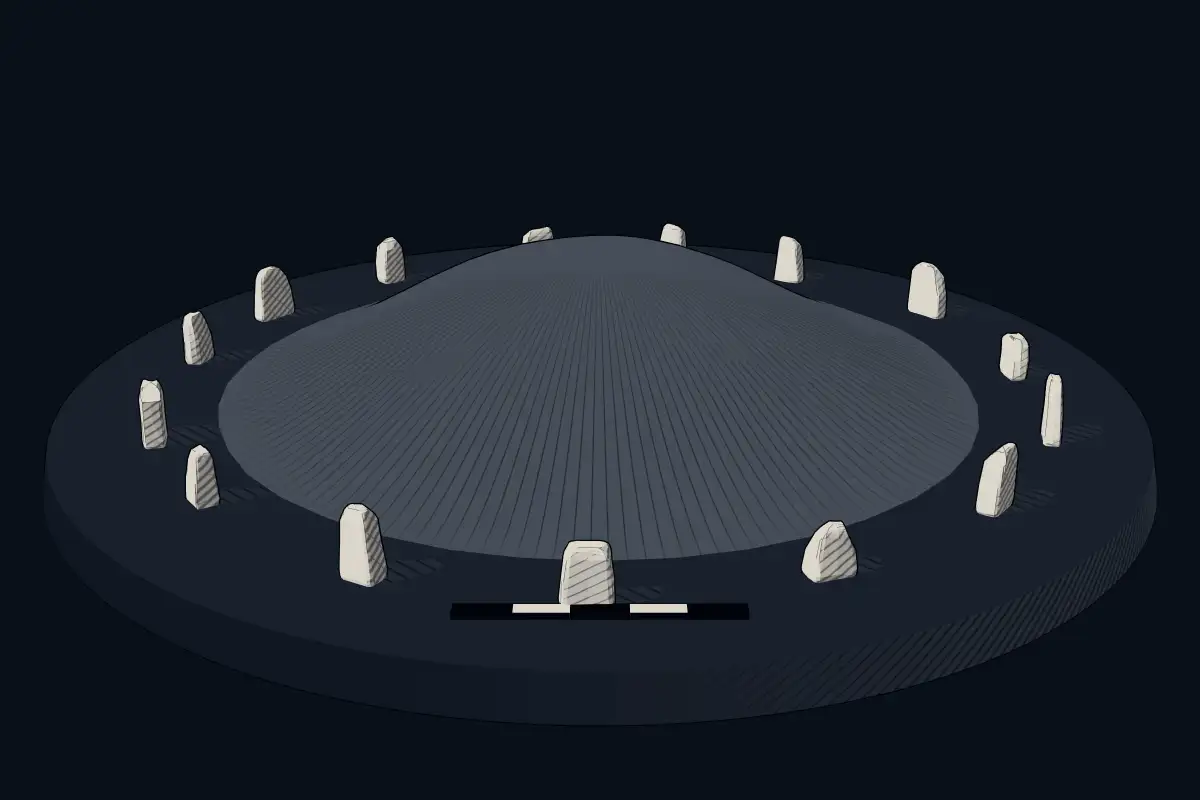
The reconstruction is ours, not a survey: it shows what a monument of this type looks like, at the size the record gives for this one.
Photographs
2 photographs, each with its author and licence
More photographs

Where it stands
Greece
The pin marks the monument itself — its exact point.
- Coordinates
- 41°31′05″ N, 26°14′16″ EFor a GPS or map app: 41.51818, 26.23781
Access is as our sources describe it; we have not visited the site to check.
Nearby
The closest sites in the Atlas, by straight line.
- Megalithic mound (tumulus with integral stones)Prehistoric tomb, Old Churches of Paliouri
 Plevun dolmen
- Stone circleMegalithic circle
 Kralimarkov kamък (Mezek)
- Megalithic mound (tumulus with integral stones)Karaağaç A Tumulus700–50 BCE
- Megalithic mound (tumulus with integral stones)Karaağaç B Tümülüsü700–50 BCE
 Senoklas
- Megalithic mound (tumulus with integral stones)Karaağaç C Tümülüsü700–50 BCE


Sources
Every record behind this page, with the link it came from.
1 source behind this page
- 01Wikidata Q12885570wikidata.org
Image files
Report a correctionWrong date, name, photograph or source? Tell us and it will be put right.
Around this place
The ten nearest sites, by compass
Credit
Text, licence and sources
Adapted from the Wikipedia article "Τύμβος Μικρής Δοξιπάρας-Ζώνης" (Greek), licensed CC BY-SA 4.0; authors are listed in the page history. Reused under CC BY-SA 4.0. Read on Wikipedia · Edit history and authors