

Overview
About this site
What the sources say
1998 führten Archäologen auf dem Abbey Knowe, in der Nähe von Lyne Kirk, nördlich der A72, und des Lyne Water (einem Nebenfluss des Tweed) und westlich von Peebles in den Scottish Borders in Schottland eine Rettungsgrabung durch, nachdem sie am Rand einer alten Kiesgrube eine Steinkiste entdeckt hatten.
Während der Ausgrabung wurde nahe der Kante eine durch Erosion gefährdete, zweite Steinkiste entdeckt. Sie könnten Exemplare eines beim Kiesabbau zerstörten Gräberfeldes sein. Die etwa Ost-West-orientierten Kisten waren etwa 0,3 m tief und bestanden aus je vier kantengesetzten Platten, zwei an beiden Enden und zwei an jeder Seite.
Die größere Kiste maß 1,1 × 0,3 m, die kleinere 0,65 × 0,25 m. Dünne Felsplatten bildeten die Decksteine (sechs bei der größeren und zwei bei der kleineren Kiste). Das Innere beider Kisten verjüngte sich vom West- zum Ostende. Beide Kisten waren voll feinem Kies, der durch die Lücken zwischen den Deckenplatten eingedrungen war. Es gab kein erhaltenes Skelettmaterial.
Die Lyne-Kisten haben dieselbe Form wie andere lange Steinkisten, sind aber relativ klein, was die Vermutung nahelegt, dass sie für ein Baby und ein Kind gedacht waren. Der Bestattungsritus dürfte christlich gewesen sein, bei dem Körperbestattungen mit dem Kopf im Westen beigesetzt wurden. Zwischen dem 6. und 8. Jahrhundert, einer Zeit zunehmenden Einflusses des Christentums, stand der Süden Schottlands unter der Kontrolle des Königreichs Northumbria.
1999 wurden weitere Arbeiten an der Stelle durchgeführt (Corder, Cowley und Ward 1998). Unter einem gerodeten Baum wurde eine dritte Kiste entdeckt, in die Wurzeln eingedrungen waren. Ihre Form unterschied sich unwesentlich von den anderen. Die Längsseiten bestanden aus drei und fünf kantengesetzten Platten. Wieder bedeckten sechs dünne Platten die Kiste, die keine Funde oder Skelettmaterial enthielt. Zwei Seitenplatten bestanden aus bearbeitetem rosa Sandstein und stammen vermutlich aus dem nahen Römerlager.
Bei der erneuten Untersuchung der ausgegrabenen Kisten wurde zwischen den Deckeln der großen Kiste eine weitere Sandsteinplatte entdeckt. Der Rest der Hügelkuppe wurde gereinigt, ließ aber keine weiteren Merkmale erkennen.
Article in GermanRead on Wikipedia4 min readCC BY-SA 4.0
Where it sits in time
The site's dated range, placed against world reference points.
The scale is logarithmic: each step to the left is about ten times older than the last.
The full article
Abbey Knowe: the whole story
In briefSources for this section
- Wikipedia (German): Abbey KnoweCC BY-SA 4.0
Sources for this section
- Wikipedia (German): Abbey KnoweCC BY-SA 4.0
Abbey Knowe is a group of stone cists near Lyne Kirk, north of the A72 and west of Peebles in the Scottish Borders, Scotland. A rescue excavation took place in 1998 after archaeologists found a cist at the edge of an old gravel pit. A second eroded cist was discovered nearby, and further work in 1999 uncovered a third cist beneath a cleared tree.
The cists were small, east-west-aligned stone boxes. The larger measured 1,1 × 0,3 m and the smaller 0,65 × 0,25 m. Each was about 0,3 m deep and built from four upright slabs, with two at each end and one along each side. Thin rock slabs formed the lids: six on the larger cist and two on the smaller. Their interiors narrowed from west to east and contained fine gravel, but no preserved skeletal material was found.
The third cist, found in 1999, had a slightly different form, with three and five upright slabs along its long sides and six thin slabs covering it. It was empty of finds and skeletal material, and roots had entered it. Two side slabs were made from worked pink sandstone, probably taken from a nearby Roman fort. During renewed examination, another sandstone slab was found between the lids of the large cist.
The cists may have belonged to a burial place destroyed during gravel extraction. Their small size has led to the suggestion that they were intended for a baby and a child. The burial rite may have been Christian, with bodies placed with their heads to the west, during a period when southern Scotland was controlled by the kingdom of Northumbria. The dating given for the site is 2900 BCE to 800 BCE, based on typological estimate.
No English Wikipedia article exists for it; the full text below is the German article "Abbey Knowe", shown in the original language.
Summary in EnglishSources for this section
- Wikipedia (German): Abbey KnoweCC BY-SA 4.0
Sources for this section
- Wikipedia (German): Abbey KnoweCC BY-SA 4.0
Abbey Knowe is a cist in Peebles, United Kingdom. A typological estimate: 2900 BCE to 800 BCE. No English Wikipedia article exists for it; the full text below is the German article "Abbey Knowe", shown in the original language.
How this page was madeSources for this section
- Wikipedia (German): Abbey KnoweCC BY-SA 4.0
Sources for this section
- Wikipedia (German): Abbey KnoweCC BY-SA 4.0
The summary at the top of this page was written by MiniMax-M3 (2026-11-07) from the cited Wikipedia article “Abbey Knowe”, translated from German. The numbers in it were checked automatically against the source text. The rest of the page is the article itself, the structured records and computed distances.
Tradition and region
About this kind of monument
British and Irish cists
In Britain and Ireland a cist is a small stone-built coffin-like box used to hold the dead, and it is one of the commonest finds in prehistoric graves. A cist may once have been covered by a cairn or a long barrow, and several are sometimes found together in the same cairn or barrow. Ornaments found in excavated cists point to the wealth or prominence of the person buried. The centre of a round barrow, which in Britain was mostly built between 2200 and 1100 BCE, may hold a stone cist or a cut grave, and the burial may be an inhumation or a cremation placed in a vessel.
The Bell Beaker phenomenon, which reached Britain and Ireland in the late Neolithic, brought individual burials, often under tumuli and with weapons, in place of the collective burials of the earlier Neolithic. Cists of this period are therefore often single graves. The Food Vessel culture of the Early Bronze Age used slab cists, and some of their stones carry cup and ring marks.
Kilmartin Glen in Argyll is the richest area, with numerous cists among its prehistoric monuments, including a linear cemetery of five burial cairns that runs for more than three miles. Several of its cairns and many natural rocks are decorated with cup and ring marks. More than 800 ancient monuments lie within ten kilometres of the village, 150 of them prehistoric.
The Atlas's cists are dated by their position in a barrow, by the pottery or ornaments found with the burial, and by radiocarbon dating of surviving bone. Where none is known, it gives a broad Neolithic to Bronze Age range.
When visiting, look for the slabs set on edge around a pit, and for the cap stone that may have fallen aside.
Paraphrased from Wikipedia: Cist, Wikipedia: Round barrow, Wikipedia: Kilmartin Glen, Wikipedia: Bell Beaker culture · CC BY-SA 4.0
From the article
Dated moments in the story
- 1998
1998 führten Archäologen auf dem Abbey Knowe, in der Nähe von Lyne Kirk, nördlich der A72, und des Lyne Water (einem Nebenfluss des Tweed) und westlich von Peebles in den Scottish Borders in Schottland eine Rettungsgrabung durch, nachdem sie am Rand einer alten Kiesgrube eine Steinkiste entdeckt hatten.
Source - 1999
1999 wurden weitere Arbeiten an der Stelle durchgeführt (Corder, Cowley und Ward 1998).
Source
See it in 3D
An interpretive reconstruction of the monument, standing on the real ground at its exact point, under the sun for that place and season. Drag to look around it.
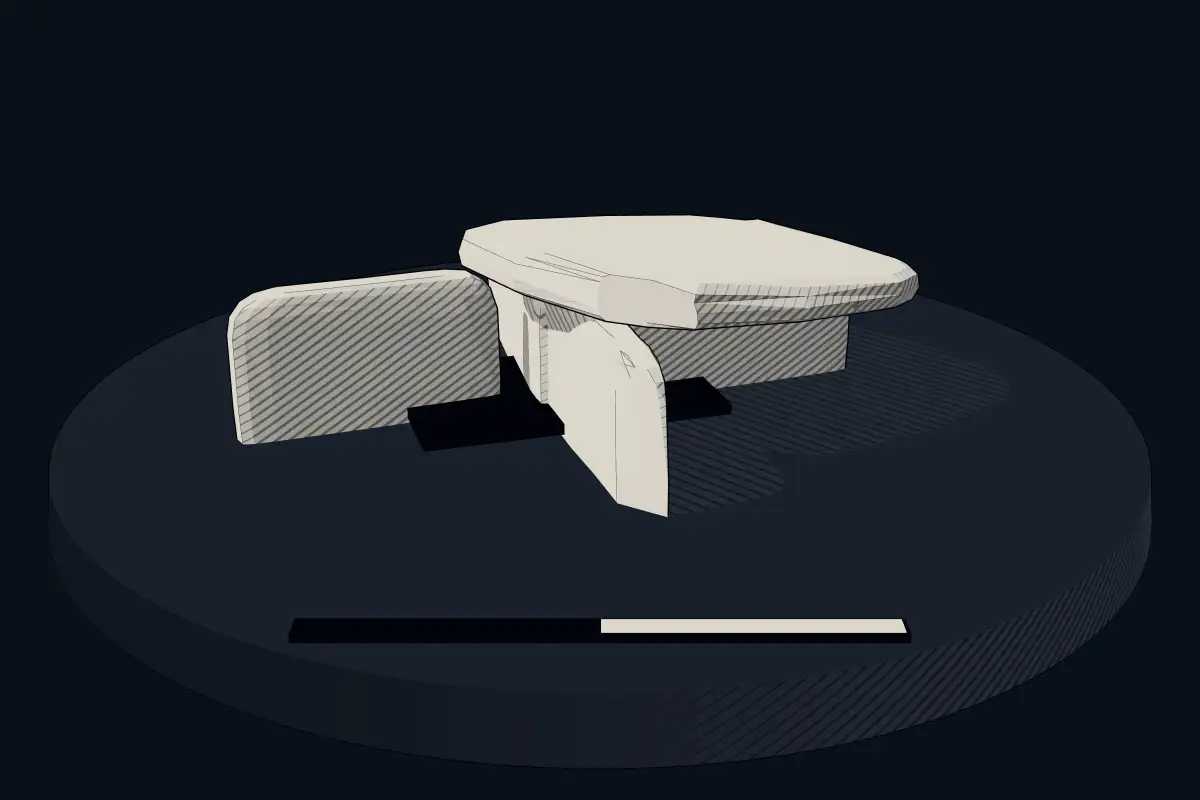
The reconstruction is ours, not a survey: it shows what a monument of this type looks like, at the size the record gives for this one.
Photographs
1 photograph, each with its author and licence
Lore
Evidence & Lore
What the sources actually support — and, kept apart, what has been claimed.
What the evidence supports
Dates
Est. 2900–800 BCEHow this date was established: Type comparisonTypical range for cists in United Kingdom; this site has not been dated itself. British barrows of many types were in use from the late Neolithic until the end of the Bronze Age (2900-800 BC) and many contain a stone cist.Source for this date
Where it stands
United Kingdom
The pin marks the monument itself — its exact point.
- Coordinates
- 55°39′06″ N, 3°17′18″ WFor a GPS or map app: 55.65169, -3.28842
Access is as our sources describe it; we have not visited the site to check.
Nearby
The closest sites in the Atlas, by straight line.
- Megalithic mound (tumulus with integral stones)Sheriff Muir, cairn4000–800 BCE
- Megalithic mound (tumulus with integral stones)Huskie Rig, mounds4000–800 BCE
 White Meldon4000–800 BCE
- Megalithic mound (tumulus with integral stones)cairn 1510m ESE of Harehope4000–800 BCE
- Megalithic mound (tumulus with integral stones)Green Knowe,cairn NE of4000–800 BCE
 Dead Wife's Grave4000–800 BCE
- Megalithic mound (tumulus with integral stones)two ring enclosures & barrow 550m SSE of Green Knowe4000–800 BCE
- Megalithic mound (tumulus with integral stones)Romanno Hope,barrow & enclosures S of4000–800 BCE


Sources
Every record behind this page, with the link it came from.
2 sources behind this page
- 01Wikidata Q132818041wikidata.org
- 02Source for this dateen.wikipedia.org
Image files
Report a correctionWrong date, name, photograph or source? Tell us and it will be put right.
Around this place
The ten nearest sites, by compass
- Sheriff Muir, cairn1.2 km E
- Huskie Rig, mounds3.4 km SW
- White Meldon3.7 km NE
- cairn 1510m ESE of Harehope3.8 km NE
- Green Knowe,cairn NE of4.4 km NE
- Dead Wife's Grave5.4 km S
- two ring enclosures & barrow 550m SSE of Green Knowe5.8 km N
- Romanno Hope,barrow & enclosures S of6.2 km N
- Pyked Stane,cairn,Pyked Stane Hill6.7 km W
- cairn 360m NNW of Wormiston6.9 km NE
Credit
Text, licence and sources
Text from the Wikipedia article "Abbey Knowe" (German), licensed CC BY-SA 4.0; authors are listed in the page history. Reused under CC BY-SA 4.0. Read on Wikipedia · Edit history and authors
- Wikipedia (German): Abbey KnoweCC BY-SA 4.0
- Wikidata Q132818041CC0