menhir de Kerigo
DatedEst. 2800–1800 BCE
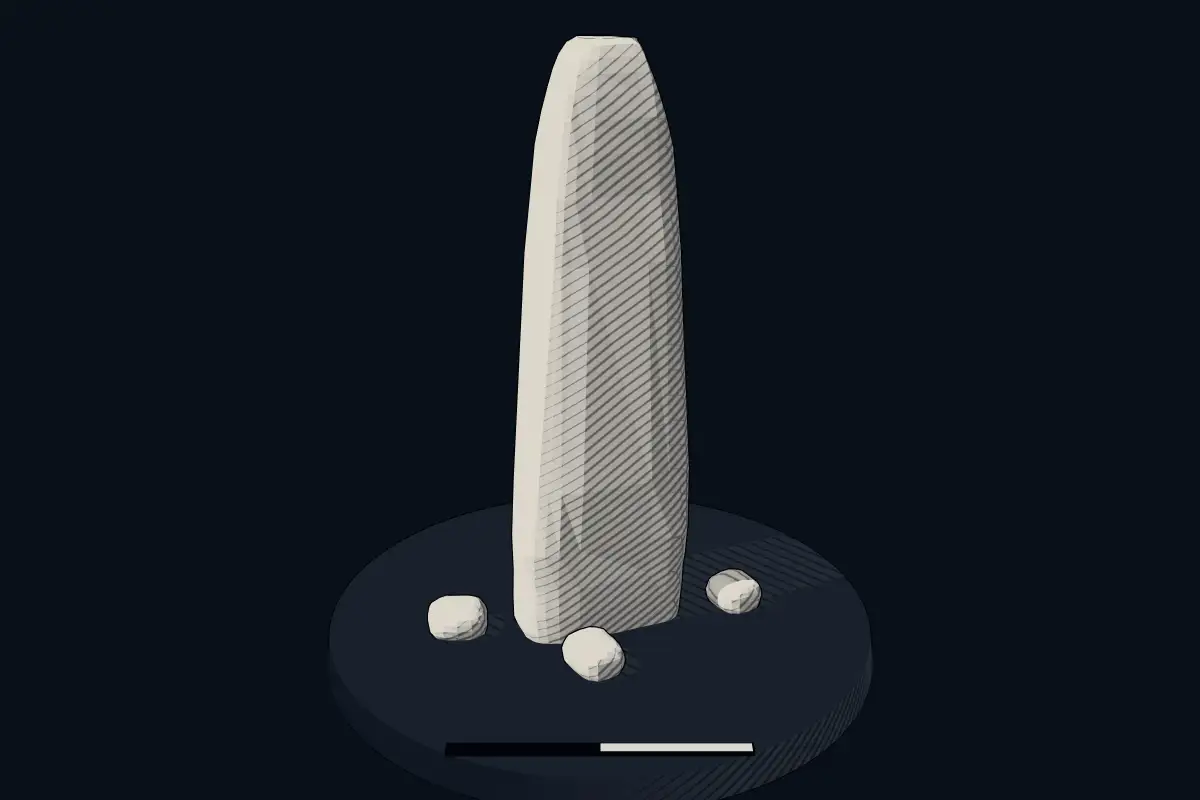
No licensed photograph yetWe have no photograph we may publish for this site, so the interpretive 3D view leads instead.
Overview
About this site
Overview
The menhir de Kerigo is a standing stone at Moustoir-Ac, in the department of Morbihan, Brittany, France. It is a granite slab 1.5 m high with a base 1.4 m wide, and it is dated to the Neolithic.
It stands in a wood at the place called Kerigo, 650 m as the crow flies south-west of the menhir de Cosquéro, which stands in the same wood.
Read on Wikipedia2 min readCC BY-SA 4.0
Where it sits in time
The site's dated range, placed against world reference points.
The scale is logarithmic: each step to the left is about ten times older than the last.
Article
menhir de Kerigo
Around it are spectacular natural formations and numerous low stones that appear to be set upright.
DescriptionSources for this section
- Wikipedia (French): Menhir de KerigoCC BY-SA 4.0
Sources for this section
- Wikipedia (French): Menhir de KerigoCC BY-SA 4.0
The menhir is an upright granite slab 1.5 m high and 1.4 m wide at the base. Around it are spectacular natural formations and numerous low stones that appear to be set upright.
A few hundred metres away stands a slab several metres long and more than 2 m high, upright but slightly inclined. Beside it lies a very elongated stone, about 6 m long, which could be a fallen menhir.
DatingSources for this section
- Wikipedia (French): Menhir de KerigoCC BY-SA 4.0
Sources for this section
- Wikipedia (French): Menhir de KerigoCC BY-SA 4.0
The menhir dates from the Neolithic. The catalogue record gives an estimated range of 2800 to 1800 BCE, based on typology.
HistorySources for this section
- Wikipedia (French): Menhir de KerigoCC BY-SA 4.0
Sources for this section
- Wikipedia (French): Menhir de KerigoCC BY-SA 4.0
A gallery grave (allée couverte) once stood in the vicinity but was destroyed about 1925. It was divided into two compartments and measured 20 m in length and 2.5 m in width. It had internal partitions and five capstones, one of which was 4 m long and 3.5 m wide.
ContextSources for this section
- Wikipedia (French): Menhir de KerigoCC BY-SA 4.0
Sources for this section
- Wikipedia (French): Menhir de KerigoCC BY-SA 4.0
A menhir is a large upright stone placed by humans. The word comes from the Breton maen and hir, "long stone", and entered archaeology through French antiquarians in the eighteenth and nineteenth centuries. Menhirs are most numerous in Western Europe, with about 1,200 in north-western France alone, and Brittany stands out for both the density of monuments and the variety of types.
Tradition and region
About this kind of monument
Breton and French menhirs
A menhir is a large upright stone placed by humans. The word comes from the Breton maen and hir, "long stone", and entered archaeology through French antiquarians in the eighteenth and nineteenth centuries; in modern Breton the word for such a stone is peulvan. Menhirs are most numerous in Western Europe, with about 1,200 in north-western France alone, and Brittany stands out for both the density of monuments and the variety of types.
The largest known menhir is the Grand Menhir Brisé at Locmariaquer. It once stood nearly 20.6 metres high, and now lies fractured in four pieces; whole, it would have weighed some 330 tonnes. Stones in the Carnac area were hewn from local granite by the pre-Celtic people of Brittany. At Carnac more than 3,000 prehistoric standing stones form the largest such collection in the world, arranged in groups of alignments that stretch for four kilometres. The stones were erected at some point in the Neolithic, probably around 3300 BCE, with some perhaps as early as 4500 BCE. Elsewhere, the Cham des Bondons in the Cévennes is the second largest concentration in France, and a menhir 4.5 metres tall stands against Le Mans Cathedral, moved there in 1778 when its dolmen was destroyed.
Dating a menhir is difficult, because standing stones are usually hard to date and were put up in many different periods.
Folklore: a Christian legend held that the stones of Carnac were pagan soldiers who had pursued Pope Cornelius and were turned to stone by him. Modern beliefs link the stones with Roman and Christian occupation, even though they date from 4500 to 3300 BCE.
When visiting, look at how the stones taper towards the top and at how the alignments run across the slope.
Paraphrased from Wikipedia: Menhir, Wikipedia: Carnac stones, Wikipedia: Locmariaquer megaliths, Wikipedia: List of menhirs · CC BY-SA 4.0
From the article
Dated moments in the story
- 1925
Une allée couverte était présente dans les environs mais elle fut détruite vers 1925. Elle était divisé en deux compartiments, longue de 20 m et large de 2,5 m.
Source
See it in 3D
An interpretive reconstruction of the monument, standing on the real ground at its exact point, under the sun for that place and season. Drag to look around it.
The reconstruction is ours, not a survey: it shows what a monument of this type looks like, at the size the record gives for this one.
Lore
Evidence & Lore
What the sources actually support — and, kept apart, what has been claimed.
What the evidence supports
Dates
Est. 2800–1800 BCEHow this date was established: Type comparisonTypical range for menhirs in France; this site has not been dated itself. Standing stones are associated with the Beaker people of the European late Neolithic and early Bronze Age c. 2800-1800 BC.Source for this date
Where it stands
France
The pin marks the monument itself — its exact point.
- Coordinates
- 47°49′20″ N, 2°53′17″ WFor a GPS or map app: 47.82222, -2.88806
Access is as our sources describe it; we have not visited the site to check.
Nearby
The closest sites in the Atlas, by straight line.
- Menhir (standing stone)Menhir von Cosquéro2800–1800 BCE
 Menhir de Men-Bras-de-Kermar-Ker B2800–1800 BCE
 Menhir de Kermarquer2800–1800 BCE
 Menhir de Kerara2800–1800 BCE
- Menhir (standing stone)menhir du Mené2800–1800 BCE
 Dolmen de Kermorvant4000–3000 BCE
- Dolmendolmen du Resto4000–3000 BCE
 Dolmen du Roh-Du4000–3000 BCE


Sources
Every record behind this page, with the link it came from.
2 sources behind this page
- 01Wikidata Q105787681wikidata.org
- 02Source for this dateen.wikipedia.org
Report a correctionWrong date, name, photograph or source? Tell us and it will be put right.
Around this place
The ten nearest sites, by compass
Credit
Text, licence and sources
Adapted from the Wikipedia article "Menhir de Kerigo" (French), licensed CC BY-SA 4.0; authors are listed in the page history. Reused under CC BY-SA 4.0. Read on Wikipedia · Edit history and authors
- Wikipedia (French): Menhir de KerigoCC BY-SA 4.0
- Wikidata Q105787681CC0