dolmen de Védernat
Also known asdolmen de Crousette · dolmen de la Crousette · dolmen de Vedernat
DatedEst. 4000–3000 BCE
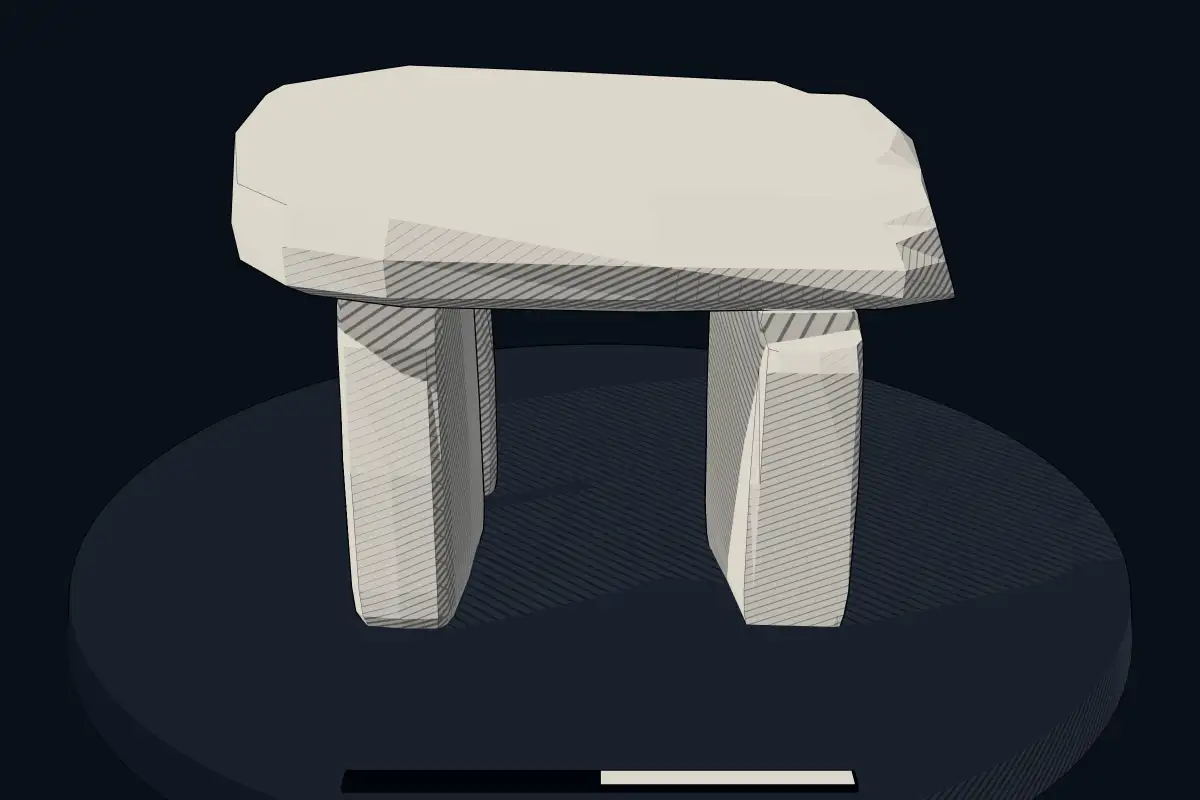
No licensed photograph yetWe have no photograph we may publish for this site, so the interpretive 3D view leads instead.
Overview
About this site
Overview
The dolmen de Védernat, also called the dolmen de Crousette or dolmen de la Crousette, is a restored dolmen on a hill south-west of the hamlet of Roffiac, near Saint-Flour, in the département of Cantal, France. It is a small, east-west oriented monument described as about 5000 years old, and the catalogue gives a typological estimate of 4000 to 3000 BCE.
In France the word dolmen is the general term for Neolithic megalithic structures of every kind.
Read on Wikipedia2 min readCC BY-SA 4.0
Where it sits in time
The site's dated range, placed against world reference points.
The scale is logarithmic: each step to the left is about ten times older than the last.
Article
dolmen de Védernat
DescriptionSources for this section
- Wikipedia (German): Dolmen von CrousetteCC BY-SA 4.0
Sources for this section
- Wikipedia (German): Dolmen von CrousetteCC BY-SA 4.0
The dolmen consists of two orthostats and a capstone. The southern orthostat measures 1.5 × 0.95 × 0.35 m, the northern one 1.4 × 1.0 × 0.2 m and the capstone 1.8 × 1.3 × 0.5 m. The stones come from local outcrops of dolerite basalt of the Bouzentés type.
Archaeological excavations and test pits were carried out in 2003 to establish the position of the displaced orthostats.
ExcavationsSources for this section
- Wikipedia (German): Dolmen von CrousetteCC BY-SA 4.0
Sources for this section
- Wikipedia (German): Dolmen von CrousetteCC BY-SA 4.0
Archaeological excavations and test pits were carried out in 2003 to establish the position of the displaced orthostats. They led to the discovery of finds including heterogeneous pottery fragments, stone tools and bone fragments.
SettingSources for this section
- Wikipedia (German): Dolmen von CrousetteCC BY-SA 4.0
Sources for this section
- Wikipedia (German): Dolmen von CrousetteCC BY-SA 4.0
The menhirs of Loubaresse stand nearby. The dolmen of Touls lies to the north-west of Saint-Flour and the dolmen of Mons to the north-east.
ContextSources for this section
- Wikipedia (German): Dolmen von CrousetteCC BY-SA 4.0
Sources for this section
- Wikipedia (German): Dolmen von CrousetteCC BY-SA 4.0
A dolmen is a single-chamber megalithic tomb with two or more upright stones carrying a great capstone. In France most date to the Late Neolithic, about 4000 to 3000 BCE, and many were covered with earth or smaller stones to form a mound.
Tradition and region
About this kind of monument
French dolmens
France is the dolmen country of Europe: the Dolmen de Bagneux at Saumur is the largest of some 4,500 dolmens scattered across 60 French departments, and one of the largest in Europe. A dolmen is a single-chamber megalithic tomb with two or more upright stones carrying a great capstone. Most date to the Late Neolithic, about 4000 to 3000 BCE, and many were covered with earth or smaller stones to form a mound.
Some of the oldest megalithic monuments in Europe are in western France. The Cairn of Barnenez in Finistère dates to the early Neolithic, around 4000 BCE, and with the Tumulus of Bougon and the Locmariaquer megaliths it is among the earliest megalithic monuments in Europe; it also has megalithic art. La Roche-aux-Fées near Essé in Ille-et-Vilaine is a covered corridor about 20 metres long, built of some 48 blocks, the heaviest around 45 tonnes, and divided into two chambers. It is thought to date from 3000 to 2500 BCE, and its entrance is aligned on sunrise at the winter solstice.
Folklore: the name of La Roche-aux-Fées, "the fairies' rock", comes from a legend that fairies placed the stones. Such stories are traditions about the monuments, not evidence of how they were built.
Because the Atlas draws on national inventories, its French records include many small and ruined dolmens, often reduced to a capstone resting on a few supports. Dates rest on the typology of the monument and, where a dolmen has been excavated, on radiocarbon dating of material from the chamber.
When visiting, look for the capstone and its supports, for the low rise of the old mound around the stones, and for the direction in which the entrance faces.
Paraphrased from Wikipedia: Dolmen, Wikipedia: Dolmen de Bagneux, Wikipedia: La Roche-aux-Fées, Wikipedia: Barnenez, Wikipedia: Carnac stones · CC BY-SA 4.0
From the article
Dated moments in the story
- 2003
2003 wurden archäologische Grabungen und Sondierungen durchgeführt, um die Lage der verschobenen Orthostaten zu erkunden.
Source
See it in 3D
An interpretive reconstruction of the monument, standing on the real ground at its exact point, under the sun for that place and season. Drag to look around it.
The reconstruction is ours, not a survey: it shows what a monument of this type looks like, at the size the record gives for this one.
Lore
Evidence & Lore
What the sources actually support — and, kept apart, what has been claimed.
What the evidence supports
Dates
Est. 4000–3000 BCEHow this date was established: Type comparisonTypical range for dolmens in France; this site has not been dated itself. Most dolmens date from the Late Neolithic period (4000-3000 BCE).Source for this date
Where it stands
France
The pin marks the monument itself — its exact point.
- Coordinates
- 45°02′41″ N, 3°01′57″ EFor a GPS or map app: 45.04470, 3.03240
Access is as our sources describe it; we have not visited the site to check.
Nearby
The closest sites in the Atlas, by straight line.


Sources
Every record behind this page, with the link it came from.
2 sources behind this page
- 01Wikidata Q51076231wikidata.org
- 02Source for this dateen.wikipedia.org
Report a correctionWrong date, name, photograph or source? Tell us and it will be put right.
Around this place
The ten nearest sites, by compass
Credit
Text, licence and sources
Adapted from the Wikipedia article "Dolmen von Crousette" (German), licensed CC BY-SA 4.0; authors are listed in the page history. Reused under CC BY-SA 4.0. Read on Wikipedia · Edit history and authors
- Wikipedia (German): Dolmen von CrousetteCC BY-SA 4.0
- Wikidata Q51076231CC0