
Dolmen de la Maison des Fées
DatedEst. 4000–3000 BCE
Photo La photo de Jojo · CC BY-SA 4.0Source file on Wikimedia Commons

Overview
About this site
What the sources say
Le dolmen de la Maison des Fées, nommé aussi dolmen des Pierres chasses, est un dolmen situé à Miré, en France.
Article in FrenchRead on Wikipedia3 min readCC BY-SA 4.0
Where it sits in time
The site's dated range, placed against world reference points.
The scale is logarithmic: each step to the left is about ten times older than the last.
The full article
Dolmen de la Maison des Fées: the whole story
In briefSources for this section
- Wikipedia (French): Dolmen de la Maison des FéesCC BY-SA 4.0
Sources for this section
- Wikipedia (French): Dolmen de la Maison des FéesCC BY-SA 4.0
The Dolmen de la Maison des Fées, also called the dolmen des Pierres chasses, is a dolmen at Miré in France. It is a megalithic tomb consisting of a large capstone supported by upright stones. The site has been protected as a historic monument since 1911.
Its capstone is trapezoidal and rests on four orthostats. All the slabs are made of Eocene sandstone, described as grès à sabalites. The upright stones meet at the north and south corners, suggesting that the burial chamber was square. The upper part of the capstone has a shallow hollow.
During work on a road ditch, the north-west orthostat was destroyed. The ditch was later routed through the centre of the dolmen, at an unknown date. No objects or grave goods are reported as having been found when the ditch was dug, so little is known about what the chamber once contained.
The dolmen is estimated by typology to date from 4000 BCE to 3000 BCE. According to legend, it was built by fairies. The impressions of a fairy's head and hands, said to have carried the stone, may be seen on the capstone. More generally, dolmens are single-chamber megalithic tombs found in large numbers across France.
No English Wikipedia article exists for it; the full text below is the French article "Dolmen de la Maison des Fées", shown in the original language.
Summary in EnglishSources for this section
- Wikipedia (French): Dolmen de la Maison des FéesCC BY-SA 4.0
Sources for this section
- Wikipedia (French): Dolmen de la Maison des FéesCC BY-SA 4.0
Dolmen de la Maison des Fées is a dolmen in Miré, France. A typological estimate: 4000 BCE to 3000 BCE. No English Wikipedia article exists for it; the full text below is the French article "Dolmen de la Maison des Fées", shown in the original language.
ProtectionSources for this section
- Wikipedia (French): Dolmen de la Maison des FéesCC BY-SA 4.0
Sources for this section
- Wikipedia (French): Dolmen de la Maison des FéesCC BY-SA 4.0
L'édifice est classé au titre des monuments historiques en 1911.
DescriptionSources for this section
- Wikipedia (French): Dolmen de la Maison des FéesCC BY-SA 4.0
Sources for this section
- Wikipedia (French): Dolmen de la Maison des FéesCC BY-SA 4.0
Le dolmen est constitué d'une table de couverture trapézoïdale reposant sur quatre orthostates. Toutes les dalles sont en grès éocène (grès à sabalites). Les piliers se touchant aux angles nord et sud, laisse supposer l'existence d'une chambre sépulcrale de forme carrée. Lors de l'aménagement du fossé de la route, l'orthostate située au nord-ouest a été détruite. La partie supérieure de la pierre horizontale comprend une légère excavation.
L'aménagement du chemin a fait passer le fossé au centre du dolmen à une date inconnue. Il n'est pas fait mention d'objets ou de mobiliers retrouvés lors du creusement du fossé.
Selon la légende, ce dolmen aurait été construit par les fées. Sur la dalle de couverture, il serait possible de voir les empreintes laissées par la tête et les mains de la fée ayant transporté la pierre.
AnnexesSources for this section
- Wikipedia (French): Dolmen de la Maison des FéesCC BY-SA 4.0
Sources for this section
- Wikipedia (French): Dolmen de la Maison des FéesCC BY-SA 4.0
Bibliographie
: document utilisé comme source pour la rédaction de cet article.
Michel Gruet, Mégalithes en Anjou, Le Coudray-Macouard, Cheminements, 2005 (1re éd. 1967, actualisation de Charles-Tanguy Le Roux), 417 p. (ISBN 2-84478-397-X, lire en ligne), p. 167
Articles connexes
Sites mégalithiques de Maine-et-Loire
Liste des monuments historiques de Maine-et-Loire
How this page was madeSources for this section
- Wikipedia (French): Dolmen de la Maison des FéesCC BY-SA 4.0
Sources for this section
- Wikipedia (French): Dolmen de la Maison des FéesCC BY-SA 4.0
The summary at the top of this page was written by MiniMax-M3 (2026-11-08) from the cited Wikipedia article “Dolmen de la Maison des Fées”, translated from French. The numbers in it were checked automatically against the source text. The rest of the page is the article itself, the structured records and computed distances.
Tradition and region
About this kind of monument
French dolmens
France is the dolmen country of Europe: the Dolmen de Bagneux at Saumur is the largest of some 4,500 dolmens scattered across 60 French departments, and one of the largest in Europe. A dolmen is a single-chamber megalithic tomb with two or more upright stones carrying a great capstone. Most date to the Late Neolithic, about 4000 to 3000 BCE, and many were covered with earth or smaller stones to form a mound.
Some of the oldest megalithic monuments in Europe are in western France. The Cairn of Barnenez in Finistère dates to the early Neolithic, around 4000 BCE, and with the Tumulus of Bougon and the Locmariaquer megaliths it is among the earliest megalithic monuments in Europe; it also has megalithic art. La Roche-aux-Fées near Essé in Ille-et-Vilaine is a covered corridor about 20 metres long, built of some 48 blocks, the heaviest around 45 tonnes, and divided into two chambers. It is thought to date from 3000 to 2500 BCE, and its entrance is aligned on sunrise at the winter solstice.
Folklore: the name of La Roche-aux-Fées, "the fairies' rock", comes from a legend that fairies placed the stones. Such stories are traditions about the monuments, not evidence of how they were built.
Because the Atlas draws on national inventories, its French records include many small and ruined dolmens, often reduced to a capstone resting on a few supports. Dates rest on the typology of the monument and, where a dolmen has been excavated, on radiocarbon dating of material from the chamber.
When visiting, look for the capstone and its supports, for the low rise of the old mound around the stones, and for the direction in which the entrance faces.
Paraphrased from Wikipedia: Dolmen, Wikipedia: Dolmen de Bagneux, Wikipedia: La Roche-aux-Fées, Wikipedia: Barnenez, Wikipedia: Carnac stones · CC BY-SA 4.0
See it in 3D
An interpretive reconstruction of the monument, standing on the real ground at its exact point, under the sun for that place and season. Drag to look around it.
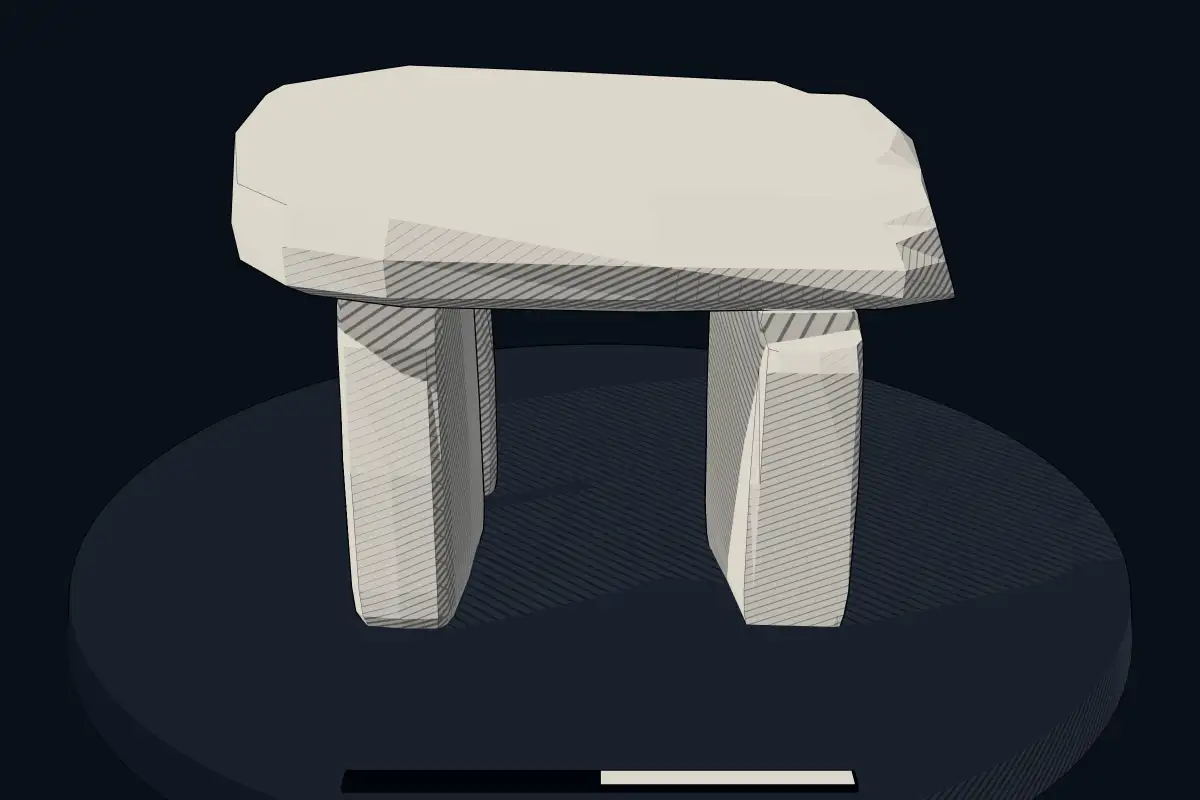
The reconstruction is ours, not a survey: it shows what a monument of this type looks like, at the size the record gives for this one.
Photographs
1 photograph, each with its author and licence
Lore
Evidence & Lore
What the sources actually support — and, kept apart, what has been claimed.
What the evidence supports
Dates
Est. 4000–3000 BCEHow this date was established: Type comparisonTypical range for dolmens in France; this site has not been dated itself. Most dolmens date from the Late Neolithic period (4000-3000 BCE).Source for this date
Where it stands
France
The pin marks the monument itself — its exact point.
- Coordinates
- 47°45′39″ N, 0°29′13″ WFor a GPS or map app: 47.76090, -0.48697
Access is as our sources describe it; we have not visited the site to check.
Nearby
The closest sites in the Atlas, by straight line.
- Menhir (standing stone)Le Doigt de César2800–1800 BCE
- Megalithensemble mégalithique du Lion-d'Angers4500–3300 BCE
 Dolmen de la Pierre Cesée4000–3000 BCE
 Pierre debout2800–1800 BCE
 La Pierre au Loup4000–3000 BCE
- DolmenDolmen du Bois de la Pidoucière4000–3000 BCE
 dolmen des Mollières4000–3000 BCE
 Dolmen de la Petifaie4000–3000 BCE


Sources
Every record behind this page, with the link it came from.
2 sources behind this page
- 01Wikidata Q3034084wikidata.org
- 02Source for this dateen.wikipedia.org
Image files
- Dolmen de la maison des fée 1 de Miré.jpgLa photo de JojoCC BY-SA 4.0
Report a correctionWrong date, name, photograph or source? Tell us and it will be put right.
Lore, kept apart
Legends and claims
These are stories and claims reported by the sources. They are not evidence, and they never stand in for the dating above.
- Tradition
The dolmen is estimated by typology to date from 4000 BCE to 3000 BCE.
The dolmen is estimated by typology to date from 4000 BCE to 3000 BCE. According to legend, it was built by fairies. The impressions of a fairy's head and hands, said to have carried the stone, may be seen on the capstone. More generally, dolmens are single-chamber megalithic tombs found in large numbers across France.
Source - Tradition
Le dolmen est constitué d'une table de couverture trapézoïdale reposant sur quatre orthostates.
Le dolmen est constitué d'une table de couverture trapézoïdale reposant sur quatre orthostates. Toutes les dalles sont en grès éocène (grès à sabalites). Les piliers se touchant aux angles nord et sud, laisse supposer l'existence d'une chambre sépulcrale de forme carrée. Lors de l'aménagement du fossé de la route, l'orthostate située au nord-ouest a été détruite. La partie supérieure de la pierre horizontale comprend une légère excavation. L'aménagement du chemin a fait passer le fossé au centre du dolmen à une date inconnue. Il n'est pas fait mention d'objets ou de mobiliers retrouvés lors du creusement du fossé. Selon la légende, ce dolmen aurait été construit par les fées. Sur la dalle de couverture, il serait possible de voir les empreintes laissées par la tête et les mains de la fée ayant transporté la pierre.
Source
Around this place
The ten nearest sites, by compass
Credit
Text, licence and sources
Text from the Wikipedia article "Dolmen de la Maison des Fées" (French), licensed CC BY-SA 4.0; authors are listed in the page history. Reused under CC BY-SA 4.0. Read on Wikipedia · Edit history and authors