
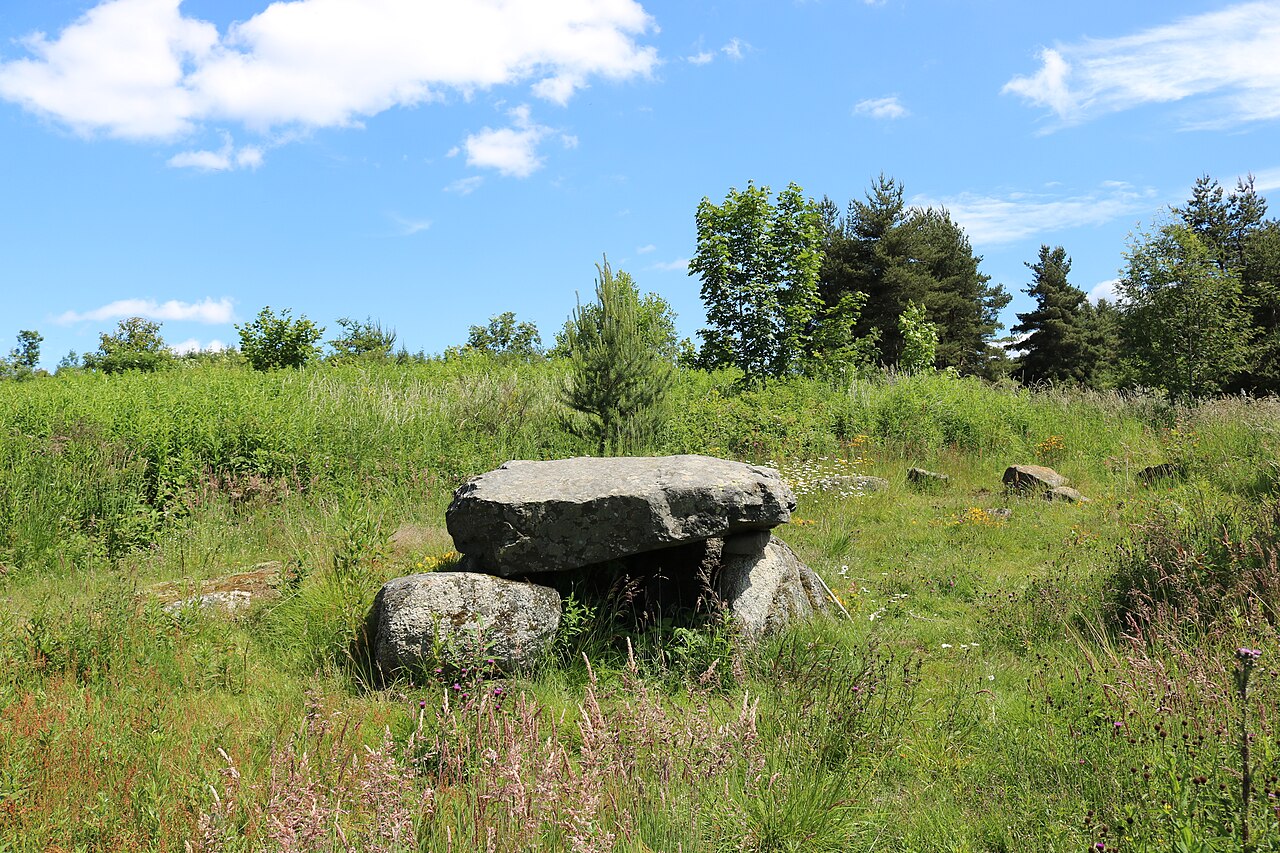
borne milliaire d'Arras-sur-Rhône
Photo Celeda · CC BY-SA 4.0Source file on Wikimedia Commons
Overview
About this site
What the sources say
Les deux bornes milliaires d'Arras-sur-Rhône sont des bornes milliaires trouvées en France sur la commune d'Arras-sur-Rhône, dans le département de l'Ardèche, en région Rhône-Alpes. Depuis 1939, elles sont conservées au château-musée de Tournon-sur-Rhône.
Article in FrenchRead on Wikipedia3 min readCC BY-SA 4.0
The full article
borne milliaire d'Arras-sur-Rhône: the whole story
In briefSources for this section
Sources for this section
The Borne milliaire d'Arras-sur-Rhône is a Roman milestone found at Arras-sur-Rhône, in the Ardèche department of the Rhône-Alpes region of France. Two milestones were found there. Since 1939, they have been kept at the château-musée de Tournon-sur-Rhône.
The classified monument consists of two stone pieces stacked together. They measure 2 m 45 for a diameter of about 35 cm. It bears two partly legible Latin inscriptions. The titles of the two emperors named in them have allowed the pieces to be dated to 285/286 for the right-hand piece and 308/311 for the left-hand piece.
The milestone originally stood in the former churchyard surrounding the church of Arras-sur-Rhône. It had also served as a support near the large door, at the corner of a tribune. In 1939 it was moved to the entrance of the courtyard of honour at the château-musée de Tournon-sur-Rhône.
The milestone has been listed as a historic monument since 15 novembre 1926. Roman milestones were numbered markers placed on routes to indicate distances to towns or landmarks. Their inscriptions often identified their function and could help place them within an emperor’s reign, as the inscriptions on this milestone do.
No English Wikipedia article exists for it; the full text below is the French article "Borne milliaire d'Arras-sur-Rhône", shown in the original language.
Summary in EnglishSources for this section
Sources for this section
borne milliaire d'Arras-sur-Rhône is a stele in Tournon-sur-Rhône, France. No English Wikipedia article exists for it; the full text below is the French article "Borne milliaire d'Arras-sur-Rhône", shown in the original language.
DescriptionSources for this section
Sources for this section
La borne classée MH est constituée de deux morceaux qui, empilés, mesurent 2 m 45[réf. nécessaire] pour un diamètre d'environ 35 cm. Elle comporte deux inscriptions en latin, partiellement lisibles, que l'on a pu dater à partir des titulatures des deux empereurs cités, soit 285/286 (pour le morceau de droite) et de 308/311 (pour le morceau de gauche).
LocalisationSources for this section
Sources for this section
Anciennement dans le cimetière désaffecté entourant l'église d'Arras-sur-Rhône (après avoir servi de support, près de la grande porte, à l'angle d'une tribune), la borne est déplacée en 1939 à l'entrée de la cour d'honneur au château-musée de Tournon-sur-Rhône[réf. nécessaire].
HistoriqueSources for this section
Sources for this section
La borne fait l’objet d'une inscription au titre des monuments historiques depuis le 15 novembre 1926.
AnnexesSources for this section
Sources for this section
Bibliographie
Joëlle Dupraz, Christel Fraisse, L'Ardèche [07], Paris, Académie des inscriptions et belles-lettres, 2001, p. 201 (Carte archéologique de la Gaule, 7) (ISBN 2-87754-069-3).
François Bertrandy, Bornes milliaires et réseau routier dans la cité de Vienne sous l'empire romain, Chambéry, Institut d'Études savoisiennes (Université de Savoie), 2001, p. 76 et p. 69 pour le deuxième milliaire (Bibliothèque d'études savoisiennes, 9) (ISSN 1250-5064).
Corpus Inscriptionum Latinarum [17]. Miliaria Imperii Romani. Pars secunda, Miliaria provinciarum Narbonensis Galliarum Germaniarum, éd. par Gerold Walser (de), Berlin, New York, G. de Gruyter, 1986, milliaire no 173 p. 66 (ISBN 978-3-11-004592-5).
Corpus Inscriptionum Latinarum [12]. Inscriptiones Galliae Narbonensis Latinae, éd. par Otto Hirschfeld, Berlin, Berlin-Brandenburgische Akademie der Wissenschaften, 1888, inscr. no 5562 p. 662, voir aussi inscr. no 5561 p. 661 (ISBN 978-3-11-001389-4) (en ligne).
Articles connexes
Liste des bornes milliaires de France protégées aux monuments historiques
Liste des monuments historiques de l'Ardèche
RéférencesSources for this section
Sources for this section
Portail des monuments historiques français Portail de l’Ardèche Portail de l’archéologie
How this page was madeSources for this section
Sources for this section
The summary at the top of this page was written by MiniMax-M3 (2026-11-07) from the cited Wikipedia article “Borne milliaire d'Arras-sur-Rhône”, translated from French. The numbers in it were checked automatically against the source text. The rest of the page is the article itself, the structured records and computed distances.
Tradition and region
About this kind of monument
French steles, milestones and memorials
The Atlas's French steles are a mixed group. A stele is a stone or wooden slab, generally taller than it is wide, erected as a monument, with text, ornament, or both. Steles were made as grave markers, as government notices and boundary markers, and as memorials to battles. Among the French records are Gaulish steles, funerary steles, Roman milestones and a number of modern memorials.
A milestone is a numbered marker placed on a route to indicate distances to towns or landmarks. In the Roman world a cippus was a low, round or rectangular pedestal set up for purposes such as a milestone or a boundary post, with inscriptions that indicated its function or the area it enclosed. A Roman milestone carries inscriptions that indicate its function, so it can often be placed within a reign.
In Rome cippi marked the limits of the pomerium after the city walls were expanded, the course of aqueducts and of the imperial post; cippi lined up in rows were often numbered, and sometimes carried the name of the magistrate responsible. Roman cippi were made of wood or stone. Stelae were also erected as memorials to battles, and the Gaulish and Roman examples of France sit in that long tradition.
Modern memorials are recorded as stone monuments in the registers, and the Atlas keeps them, but they are not prehistoric.
When visiting, read the inscription, which is the quickest way to tell a Roman milestone from a modern memorial.
Paraphrased from Wikipedia: Stele, Wikipedia: Milestone, Wikipedia: Cippus · CC BY-SA 4.0
From the article
Dated moments in the story
- 661 CE
661 (ISBN 978-3-11-001389-4) (en ligne). Liste des bornes milliaires de France protégées aux monuments historiques Liste des monuments historiques de l'Ardèche
Source - 662 CE
662, voir aussi inscr. no 5561 p.
Source - 1250
69 pour le deuxième milliaire (Bibliothèque d'études savoisiennes, 9) (ISSN 1250-5064).
Source - 1888
Inscriptiones Galliae Narbonensis Latinae, éd. par Otto Hirschfeld, Berlin, Berlin-Brandenburgische Akademie der Wissenschaften, 1888, inscr. no 5562 p.
Source - 1926
La borne fait l’objet d'une inscription au titre des monuments historiques depuis le 15 novembre 1926.
Source - 1939
Depuis 1939, elles sont conservées au château-musée de Tournon-sur-Rhône.
Source - 1939
Anciennement dans le cimetière désaffecté entourant l'église d'Arras-sur-Rhône (après avoir servi de support, près de la grande porte, à l'angle d'une tribune), la borne est déplacée en 1939 à l'entrée de la cour d'honneur au château-musée de Tournon-sur-Rhône[réf. nécessaire].
Source - 1986
Pars secunda, Miliaria provinciarum Narbonensis Galliarum Germaniarum, éd. par Gerold Walser (de), Berlin, New York, G. de Gruyter, 1986, milliaire no 173 p.
Source - 2001
François Bertrandy, Bornes milliaires et réseau routier dans la cité de Vienne sous l'empire romain, Chambéry, Institut d'Études savoisiennes (Université de Savoie), 2001, p.
Source
Photographs
2 photographs, each with its author and licence
More photographs
Where it stands
France
The pin marks the monument itself — its exact point.
- Coordinates
- 45°04′06″ N, 4°49′55″ EFor a GPS or map app: 45.06830, 4.83202
Access is as our sources describe it; we have not visited the site to check.
Nearby
The closest sites in the Atlas, by straight line.




Sources
Every record behind this page, with the link it came from.
1 source behind this page
- 01Wikidata Q2911145wikidata.org
Image files
Report a correctionWrong date, name, photograph or source? Tell us and it will be put right.
Around this place
The ten nearest sites, by compass
- Roche Péréandre19 km NW
- Druidic stone of Crouzilhac42 km W
- dolmen des Pennes45 km W
- Bornes milliaires de Cruas46 km S
- dolmen des Baumes48 km SW
- menhir de Saint-Jeures50 km W
- borne milliaire de Saillans50 km SE
- borne routière (borne milliaire) à Barsac52 km SE
- Borne milliaire gallo-romaine de Rochemaure54 km S
- Statuenmenhir von Die55 km SE
Credit
Text, licence and sources
Text from the Wikipedia article "Borne milliaire d'Arras-sur-Rhône" (French), licensed CC BY-SA 4.0; authors are listed in the page history. Reused under CC BY-SA 4.0. Read on Wikipedia · Edit history and authors