Megalithic mound (tumulus with integral stones)The Bronze Age
Råberg
DatedEst. 2000–500 BCE
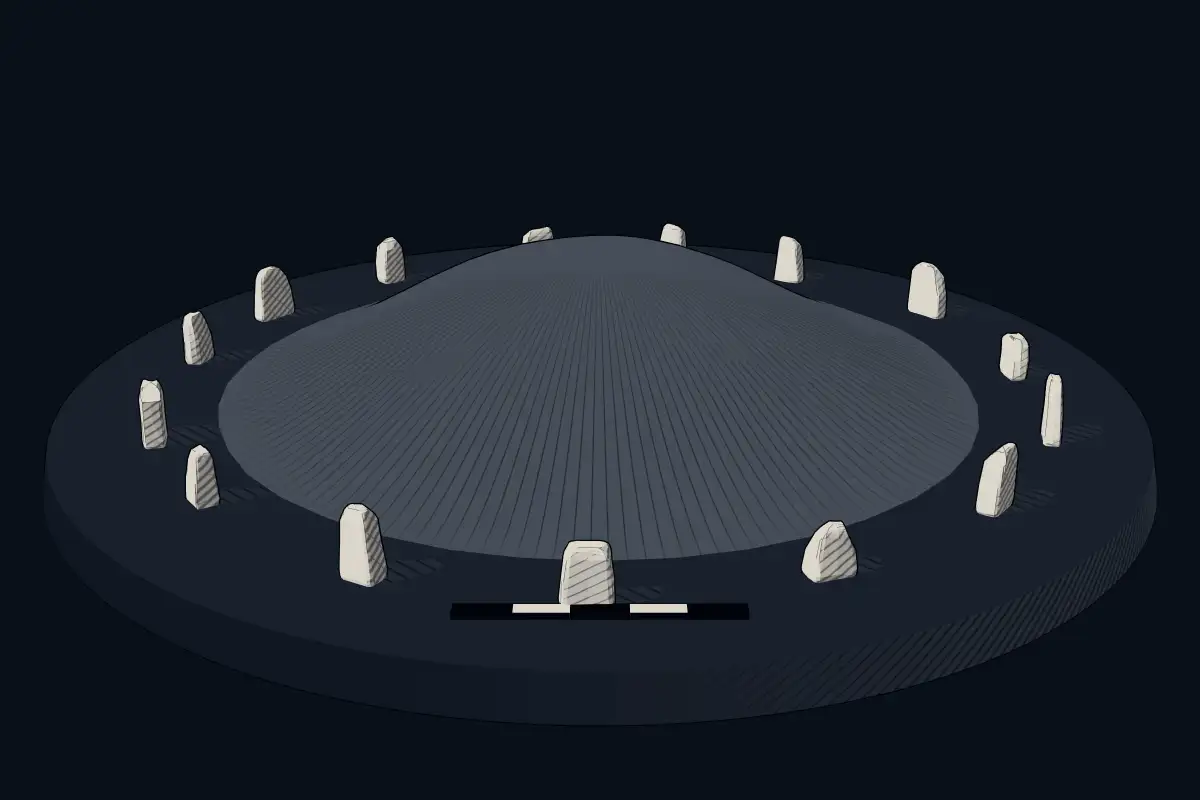
No licensed photograph yetWe have no photograph we may publish for this site, so the interpretive 3D view leads instead.
Overview
About this site
Overview
Råberg is a megalithic mound in Pargas, Finland. It lies at 60.1897° N, 21.3554° E.
Catalogue recordSources and licences
Where it sits in time
The site's dated range, placed against world reference points.
The scale is logarithmic: each step to the left is about ten times older than the last.
Article
Råberg
ContextSources for this section
- en.wikipedia.orgCC BY-SA 4.0
- en.wikipedia.orgCC BY-SA 4.0
- en.wikipedia.orgCC BY-SA 4.0
- en.wikipedia.orgCC BY-SA 4.0
Sources for this section
- en.wikipedia.orgCC BY-SA 4.0
- en.wikipedia.orgCC BY-SA 4.0
- en.wikipedia.orgCC BY-SA 4.0
- en.wikipedia.orgCC BY-SA 4.0
Finland's prehistoric stone monuments are cairns and boulder enclosures, built by hunter-gatherers and early farmers on ridges that once looked out over the sea. The best-preserved cairn field is Sammallahdenmäki, near Rauma, a UNESCO World Heritage Site since 1999. Thirty-three granite cairns lie in clusters along a long ridge, built from boulders quarried from the cliff below or gathered on the spot. They date from about 1500 to 500 BCE; twenty-eight are early Bronze Age and the rest early Iron Age. Two are unusual: the Huilun pitkä raunio, the "long ruin of Huilu", is ringed by an ancient stone wall, and Kirkonlaattia, "Church Floor", is a rectangular cairn. Many cairns have not been dug, and dating then relies on their shape and on excavated neighbours. The regional background, “Finnish Bronze Age cairns and giant's churches”, is given below.
DatingSources for this section
- en.wikipedia.orgCC BY-SA 4.0
Sources for this section
- en.wikipedia.orgCC BY-SA 4.0
No scientific date has been published for this site. Monuments of this type in Finland are generally dated 2000 BCE to 500 BCE; the site itself may fall inside or outside that range.
Finnish burial mounds belong to the Bronze Age of the Nordic sphere (c. 2000-500 BC); the Battle Axe culture flourished in south-west Finland c. 2800-2300 BC.
Setting
26 other recorded monuments lie within 10 km (2 within 1 km, 7 within 5 km), 23 of them of the same type. In Pargas, Finland, 163 of the 176 recorded monuments are of this type.
The nearest recorded monuments are Mars (0.3 km north, megalithic mound); Västerskogen 2 (0.6 km north, megalithic mound); Trollberg (2.4 km north-east, megalithic mound); Grangård (3.2 km north-east, megalithic mound).
ProtectionSources for this section
Sources for this section
Heritage status: registered archaeological site in Finland.
Tradition and region
About this kind of monument
Finnish Bronze Age cairns and giant's churches
Finland's prehistoric stone monuments are cairns and boulder enclosures, built by hunter-gatherers and early farmers on ridges that once looked out over the sea. The best-preserved cairn field is Sammallahdenmäki, near Rauma, a UNESCO World Heritage Site since 1999. Thirty-three granite cairns lie in clusters along a long ridge, built from boulders quarried from the cliff below or gathered on the spot. They date from about 1500 to 500 BCE; twenty-eight are early Bronze Age and the rest early Iron Age. Two are unusual: the Huilun pitkä raunio, the "long ruin of Huilu", is ringed by an ancient stone wall, and Kirkonlaattia, "Church Floor", is a rectangular cairn. Many cairns have not been dug, and dating then relies on their shape and on excavated neighbours.
An older and different tradition is the "Giant's Churches" (Jätinkirkko) of the Ostrobothnia coast. These are rectangular or oval embankments of boulders, about forty known, spread along a 400-kilometre strip of coast from Kokkola to Kemi. They are dated to the Subneolithic, roughly 3500 to 2000 BCE, and were built by hunter-gatherers; the largest known, Kastelli, encloses an area of 60 by 35 metres. Although they stand inland today, they were probably built on the shore. There is no firm evidence of their purpose; one suggestion is that seal hunters used them on the spring ice.
The name is itself folk tradition: jätinkirkko, "giant's church", is a popular label that says nothing about what the enclosures were really for.
When visiting, walk a cairn field along the ridge and notice how each cairn sits slightly apart, often on the highest ground, and look for the straight sides and rounded corners of a giant's church in the forest.
Paraphrased from Wikipedia: Sammallahdenmäki, Wikipedia: Giant's Churches, Wikipedia: Cairn, Wikipedia: Burial mound · CC BY-SA 4.0
See it in 3D
An interpretive reconstruction of the monument, standing on the real ground at its exact point, under the sun for that place and season. Drag to look around it.
The reconstruction is ours, not a survey: it shows what a monument of this type looks like, at the size the record gives for this one.
Lore
Evidence & Lore
What the sources actually support — and, kept apart, what has been claimed.
What the evidence supports
Dates
Est. 2000–500 BCEHow this date was established: Type comparisonTypical range for megalithic mounds in Finland; this site has not been dated itself. Finnish burial mounds belong to the Bronze Age of the Nordic sphere (c. 2000-500 BC); the Battle Axe culture flourished in south-west Finland c. 2800-2300 BC.Source for this date
Where it stands
Finland
The pin marks the monument itself — its exact point.
- Coordinates
- 60°11′23″ N, 21°21′19″ EFor a GPS or map app: 60.18972, 21.35540
Access is as our sources describe it; we have not visited the site to check.
Nearby
The closest sites in the Atlas, by straight line.
- Megalithic mound (tumulus with integral stones)Mars2000–500 BCE
- Megalithic mound (tumulus with integral stones)Västerskogen 22000–500 BCE
- Megalithic mound (tumulus with integral stones)Trollberg2000–500 BCE
- Megalithic mound (tumulus with integral stones)Grangård2000–500 BCE
- Megalithic mound (tumulus with integral stones)Timmerholm2000–500 BCE
- Megalithic mound (tumulus with integral stones)Bertvik2000–500 BCE
- Megalithic mound (tumulus with integral stones)Västerskogen 12000–500 BCE
- Megalithic mound (tumulus with integral stones)Kärrback2000–500 BCE
Sources
Every record behind this page, with the link it came from.
2 sources behind this page
- 01Wikidata Q65106927wikidata.org
- 02Source for this dateen.wikipedia.org
Report a correctionWrong date, name, photograph or source? Tell us and it will be put right.
Around this place
The ten nearest sites, by compass
Credit
Text, licence and sources
Compiled from open records (Wikidata, CC0; OpenStreetMap, ODbL) and a regional background article based on Wikipedia (CC BY-SA 4.0).
- Wikidata Q65106927CC0
- en.wikipedia.orgCC BY-SA 4.0
- en.wikipedia.orgCC BY-SA 4.0
- en.wikipedia.orgCC BY-SA 4.0
- en.wikipedia.orgCC BY-SA 4.0
- en.wikipedia.orgCC BY-SA 4.0