Megalithic mound (tumulus with integral stones)The Copper Age
Zearbide 2
DatedEst. 4300–1200 BCE
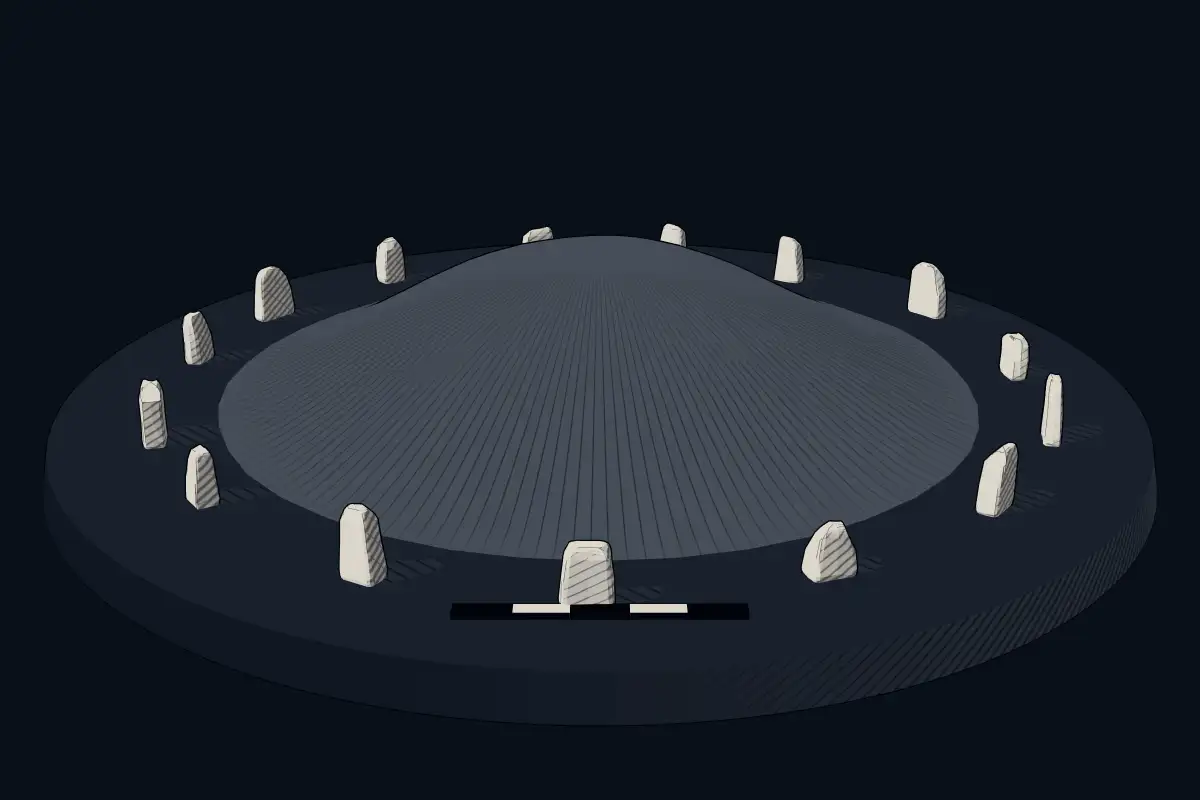
No licensed photograph yetWe have no photograph we may publish for this site, so the interpretive 3D view leads instead.
Overview
About this site
Overview
Zearbide 2 is a megalithic mound in Ultzama, Spain. It lies at 42.9738° N, 1.6532° W, at an elevation of 756 m.
Catalogue recordSources and licences
Where it sits in time
The site's dated range, placed against world reference points.
The scale is logarithmic: each step to the left is about ten times older than the last.
Article
Zearbide 2
ContextSources for this section
- en.wikipedia.orgCC BY-SA 4.0
- en.wikipedia.orgCC BY-SA 4.0
- en.wikipedia.orgCC BY-SA 4.0
- en.wikipedia.orgCC BY-SA 4.0
Sources for this section
- en.wikipedia.orgCC BY-SA 4.0
- en.wikipedia.orgCC BY-SA 4.0
- en.wikipedia.orgCC BY-SA 4.0
- en.wikipedia.orgCC BY-SA 4.0
Most of the Atlas's Iberian mounds lie in the northern highlands, especially the Basque country, where prehistoric collective graves are found in great numbers. Archaeologists there separate dolmens, which have a stone chamber covered by a mound of stones and earth, from "tumuli" or mounds that have no chamber but were used in the same way, for collective burial. Roughly 800 dolmens and about 500 mounds are known in the Basque Country, though some of the mounds may be dolmens waiting to be excavated. The regional background, “Iberian tumuli”, is given below.
DatingSources for this section
- en.wikipedia.orgCC BY-SA 4.0
Sources for this section
- en.wikipedia.orgCC BY-SA 4.0
No scientific date has been published for this site. Monuments of this type in Spain are generally dated 4300 BCE to 1200 BCE; the site itself may fall inside or outside that range.
Megalithic construction in southern Spain c. 4300 BC and in Malaga and Guadiana c. 3500 BC; the last vestiges of the Mediterranean megalithic tradition date to c. 1200 BC.
Setting
156 other recorded monuments lie within 10 km (15 within 1 km, 27 within 5 km), 42 of them of the same type. The site belongs to a dense concentration of monuments. In Ultzama, Spain, 11 of the 54 recorded monuments are of this type.
The nearest recorded monuments are Zearbide 3 (0.0 km south-east, megalithic mound); Zearbide 1 (0.0 km north-west, megalithic mound); Zearbide 4 (0.1 km south, megalithic mound); Zearbide 5 (0.1 km east, megalithic mound).
ProtectionSources for this section
Sources for this section
Heritage status: Archaeological site in Nafarroa.
Tradition and region
About this kind of monument
Iberian tumuli
Most of the Atlas's Iberian mounds lie in the northern highlands, especially the Basque country, where prehistoric collective graves are found in great numbers. Archaeologists there separate dolmens, which have a stone chamber covered by a mound of stones and earth, from "tumuli" or mounds that have no chamber but were used in the same way, for collective burial. Roughly 800 dolmens and about 500 mounds are known in the Basque Country, though some of the mounds may be dolmens waiting to be excavated.
Both kinds are placed in spots of great visibility, often on mountain ridges, and are built of local materials; the larger ones tend to be in lowland areas and the smaller ones in mountain zones. The dead were placed in the chamber or under the mound over generations, and older remains were moved aside to make room for newer ones, which is why very few Basque monuments have a clear layered record. Megalithic burial arrived in the late Neolithic, was in constant use in the Chalcolithic and Early Bronze Age, and in some mounds continued as late as the Iron Age.
Across Iberia the picture changes with the Bell Beaker phenomenon of the late Chalcolithic, which brought individual graves, often under mounds, in contrast with the collective graves that came before.
Dating is difficult, because few mounds have been excavated and the collective burials were disturbed, so the Atlas gives broad typological ranges.
When visiting, look for low circular mounds of stone on high ground in pasture, often with a ring of larger stones or a dip in the centre where a chamber may have collapsed, and for neighbouring stone circles on the same ridge.
Paraphrased from Wikipedia: Basque prehistory, Wikipedia: Tumulus, Wikipedia: Bell Beaker culture, Wikipedia: Dolmen · CC BY-SA 4.0
See it in 3D
An interpretive reconstruction of the monument, standing on the real ground at its exact point, under the sun for that place and season. Drag to look around it.
The reconstruction is ours, not a survey: it shows what a monument of this type looks like, at the size the record gives for this one.
Lore
Evidence & Lore
What the sources actually support — and, kept apart, what has been claimed.
What the evidence supports
Dates
Est. 4300–1200 BCEHow this date was established: Type comparisonTypical range for megalithic mounds in Spain; this site has not been dated itself. Megalithic construction in southern Spain c. 4300 BC and in Malaga and Guadiana c. 3500 BC; the last vestiges of the Mediterranean megalithic tradition date to c. 1200 BC.Source for this date
Where it stands
Spain
The pin marks the monument itself — its exact point.
- Coordinates
- 42°58′26″ N, 1°39′12″ WFor a GPS or map app: 42.97375, -1.65325
Access is as our sources describe it; we have not visited the site to check.
Nearby
The closest sites in the Atlas, by straight line.
- Megalithic mound (tumulus with integral stones)Zearbide 34300–1200 BCE
- Megalithic mound (tumulus with integral stones)Zearbide 14300–1200 BCE
- Megalithic mound (tumulus with integral stones)Zearbide 44300–1200 BCE
- Megalithic mound (tumulus with integral stones)Zearbide 54300–1200 BCE
- Megalithic mound (tumulus with integral stones)Zearbide 64300–1200 BCE
- MegalithBordaondoa 54300–1200 BCE
- MegalithBordaondoa 64300–1200 BCE
- MegalithBordaondoa 44300–1200 BCE
Sources
Every record behind this page, with the link it came from.
2 sources behind this page
- 01Wikidata Q66115139wikidata.org
- 02Source for this dateen.wikipedia.org
Report a correctionWrong date, name, photograph or source? Tell us and it will be put right.
Around this place
The ten nearest sites, by compass
Credit
Text, licence and sources
Compiled from open records (Wikidata, CC0; OpenStreetMap, ODbL) and a regional background article based on Wikipedia (CC BY-SA 4.0).
- Wikidata Q66115139CC0
- en.wikipedia.orgCC BY-SA 4.0
- en.wikipedia.orgCC BY-SA 4.0
- en.wikipedia.orgCC BY-SA 4.0
- en.wikipedia.orgCC BY-SA 4.0
- en.wikipedia.orgCC BY-SA 4.0