Iontza
DatedEst. 3300–2500 BCE
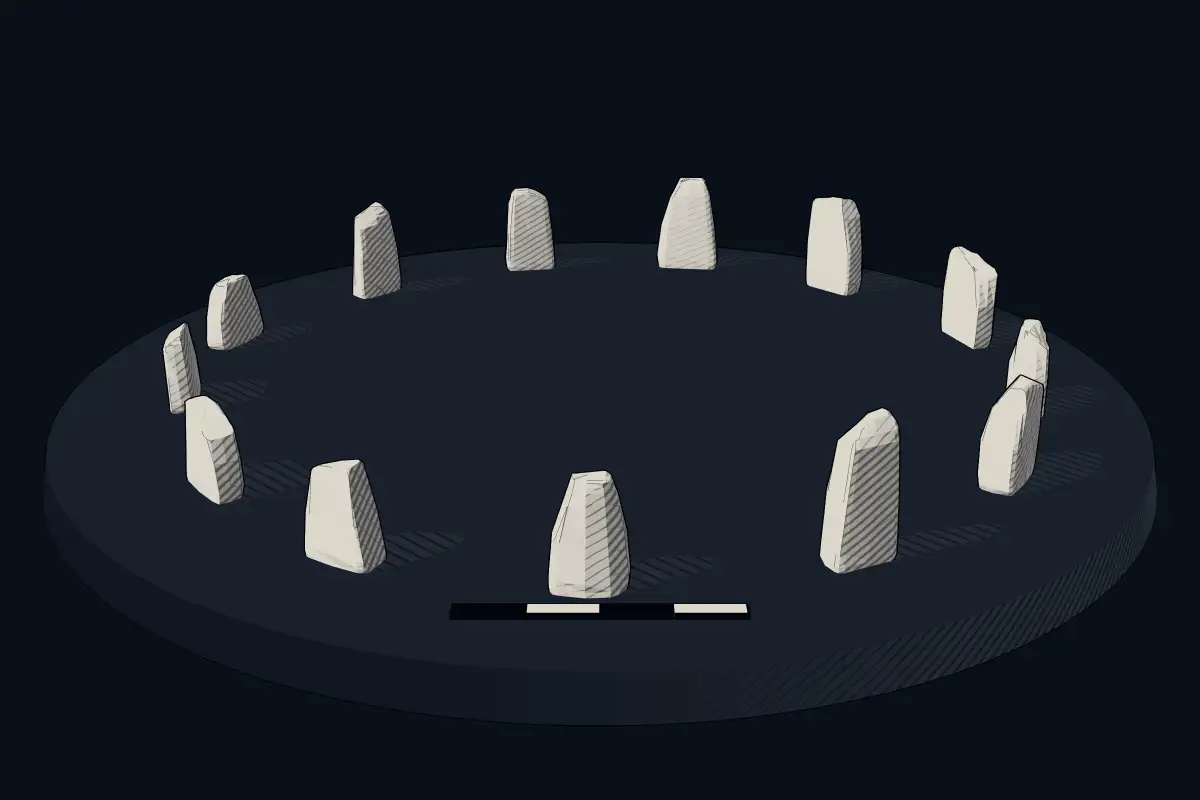
No licensed photograph yetWe have no photograph we may publish for this site, so the interpretive 3D view leads instead.
Overview
About this site
What the sources say
Iontza is a stone circle in Basaburua, Spain. Its entries are Wikidata item Q66114038; the position in the catalogue is 43.0412° N, 1.8555° W. Wikidata gives an elevation of 895 m.
Built from structured records, not from an articleSources and licences
Where it sits in time
The site's dated range, placed against world reference points.
The scale is logarithmic: each step to the left is about ten times older than the last.
The full article
About Iontza
This kind of monument hereSources for this section
- en.wikipedia.orgCC BY-SA 4.0
- en.wikipedia.orgCC BY-SA 4.0
- en.wikipedia.orgCC BY-SA 4.0
- en.wikipedia.orgCC BY-SA 4.0
- en.wikipedia.orgCC BY-SA 4.0
Sources for this section
- en.wikipedia.orgCC BY-SA 4.0
- en.wikipedia.orgCC BY-SA 4.0
- en.wikipedia.orgCC BY-SA 4.0
- en.wikipedia.orgCC BY-SA 4.0
- en.wikipedia.orgCC BY-SA 4.0
In French, Spanish and many other languages a cromlech is a stone circle. In the Pyrenees, and especially in the Basque lands, the commonest stone circles are small burial monuments of the Iron Age. About 851 of these funerary cromlechs are documented in the Pyrenean region. Their diameters are 3 to 7 metres, with a burial in the middle, and the dead were not cremated inside the circle but at a nearby place, with only a handful of ashes carried to the monument. Burial customs changed over time, with a clear dominance of cremation in the Iron Age, and the ashes were placed in stone circles, mounds, caves, cists or urn fields. The full article, “Iberian and French cromlechs”, follows below under About this kind of monument.
DatingSources for this section
- en.wikipedia.orgCC BY-SA 4.0
Sources for this section
- en.wikipedia.orgCC BY-SA 4.0
Typological estimate, not a date for this site: monuments of this kind in this region are normally dated 3300 BCE to 2500 BCE. The range comes from what is known about stone circle monuments in Spain; nothing measured on this site itself is on record, so it may be younger or older than the range suggests.
The range rests on this regional background (source: the Wikipedia article “Stone circle”): Stone circles are typical of north-western Europe and most were built between 3300 and 2500 BC.
Landscape and neighbours
Within 10 km lie 180 other catalogued sites (0 within 1 km, 37 within 5 km); 29 of them are also classed as stone circle. That puts it inside a dense cluster of monuments. In Basaburua, Spain, 1 of the 22 catalogued sites are classed as stone circle.
The closest catalogued sites are Beztaun (Korosmendia) (1.2 km south-east, dolmen); Dolmen de Bi Aizpen (1.5 km north-east, dolmen); Bi Ahizpen Sepultura (Leitzegi) (1.5 km north-east, dolmen); Oriñ (destruido) (1.5 km north, dolmen). The catalogue is assembled from open records and is not complete, so unrecorded monuments may lie closer.
Records and protectionSources for this section
Sources for this section
Heritage records attach the status Archaeological site in Nafarroa to this site. The open records for it are Wikidata (Q66114038), where corrections and further identifiers can be added. Sites of this kind often lie on farmland or other private ground, so check local access rules before visiting and leave the monument as you found it.
How this page was madeSources for this section
Sources for this section
Nothing on this page was written by an AI model: it is assembled by program from Wikidata (CC0), the heritage register named above and the regional article “Iberian and French cromlechs”, written for the Atlas from the Wikipedia articles it cites (CC BY-SA 4.0), with distances and counts calculated from the catalogue coordinates.
Tradition and region
About this kind of monument
Iberian and French cromlechs
In French, Spanish and many other languages a cromlech is a stone circle. In the Pyrenees, and especially in the Basque lands, the commonest stone circles are small burial monuments of the Iron Age. About 851 of these funerary cromlechs are documented in the Pyrenean region. Their diameters are 3 to 7 metres, with a burial in the middle, and the dead were not cremated inside the circle but at a nearby place, with only a handful of ashes carried to the monument. Burial customs changed over time, with a clear dominance of cremation in the Iron Age, and the ashes were placed in stone circles, mounds, caves, cists or urn fields.
The Alentejo in Portugal has much older circles. The Almendres Cromlech, near Évora, is the largest group of structured menhirs on the Iberian Peninsula, one of the largest in Europe. About 95 granite monoliths stand in small groups. The older Early Neolithic stones form two or three concentric circles of smaller monoliths in the west, the Middle Neolithic ones form two irregular ellipses with large menhirs, and in the Late Neolithic the earlier work was modified into a site for ritual. Many stones were found where they had fallen and were re-erected by Mário Varela Gomes. The site was rediscovered in 1966.
The dates are very different, from the Neolithic in Portugal to the Iron Age in the Pyrenees, so the single word cromlech hides several traditions.
When visiting, look for the entrance gap or axis of a circle, for the stones' differing heights, and for the position of the monument in relation to the sunrise.
Paraphrased from Wikipedia: Cromlech, Wikipedia: Almendres Cromlech, Wikipedia: Basque prehistory, Wikipedia: Portela de Mogos Cromlech, Wikipedia: Carnac stones · CC BY-SA 4.0
See it in 3D
An interpretive reconstruction of the monument, standing on the real ground at its exact point, under the sun for that place and season. Drag to look around it.
The reconstruction is ours, not a survey: it shows what a monument of this type looks like, at the size the record gives for this one.
Lore
Evidence & Lore
What the sources actually support — and, kept apart, what has been claimed.
What the evidence supports
Dates
Est. 3300–2500 BCEHow this date was established: Type comparisonTypical range for stone circles in Spain; this site has not been dated itself. Stone circles are typical of north-western Europe and most were built between 3300 and 2500 BC.Source for this date
Where it stands
Spain
The pin marks the monument itself — its exact point.
- Coordinates
- 43°02′28″ N, 1°51′20″ WFor a GPS or map app: 43.04115, -1.85548
Access is as our sources describe it; we have not visited the site to check.
Nearby
The closest sites in the Atlas, by straight line.


Sources
Every record behind this page, with the link it came from.
2 sources behind this page
- 01Wikidata Q66114038wikidata.org
- 02Source for this dateen.wikipedia.org
Report a correctionWrong date, name, photograph or source? Tell us and it will be put right.
Around this place
The ten nearest sites, by compass
Credit
Text, licence and sources
This page is assembled from open records (Wikidata, CC0; OpenStreetMap, ODbL) and a tradition article paraphrasing Wikipedia (CC BY-SA 4.0). No article exists for this site, and nothing here is written by a model.
- Wikidata Q66114038CC0
- en.wikipedia.orgCC BY-SA 4.0
- en.wikipedia.orgCC BY-SA 4.0
- en.wikipedia.orgCC BY-SA 4.0
- en.wikipedia.orgCC BY-SA 4.0
- en.wikipedia.orgCC BY-SA 4.0
- en.wikipedia.orgCC BY-SA 4.0