
Casal de Vilalba
Photo ca:user:amadalvarez · Public domainSource file on Wikimedia Commons

Overview
About this site
Overview
Casal de Vilalba is a large house in the municipality of La Roca del Vallès, in the Vallès Oriental, Catalonia, Spain. It is declared a cultural asset of national interest (bé cultural d'interès nacional). It stands on an extensive archaeological site that is included in the Inventory of Archaeological and Palaeontological Heritage of Catalonia. The atlas record lists it with the type cist.
Read on Wikipedia2 min readCC BY-SA 4.0
Article
Casal de Vilalba
The house was raised in the middle of the nineteenth century on prehistoric, Iberian, Roman, Visigothic, Romanesque and Gothic remains.
DescriptionSources for this section
- Wikipedia (Catalan): Casal de VilalbaCC BY-SA 4.0
Sources for this section
- Wikipedia (Catalan): Casal de VilalbaCC BY-SA 4.0
The house was raised in the middle of the nineteenth century on prehistoric, Iberian, Roman, Visigothic, Romanesque and Gothic remains. It has a complex plan with several annexes, and arcaded galleries on the north and east sides. In front of the north facade lies a courtyard closed by a portico with semicircular arches. The portico joins the entrance door, which continues along the east facade to form a large courtyard in front of the south facade. The facade was restored in 1951 and keeps an original lintel with the monogram of Christ.
Remains of the old tower with arrow slits survive inside the house, together with the old door of iron and wood that gave access to the former castle. Inside there is also a domed space four storeys high with a skylight and pointed arches, and a chapel with a single nave, a barrel vault with two transverse arches, a square apse and a polychrome wooden altar. The house is surrounded by woods, meadows and gardens, and a golf course was laid out on the adjacent land at the end of the twentieth century.
HistorySources for this section
- Wikipedia (Catalan): Casal de VilalbaCC BY-SA 4.0
Sources for this section
- Wikipedia (Catalan): Casal de VilalbaCC BY-SA 4.0
The small settlement called Vilalba is first mentioned in 932, when Teodoric, bishop of Barcelona, consecrated and endowed the church of Sant Genís with this property. A deed of Ramon Borrell dates from 996 and is kept in the Archive of the Crown of Aragon. The place is mentioned again in 1013 and in documents of 1471 and 1713.
It later belonged to the monastery of Montserrat. After the confiscation of church property in 1836, it was bought at auction by Marià Borrell i de Miralpeix, who transformed the old building into the present house. In December 1919 it was bought by Francisco Rivière Chavany, who wished to open up investment possibilities other than industry and to create a house where his family could gather as it grew.
Tradition and region
About this kind of monument
Stone cists
A cist, or kist, is a small stone-built coffin-like box or ossuary used to hold the bodies of the dead. Cists are found across Europe and the Middle East, and in some ways resemble a shaft tomb. They may have been associated with other monuments, perhaps under a cairn or a long barrow, and several cists are sometimes found close together within the same cairn or barrow. Ornaments have often been found in excavated cists, indicating the wealth or prominence of the person buried. The word is related to the Ancient Greek kiste and to English chest.
In Britain and Ireland, the Bronze Age cist is a common grave type: a round barrow may have a stone cist or a cut grave at its centre, and the burial may be an inhumation or a cremation placed in a vessel. The Bell Beaker phenomenon brought individual burials, often under tumuli, with weapons, in contrast with the earlier Neolithic tradition of collective burial.
Cists differ from chambered cairns because the cist is typically smaller than a chamber and holds fewer interments.
Dating relies on the objects inside and on radiocarbon dating of surviving bone; where neither is available the Atlas gives a broad range from the Neolithic to the Bronze Age.
When visiting, look for the slab lining, the capping stone and any ring of stones that marks where a cairn stood.
Paraphrased from Wikipedia: Cist, Wikipedia: Round barrow, Wikipedia: Bell Beaker culture, Wikipedia: Cairn, Wikipedia: Chambered cairn · CC BY-SA 4.0
From the article
Dated moments in the story
- 932 CE
La Vileta anomenada Vilalba se cita per primer cop el 932 quan Teodoric, bisbe de Barcelona consagra i dota l'església de Sant Genís amb aquest bé.
Source - 996 CE
Del 996 data l'escriptura de Ramon Borrell, conservat a l'Arxiu de la Corona d'Aragó.
Source - 1013
El mateix el 1013 i altres documents del 1471, 1713… Després fou del monestir de Montserrat però amb la desamortització de 1836, ho adquirí per subhasta Marià Borrell i de Miralpeix, que transformà l'antic edifici en el casal actual.
Source - 1919
El desembre de 1919 el comprà Francisco Rivière Chavany per obrir noves possibilitats d'inversió diferents de la industrial i al mateix temps per crear una casa on poder reunir tota la família a mida que aquesta anès creixent.
Source - 1951
A la façana, restaurada en el 1951, s'hi conserva una llinda original amb l'anagrama de Crist.
Source
See it in 3D
An interpretive reconstruction of the monument, standing on the real ground at its exact point, under the sun for that place and season. Drag to look around it.
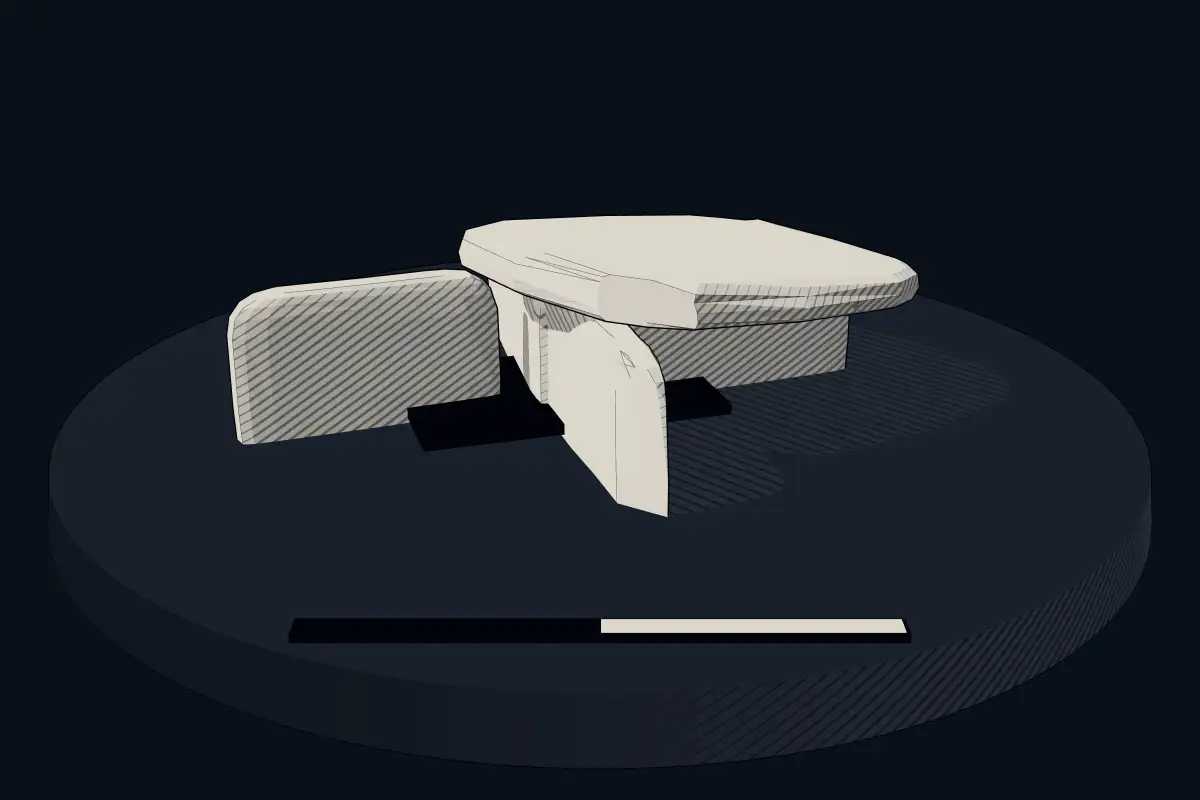
The reconstruction is ours, not a survey: it shows what a monument of this type looks like, at the size the record gives for this one.
Photographs
1 photograph, each with its author and licence
Where it stands
Spain
The pin marks the monument itself — its exact point.
- Coordinates
- 41°37′51″ N, 2°20′58″ EFor a GPS or map app: 41.63070, 2.34945
Access is as our sources describe it; we have not visited the site to check.
Nearby
The closest sites in the Atlas, by straight line.
 Cromlec de Pins Rosers3300–2500 BCE
 Pedra Gravada del Turó dels Castellans4300–1200 BCE
 Dolmen de Can Planes4000–3000 BCE
 Roca Foradada de Can Planes4300–1200 BCE
- MegalithPedra de l'Escorpí4300–1200 BCE
- Statue-menhirStatue-menhir of Ca l'Estrada
 Dolmen de Céllecs4000–3000 BCE
- MegalithPedra de les Creus4300–1200 BCE


Sources
Every record behind this page, with the link it came from.
1 source behind this page
- 01Wikidata Q18003813wikidata.org
Image files
- Laroca-castellvilalba-6962-01.jpgca:user:amadalvarezPublic domain
Report a correctionWrong date, name, photograph or source? Tell us and it will be put right.
Around this place
The ten nearest sites, by compass
- Cromlec de Pins Rosers1.6 km SE
- Pedra Gravada del Turó dels Castellans4.7 km SE
- Dolmen de Can Planes5.0 km S
- Roca Foradada de Can Planes5.5 km S
- Pedra de l'Escorpí5.5 km S
- Statue-menhir of Ca l'Estrada5.7 km SW
- Dolmen de Céllecs7.3 km S
- Pedra de les Creus7.3 km S
- Dolmen de Pedrarca7.5 km E
- Pedra de les Creus7.6 km S
Credit
Text, licence and sources
Adapted from the Wikipedia article "Casal de Vilalba" (Catalan), licensed CC BY-SA 4.0; authors are listed in the page history. Reused under CC BY-SA 4.0. Read on Wikipedia · Edit history and authors
- Wikipedia (Catalan): Casal de VilalbaCC BY-SA 4.0
- Wikidata Q18003813CC0