

Overview
About this site
What the sources say
Le dolmen d'Artzanburu est un site archéologique mégalithique qui se situe dans la commune de Oñati, dans la province de Guipuscoa au Pays basque (Espagne).
Il est classé bien d'intérêt culturel.
Article in FrenchRead on Wikipedia3 min readCC BY-SA 4.0
Where it sits in time
The site's dated range, placed against world reference points.
The scale is logarithmic: each step to the left is about ten times older than the last.
The full article
Artzanburu: the whole story
In briefSources for this section
- Wikipedia (French): Dolmen d'ArtzanburuCC BY-SA 4.0
Sources for this section
- Wikipedia (French): Dolmen d'ArtzanburuCC BY-SA 4.0
Artzanburu is a dolmen in Oñati, in Guipuscoa province in the Basque Country, Spain. It is classified as a site of cultural interest and forms part of the Aizkorri megalithic station. The site has been associated with the Neolithic, Copper Age and Bronze Age.
The monument is a stone-and-earth tumulus measuring 13,5 m in diameter and 1,50 m in height. At its centre is a crater 6,5 m across, containing a dolmenic chamber measuring 2 × 2 m and 0,70 m deep. Four orthostates form the top of the former chamber, and fragments of other broken slabs also survive. It was built from local limestone.
José Miguel de Barandiarán Ayerbe discovered Artzanburu in 1917. Barandiarán, Telesforo Aranzadi and Enrique Eguren excavated it in 1918. Its estimated date is 4000 BCE to 3000 BCE, based on typological comparison.
Dolmens in Spain include examples from Andalusia in the south to Galicia in the north-west. The tradition accompanying Artzanburu describes the Antequera Dolmens Site in Andalusia, including Menga, Viera and El Romeral, which was inscribed as a UNESCO World Heritage Site in 2016.
No English Wikipedia article exists for it; the full text below is the French article "Dolmen d'Artzanburu", shown in the original language.
Summary in EnglishSources for this section
- Wikipedia (French): Dolmen d'ArtzanburuCC BY-SA 4.0
Sources for this section
- Wikipedia (French): Dolmen d'ArtzanburuCC BY-SA 4.0
Artzanburu is a dolmen in Oñati, Spain. A typological estimate: 4000 BCE to 3000 BCE. No English Wikipedia article exists for it; the full text below is the French article "Dolmen d'Artzanburu", shown in the original language.
HistoriqueSources for this section
- Wikipedia (French): Dolmen d'ArtzanburuCC BY-SA 4.0
Sources for this section
- Wikipedia (French): Dolmen d'ArtzanburuCC BY-SA 4.0
Il a été découvert par José Miguel de Barandiarán Ayerbe en 1917. Il a été fouillé en 1918 par Barandiaran lui-même, Telesforo Aranzadi et Enrique Eguren.
C'est un des éléments de la station mégalithique d'Aizkorri (eu). Le site a été associé aux périodes néolithique, âge du cuivre et de l'âge du bronze.
DescriptionSources for this section
- Wikipedia (French): Dolmen d'ArtzanburuCC BY-SA 4.0
Sources for this section
- Wikipedia (French): Dolmen d'ArtzanburuCC BY-SA 4.0
Il s'agit d' un tumulus de pierre et de terre de 13,5 m de diamètre et 1,50 m de hauteur. Son centre présente un cratère de 6,5 m de diamètre, renfermant une chambre dolmenique de 2 × 2 m de diamètre et 0,70 m de profondeur. À l'intérieur de cette dernière, quatre orthostates forment le sommet de l'ancienne chambre. On y trouve également des vestiges d'autres dalles brisées. Le dolmen a été construit en calcaire local.
How this page was madeSources for this section
- Wikipedia (French): Dolmen d'ArtzanburuCC BY-SA 4.0
Sources for this section
- Wikipedia (French): Dolmen d'ArtzanburuCC BY-SA 4.0
The summary at the top of this page was written by MiniMax-M3 (2026-11-08) from the cited Wikipedia article “Dolmen d'Artzanburu”, translated from French. The numbers in it were checked automatically against the source text. The rest of the page is the article itself, the structured records and computed distances.
Tradition and region
About this kind of monument
Dolmens of Andalusia, Extremadura and Galicia
Spain has a great many megalithic tombs, and the Atlas's Spanish dolmens run from Andalusia in the south to Galicia in the north-west. The finest are at Antequera in Andalusia, where the Dolmen of Menga, dated to about 3750 to 3650 BCE, is among the largest ancient megalithic structures in Europe. It is 27.5 metres long, 6 metres wide and 3.5 metres high, built with thirty-two megaliths, the largest weighing about 180 tonnes. After the chamber was finished it was covered with soil and built up into the hill seen today; when it was opened in the nineteenth century archaeologists found the skeletons of several hundred people. The Dolmen of Viera stands 70 metres away, and the tholos of El Romeral lies about 4 kilometres off; the three were inscribed as the Antequera Dolmens Site, a UNESCO World Heritage Site, in 2016.
In the south-west, the Dolmen de Soto at Trigueros in Huelva province is a Neolithic tomb estimated to date between 3000 and 2500 BCE, one of about 200 Neolithic burial sites in the province. It was found in 1922 when its owner, Armando de Soto Morillas, wanted to build a house; the German archaeologist Hugo Obermaier found eight bodies in a fetal position with artefacts, and its engraved and painted uprights have been studied more recently.
In Galicia and Portugal a dolmen is an anta, and in Catalan-speaking areas dolmens have folk names such as cova (cave), caixa (crate or coffin), taula (table) and arca (chest). These names are tradition: they record what people made of the monuments, not what they were built for.
When visiting Menga, look at the great capstones from inside the corridor, and at the way the mound was built up over the chamber.
Paraphrased from Wikipedia: Dolmen of Menga, Wikipedia: Dolmen of Viera, Wikipedia: Antequera Dolmens Site, Wikipedia: Dolmen de Soto, Wikipedia: Dolmen · CC BY-SA 4.0
From the article
Dated moments in the story
- 1917
Il a été découvert par José Miguel de Barandiarán Ayerbe en 1917. Il a été fouillé en 1918 par Barandiaran lui-même, Telesforo Aranzadi et Enrique Eguren.
Source
See it in 3D
An interpretive reconstruction of the monument, standing on the real ground at its exact point, under the sun for that place and season. Drag to look around it.
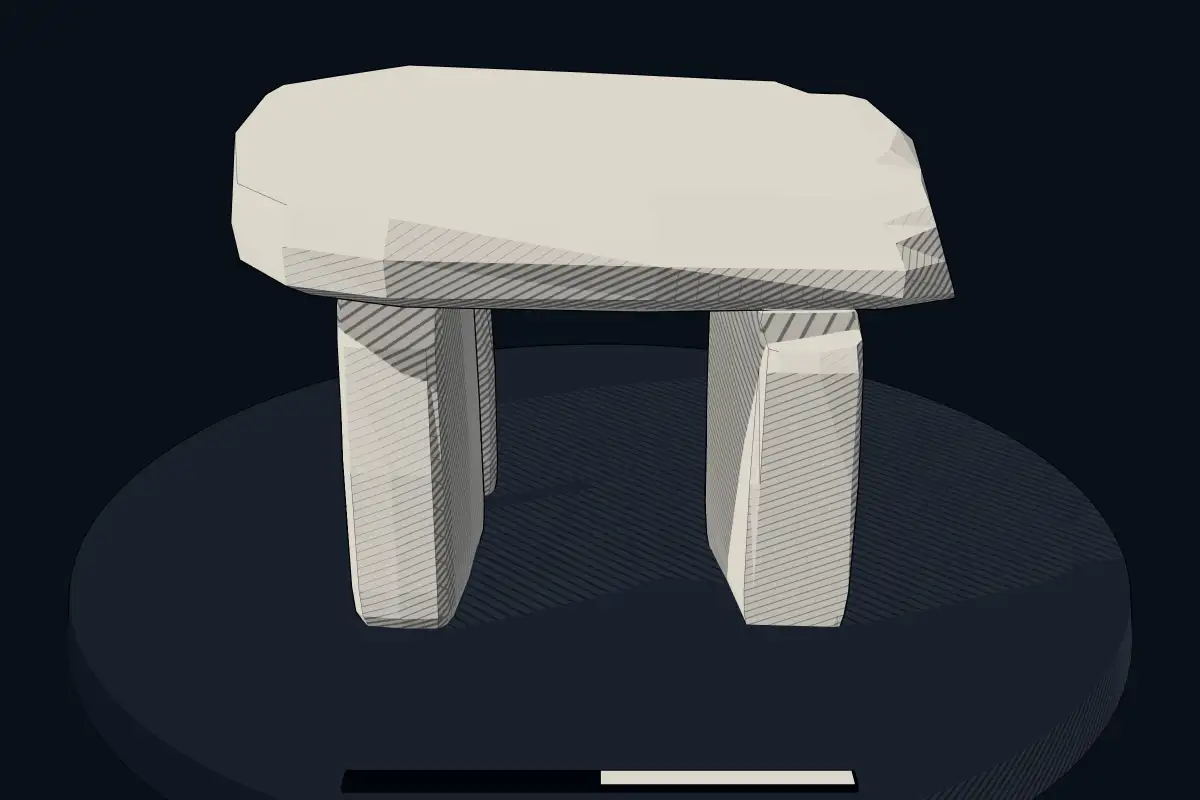
The reconstruction is ours, not a survey: it shows what a monument of this type looks like, at the size the record gives for this one.
Photographs
1 photograph, each with its author and licence
Lore
Evidence & Lore
What the sources actually support — and, kept apart, what has been claimed.
What the evidence supports
Dates
Est. 4000–3000 BCEHow this date was established: Type comparisonTypical range for dolmens in Spain; this site has not been dated itself. Most dolmens date from the Late Neolithic period (4000-3000 BCE); the Dolmen of Menga in Andalusia dates to about 3750-3650 BCE.Source for this date
Where it stands
Spain
The pin marks the monument itself — its exact point.
- Coordinates
- 42°58′37″ N, 2°22′05″ WFor a GPS or map app: 42.97696, -2.36795
Access is as our sources describe it; we have not visited the site to check.
Nearby
The closest sites in the Atlas, by straight line.
- Megalithic mound (tumulus with integral stones)Malla4300–1200 BCE
- DolmenGorostiaran Mendebaldea4000–3000 BCE
- DolmenAizkorritxo4000–3000 BCE
- Megalithic mound (tumulus with integral stones)Gorostiaran Ekialdea4300–1200 BCE
 Pagobakoitza4000–3000 BCE
- Pagobakoitza4000–3000 BCE
 Kalparmuñobarrena4000–3000 BCE
- Menhir (standing stone)Zorrotzarri2800–1800 BCE


Sources
Every record behind this page, with the link it came from.
2 sources behind this page
- 01Wikidata Q133514916wikidata.org
- 02Source for this dateen.wikipedia.org
Image files
Report a correctionWrong date, name, photograph or source? Tell us and it will be put right.
Around this place
The ten nearest sites, by compass
Credit
Text, licence and sources
Text from the Wikipedia article "Dolmen d'Artzanburu" (French), licensed CC BY-SA 4.0; authors are listed in the page history. Reused under CC BY-SA 4.0. Read on Wikipedia · Edit history and authors
- Wikipedia (French): Dolmen d'ArtzanburuCC BY-SA 4.0
- Wikidata Q133514916CC0