

Overview
About this site
What the sources say
Le Mámoa de Chousa Nova est un dolmen situé dans la commune de Silleda, dans la province de Pontevedra, en Galice.
Le mot Mámoa (es) est utilisé dans le nord-ouest de la péninsule ibérique pour désigner les tumulus funéraires caractéristiques du Néolithique.
Article in FrenchRead on Wikipedia5 min readCC BY-SA 4.0
Where it sits in time
The site's dated range, placed against world reference points.
The scale is logarithmic: each step to the left is about ten times older than the last.
The full article
A Chousa Nova: the whole story
In briefSources for this section
- Wikipedia (French): Mámoa de Chousa NovaCC BY-SA 4.0
Sources for this section
- Wikipedia (French): Mámoa de Chousa NovaCC BY-SA 4.0
A Chousa Nova, also known as Mámoa de Chousa Nova, is a dolmen in Silleda, in Pontevedra province, Galicia, Spain. The word “Mámoa” is used in north-west of the Iberian Peninsula for the funerary tumuli characteristic of the Neolithic. The site was found and excavated during construction of the Renfe AVE line between Ourense and Saint-Jacques-de-Compostelle.
The burial chamber was found intact, still containing its funerary goods, making Chousa Nova the second intact dolmen discovered in north-west of the Iberian Peninsula. It consists of a low earth mound surrounded by an outer ditch and a ring of stones. The chamber is formed by five granite orthostates, with an opening to the east, while another pillar and smaller stones appear to mark an entrance. Its covering slab weighed 2 950 kg and had broken into three pieces.
Carbon-14 tests dated Chousa Nova to around 4350 av. J.-C., placing it among the oldest dolmens in Galicia. Excavation revealed a necklace of 35 beads, some of amber and others of variscite, probably from a vein in Zamora province, which seems to have lain on a human chest. It is the second necklace found in situ in Europe. A hoe lay near the head, a chisel near the hand, and a worn sharpener under the feet.
After excavation, the slabs were stored for nearly two years in a warehouse in Silleda. The monument was then reconstructed under archaeological supervision in its original position. The path crossing part of the mound was moved away, electric poles were relocated, and the area was fenced, marked and made museographic, with explanatory panels. Chousa Nova was declared a Bien d interés cultural in 2011.
No English Wikipedia article exists for it; the full text below is the French article "Mámoa de Chousa Nova", shown in the original language.
Summary in EnglishSources for this section
- Wikipedia (French): Mámoa de Chousa NovaCC BY-SA 4.0
Sources for this section
- Wikipedia (French): Mámoa de Chousa NovaCC BY-SA 4.0
A Chousa Nova is a dolmen in Abades, Silleda, Spain. Wikidata describes it as: dolmen in Silleda, Spain. A typological estimate: 4000 BCE to 3000 BCE. No English Wikipedia article exists for it; the full text below is the French article "Mámoa de Chousa Nova", shown in the original language.
DescriptionSources for this section
- Wikipedia (French): Mámoa de Chousa NovaCC BY-SA 4.0
Sources for this section
- Wikipedia (French): Mámoa de Chousa NovaCC BY-SA 4.0
Ce site mégalithique a été trouvé et fouillé lors des travaux de construction de la ligne Renfe AVE entre Ourense et Saint-Jacques-de-Compostelle. La chambre funéraire du dolmen n'avait pas été pillée, elle était intacte et était conservée avec son mobilier funéraire. Il s'agit du deuxième dolmen retrouvé intact dans le nord-ouest de la péninsule ibérique. Des tests au Carbone 14 ont donné une datation à Chousa Nova qui le place comme l'un des plus anciens dolmens de Galice (environ 6 350 ans).
Le tumulus, partiellement détruit par une piste forestière et des travaux agricoles dans la région, était délimité par un fossé extérieur et un anneau de pierres, qui entourent le tertre de terre. Au centre, se trouve une chambre funéraire formée de cinq orthostates délimitant un espace ouvert à l'est, et de faible hauteur. Un autre pilier, ainsi que d'autres pierres plus petites, semblent délimiter une entrée. Le monticule a été affecté par la construction de l'AVE entre Santiago et Ourense.
Fouilles archéologiquesSources for this section
- Wikipedia (French): Mámoa de Chousa NovaCC BY-SA 4.0
Sources for this section
- Wikipedia (French): Mámoa de Chousa NovaCC BY-SA 4.0
.
Les tests au carbone 14 ont donné des dates autour de 4350 av. J.-C., plus ancien que le dolmen de Dombate à Cabana de Bergantiños ou le dolmen de Forno dos Mouros à Toques.
Le Chousa Nova dispose de trois stades. Le premier correspond à une série de fossés sous le monument et de fonction inconnue. Le fossé périphérique actuel mesure environ 8 m autour du monticule et est similaire à celui de Dombate ou d'autres monuments mégalithiques britanniques.
La chambre est composée de cinq dalles de granit. La dalle de couverture de la chambre était une grande dalle pesant 2 950 kg. Celle-ci a été brisée en trois morceaux, dont l'une a été retrouvée dans la même position que lors de sa rupture et les deux autres à l'intérieur de la chambre. À l'intérieur, le mobilier funéraire comprenait un collier de 35 perles, certaines d'ambre et d'autres de variscite, provenant probablement d'une veine de la province de Zamora, semblant se trouver sur une poitrine humaine. Il s'agit du deuxième collier retrouvé in situ en Europe. Une houe placée près de la tête, un ciseau près de la main et un aiguiseur usé sous les pieds. La houe et le ciseau, objets peu communs lors de fouilles, sont interprétés comme un symbole de luxe et de position sociale.
ReconstructionSources for this section
- Wikipedia (French): Mámoa de Chousa NovaCC BY-SA 4.0
Sources for this section
- Wikipedia (French): Mámoa de Chousa NovaCC BY-SA 4.0
Après l'excavation, les dalles du monument ont été conservées pendant près de deux ans dans un entrepôt à Silleda. La reconstruction a été supervisée archéologiquement et l'a placée exactement au même endroit. Le chemin qui traversait une partie du monticule a été modifié, l'éloignant, et les poteaux électriques ont été déplacés. L'espace est clôturé, balisé et muséifié, désormais libre de toute utilisation agricole et forestière. Des panneaux explicatifs sont présents sur le monument, les travaux de fouilles et de reconstruction. Le monument est tel qu'on le connaît. Les trois morceaux de la dalle de couche ont été collés ensemble et sont bien visibles ; quelques pierres de ballast ferroviaire marquent les limites de la construction. Tout près de la zone se trouvent deux autres tombes non fouillées.
Il a été déclaré Bien d'intérêt culturel en 2011.
How this page was madeSources for this section
- Wikipedia (French): Mámoa de Chousa NovaCC BY-SA 4.0
Sources for this section
- Wikipedia (French): Mámoa de Chousa NovaCC BY-SA 4.0
The summary at the top of this page was written by MiniMax-M3 (2026-11-07) from the cited Wikipedia article “Mámoa de Chousa Nova”, translated from French. The numbers in it were checked automatically against the source text. The rest of the page is the article itself, the structured records and computed distances.
Tradition and region
About this kind of monument
Dolmens of Andalusia, Extremadura and Galicia
Spain has a great many megalithic tombs, and the Atlas's Spanish dolmens run from Andalusia in the south to Galicia in the north-west. The finest are at Antequera in Andalusia, where the Dolmen of Menga, dated to about 3750 to 3650 BCE, is among the largest ancient megalithic structures in Europe. It is 27.5 metres long, 6 metres wide and 3.5 metres high, built with thirty-two megaliths, the largest weighing about 180 tonnes. After the chamber was finished it was covered with soil and built up into the hill seen today; when it was opened in the nineteenth century archaeologists found the skeletons of several hundred people. The Dolmen of Viera stands 70 metres away, and the tholos of El Romeral lies about 4 kilometres off; the three were inscribed as the Antequera Dolmens Site, a UNESCO World Heritage Site, in 2016.
In the south-west, the Dolmen de Soto at Trigueros in Huelva province is a Neolithic tomb estimated to date between 3000 and 2500 BCE, one of about 200 Neolithic burial sites in the province. It was found in 1922 when its owner, Armando de Soto Morillas, wanted to build a house; the German archaeologist Hugo Obermaier found eight bodies in a fetal position with artefacts, and its engraved and painted uprights have been studied more recently.
In Galicia and Portugal a dolmen is an anta, and in Catalan-speaking areas dolmens have folk names such as cova (cave), caixa (crate or coffin), taula (table) and arca (chest). These names are tradition: they record what people made of the monuments, not what they were built for.
When visiting Menga, look at the great capstones from inside the corridor, and at the way the mound was built up over the chamber.
Paraphrased from Wikipedia: Dolmen of Menga, Wikipedia: Dolmen of Viera, Wikipedia: Antequera Dolmens Site, Wikipedia: Dolmen de Soto, Wikipedia: Dolmen · CC BY-SA 4.0
From the article
Dated moments in the story
- 2011
Il a été déclaré Bien d'intérêt culturel en 2011.
Source
See it in 3D
An interpretive reconstruction of the monument, standing on the real ground at its exact point, under the sun for that place and season. Drag to look around it.
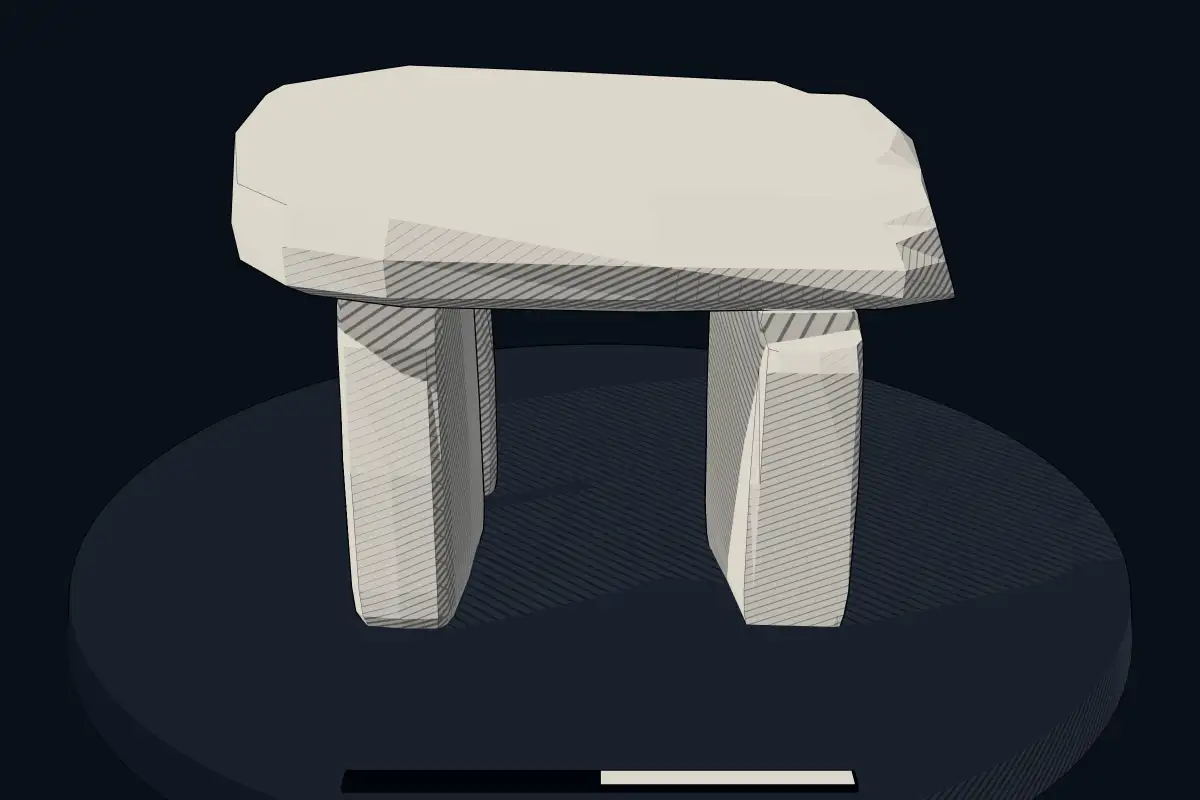
The reconstruction is ours, not a survey: it shows what a monument of this type looks like, at the size the record gives for this one.
Photographs
3 photographs, each with its author and licence
More photographs


Lore
Evidence & Lore
What the sources actually support — and, kept apart, what has been claimed.
What the evidence supports
Dates
Est. 4000–3000 BCEHow this date was established: Type comparisonTypical range for dolmens in Spain; this site has not been dated itself. Most dolmens date from the Late Neolithic period (4000-3000 BCE); the Dolmen of Menga in Andalusia dates to about 3750-3650 BCE.Source for this date
Where it stands
Spain
The pin marks the monument itself — its exact point.
- Coordinates
- 42°45′24″ N, 8°17′34″ WFor a GPS or map app: 42.75679, -8.29275
Access is as our sources describe it; we have not visited the site to check.
Nearby
The closest sites in the Atlas, by straight line.
 Pedrafita do Casal2800–1800 BCE
 pedrafita de Lamas de Lagorzos2800–1800 BCE
 necrópole da Bola4300–1200 BCE
 Mámoa da Xirazga4300–1200 BCE
 Lapa de Gargantáns3000–2000 BCE
Photo: Lameiro at Galician Wikipedia ( Original text: ) · Public domain
 pedrafita de Andavao I2800–1800 BCE
 pedrafita de Andavao II2800–1800 BCE
 pedrafita de Andavao III2800–1800 BCE


Sources
Every record behind this page, with the link it came from.
2 sources behind this page
- 01Wikidata Q12380438wikidata.org
- 02Source for this dateen.wikipedia.org
Image files
- Chousa-nova-lousa.jpgNemigoPublic domain
- Chousa-nova-xeral.jpgNemigoPublic domain
- Galicia, un relato no mundo, 01-15b, colar de variscita (Chousa Nova, Silleda).jpgLameiroCC BY-SA 4.0
Report a correctionWrong date, name, photograph or source? Tell us and it will be put right.
Around this place
The ten nearest sites, by compass
Credit
Text, licence and sources
Text from the Wikipedia article "Mámoa de Chousa Nova" (French), licensed CC BY-SA 4.0; authors are listed in the page history. Reused under CC BY-SA 4.0. Read on Wikipedia · Edit history and authors
- Wikipedia (French): Mámoa de Chousa NovaCC BY-SA 4.0
- Wikidata Q12380438CC0