
Double Pyramid
Also known asDouble pyramid
DatedEst. 4000 BCE–600 CE
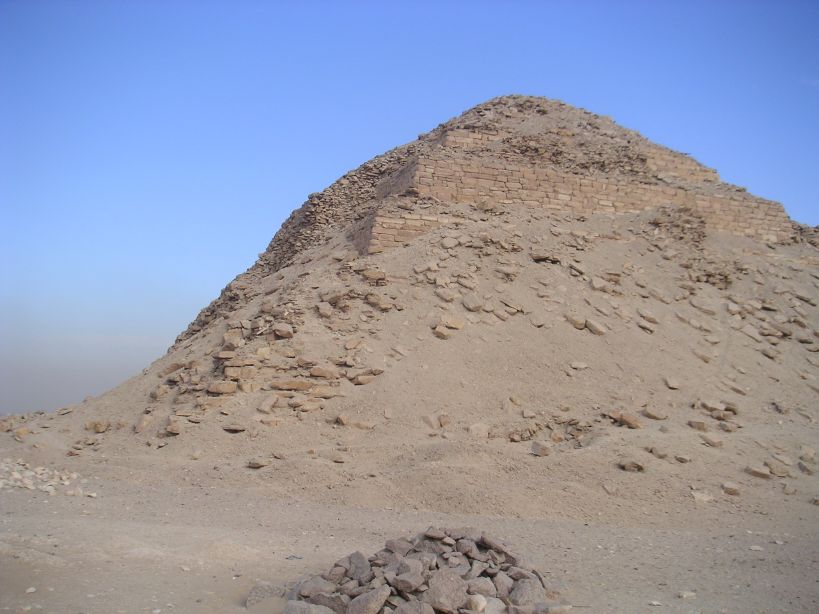
Photo Abousir_KhentkaousII_01.jpg : Neithsabes · Public domainSource file on Wikimedia Commons

Overview
About this site
Overview
The Double Pyramid, also known as Lepsius XXV, is a pair of adjacent monuments on the south-eastern edge of the Abusir necropolis in Egypt. It lies south of the pyramid Lepsius XXIV and of the pyramid of Khentkaus II. The pair was built during the mid-Fifth Dynasty, likely during the reign of Nyuserre Ini, for two female members of the extended royal family.
Because of its unusual architecture, with no mortuary temple, a funerary chapel inside the superstructure and a north-south descending corridor to the burial chamber, the monument is regarded by the Egyptologist Miroslav Verner as a distinct type of tomb. This view is debated.
Read on Wikipedia3 min readCC BY-SA 4.0
Where it sits in time
The site's dated range, placed against world reference points.
The scale is logarithmic: each step to the left is about ten times older than the last.
Article
Double Pyramid
Its outer walls, only roughly worked, had an incline of 78°, which indicates a mastaba or a pyramid base rather than a true pyramid.
DescriptionSources for this section
- Wikipedia (English): Double PyramidCC BY-SA 4.0
Sources for this section
- Wikipedia (English): Double PyramidCC BY-SA 4.0
The larger, eastern tomb has a base measurement of 27.7 m x 21.53 m and is made of large blocks of white limestone. Its outer walls, only roughly worked, had an incline of 78°, which indicates a mastaba or a pyramid base rather than a true pyramid. The height cannot be determined. A descending passage leads from the middle of the north side to the burial chamber, which measures 4.5 m x 2.7 m. The sarcophagus stands in a niche on the west side of the chamber.
The smaller, western tomb measures 21.7 x 15.7 m and also has an incline of 78°. It is built of roughly hewn grey limestone and has been heavily robbed of stone, so that only a few layers remain. The layering of the surviving masonry indicates that it was built after the eastern tomb.
ExcavationsSources for this section
- Wikipedia (English): Double PyramidCC BY-SA 4.0
Sources for this section
- Wikipedia (English): Double PyramidCC BY-SA 4.0
Karl Richard Lepsius located the structure and listed it as pyramid number XXV. Ludwig Borchardt later classified it as a double mastaba but did not examine it closely. A Czech archaeological team led by Miroslav Verner carried out the first intensive excavation between 2001 and 2004. It showed that there was no mortuary temple, and that the area once taken for one was part of the western tomb. An offering chapel stood on the east side of the eastern tomb; the height of its rooms is known to have been about 5 metres. Papyrus fragments of a list of offerings and an alabaster fragment of a female statue were found in its ruins.
In the eastern burial chamber, thoroughly stripped by grave robbers, parts of a woman's remains, fragments of limestone canopic jars and grave goods were found. In the western tomb only very few traces of a woman's burial and a single object of grave goods survived. Building inscriptions and marks in the masonry included the name of the structure, which can be rendered as "the two [pyramids] are watchful."
InterpretationSources for this section
- Wikipedia (English): Double PyramidCC BY-SA 4.0
Sources for this section
- Wikipedia (English): Double PyramidCC BY-SA 4.0
The Egyptologist Dušan Magdolen argues that the monument is simply a double mastaba. He points out that neither tomb has a square plan, whereas Egyptian pyramids, except the earliest, that of Djoser, have square bases, and that the incline of the walls falls within the normal range of mastabas. No inscription naming the owner has been found, so the monument cannot yet be exactly dated. The attribution to the reign of Nyuserre rests on its location at Abusir, which was abandoned as a royal necropolis after his death.
ContextSources for this section
- Wikipedia (English): Double PyramidCC BY-SA 4.0
Sources for this section
- Wikipedia (English): Double PyramidCC BY-SA 4.0
The pyramid in Egypt took shape from the mastaba, a flat-roofed rectangular tomb with sloping sides built of mudbrick or limestone, which marked the burial sites of eminent Egyptians in the Early Dynastic Period and Old Kingdom.
Tradition and region
About this kind of monument
Pharaonic stone monuments of Egypt
Egypt's stone monuments are the best dated and the most famous in the Atlas. The pyramid took shape from the mastaba, a flat-roofed rectangular tomb with sloping sides built of mudbrick or limestone, which marked the burial sites of eminent Egyptians in the Early Dynastic Period and Old Kingdom. The Great Pyramid of Giza, the tomb of the Fourth Dynasty pharaoh Khufu ("Cheops"), was built about 2600 BCE over a period of about 26 years. It was originally 146.6 metres high and remained the world's tallest human-made structure for more than 3,700 years. Most of the smooth white limestone casing has been removed over time, which has lowered the pyramid's height to the present 138.5 metres.
Temples were just as large. The Karnak Temple Complex near Luxor is a vast mix of temples, pylons, chapels and other buildings. Construction began in the reign of Senusret I (1971 to 1926 BCE) in the Middle Kingdom and continued into the Ptolemaic Kingdom (305 to 30 BCE), though most of the surviving buildings date from the New Kingdom. An obelisk, which the Egyptians called tekhenu, is a tall, four-sided, narrow tapering monument, usually a single block of stone, with a pyramidal top.
Egyptian monuments are dated by the reigns of the kings who built them, and many carry their names. This is a strong contrast with the prehistoric megaliths of Europe, which can be dated only by radiocarbon or by comparison.
The Atlas files these monuments among the megaliths only because they are great works in stone.
When visiting, look at the scale of the blocks and at the inscriptions and reliefs that give the names of the kings.
Paraphrased from Wikipedia: Pyramid, Wikipedia: Great Pyramid of Giza, Wikipedia: Temple of Karnak, Wikipedia: Obelisk, Wikipedia: Mastaba · CC BY-SA 4.0
From the article
Dated moments in the story
- 2001
A Czech archaeological team led by Miroslav Verner conducted the first intensive excavation between 2001 and 2004, in which the unusual character of the structure as a "Double pyramid" became clear.
Source
Photographs
2 photographs, each with its author and licence
More photographs

Lore
Evidence & Lore
What the sources actually support — and, kept apart, what has been claimed.
What the evidence supports
Dates
Est. 4000 BCE–600 CEHow this date was established: Type comparisonTypological estimate, not a date for this site: a other in North Africa is normally dated between 4000 BCE and 600 CE (Atlas typological table).Source for this date
Measured facts
- Mainstream position
- The source presents the double-pyramid and double-mastaba interpretations as an unresolved scholarly disagreement.Source: Mainstream position
- Alternative name
- Lepsius XXVSource: Alternative name
- Location
- Southeastern edge of the Abusir necropolisSource: Location
- Patrons
- Two female members of the extended royal familySource: Patrons
- Probable reign
- Nyuserre IniSource: Probable reign
- Architectural features
- Internal funerary chapel and north-south descending corridorSource: Architectural features
- Burial chamber
- Reached by the descending corridorSource: Burial chamber
Alternative claims
Alternative claims about this site, kept in their own block and labelled with where they stand.
The monument is a distinct type of Ancient Egyptian tomb called a double pyramid.
The monument is simply a double mastaba.
DebatedSource for this claim: The monument is simply a double mastaba.
Where it stands
Egypt
The pin marks the monument itself — its exact point.
- Coordinates
- 29°53′35″ N, 31°12′11″ EFor a GPS or map app: 29.89306, 31.20306
Access is as our sources describe it; we have not visited the site to check.
Nearby
The closest sites in the Atlas, by straight line.
 Lepsius XXIV4000 BCE–600 CE
- pyramid of Khentkaus II4000 BCE–600 CE
Photo: Abousir_KhentkaousII_01.jpg : Neithsabes · Public domain
 Pyramid of Neferefre3150 BCE–300 CE
 Pyramid of Neferirkare4000 BCE–600 CE
 Pyramid of Nyuserre Ini4000 BCE–600 CE
 Pyramid of Sahure2450–2350 BCE
- MegalithUnfinished Pyramid of Abusir4000 BCE–600 CE
- MegalithPyramid of Niuserre3150 BCE–300 CE


Sources
Every record behind this page, with the link it came from.
2 sources behind this page
- 01Wikidata Q1377626wikidata.org
- 02Wikipedia (en)en.wikipedia.org
Image files
- Abousir KhentkaousII 01 b.jpgAbousir_KhentkaousII_01.jpg : NeithsabesPublic domain
- Abousir KhentkaousII 01.jpgNo machine-readable author provided. Neithsabes assumed (based on copyright claims).Public domain
Report a correctionWrong date, name, photograph or source? Tell us and it will be put right.
Lore, kept apart
Legends and claims
These are stories and claims reported by the sources. They are not evidence, and they never stand in for the dating above.
Around this place
The ten nearest sites, by compass
Credit
Text, licence and sources
Adapted from the Wikipedia article "Double Pyramid" (English), licensed CC BY-SA 4.0; authors are listed in the page history. Reused under CC BY-SA 4.0. Read on Wikipedia · Edit history and authors
- Wikipedia (English): Double PyramidCC BY-SA 4.0
- Wikidata Q1377626CC0