Passage tomb (passage grave)The Copper Age
Slåenhøj
DatedEst. 3500–2800 BCE
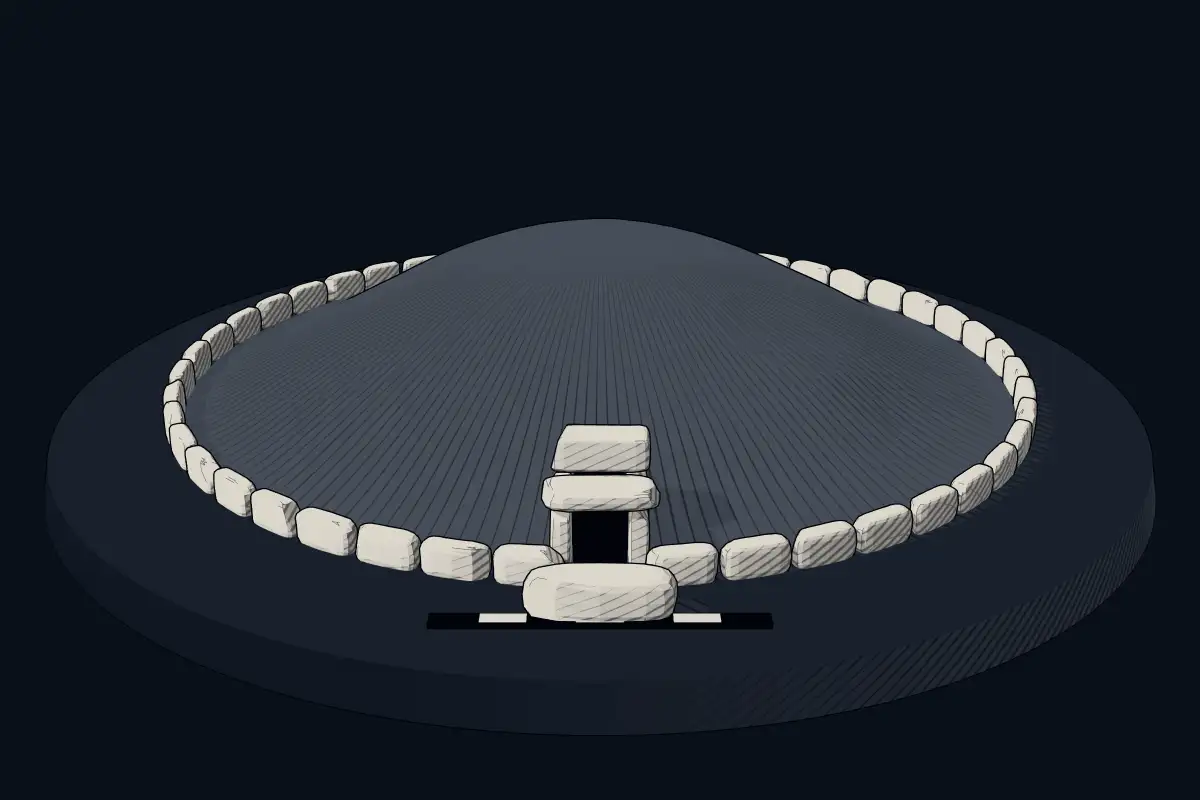
No licensed photograph yetWe have no photograph we may publish for this site, so the interpretive 3D view leads instead.
Overview
About this site
Overview
The Slåenhøj, also written Slaaenhøj or called Slaaenbjerg von Nyrup, is a megalithic monument in a round mound 15 to 19 metres in diameter, north-west of Kalundborg between Nyrup and Raklev on the Danish island of Zealand. It is a protected ancient monument in Denmark.
In the south-east of the mound lies a double passage grave (Danish dobbeltjættestue) of the Funnel Beaker culture, built between 3500 and 2800 BCE. It was excavated in 1876.
Read on Wikipedia3 min readCC BY-SA 4.0
Where it sits in time
The site's dated range, placed against world reference points.
The scale is logarithmic: each step to the left is about ten times older than the last.
Article
Slåenhøj
A passage grave is a form of Neolithic megalithic monument consisting of a chamber and a structurally separate lateral passage.
DescriptionSources for this section
- Wikipedia (German): SlåenhøjCC BY-SA 4.0
Sources for this section
- Wikipedia (German): SlåenhøjCC BY-SA 4.0
A passage grave is a form of Neolithic megalithic monument consisting of a chamber and a structurally separate lateral passage. Double passage graves are known from 57 examples on Zealand. In most of them the two chambers share supporting stones on their adjacent narrow sides. At Slåenhøj, as in some Jutland monuments, the chambers lie separate from each other but close together in the same mound. Both chambers are oval and oriented north-east to south-west.
ArchaeologySources for this section
- Wikipedia (German): SlåenhøjCC BY-SA 4.0
Sources for this section
- Wikipedia (German): SlåenhøjCC BY-SA 4.0
The southern chamber is 3.4 m long and 2.3 m wide and is built of nine supporting stones. Its floor was made of round stones and flint flakes and was strongly coloured by traces of burning. Over this layer lay a layer of flat stone slabs. The passage, set centrally and oriented north-west to south-east, is 4.5 m long, 0.6 m wide and 0.5 to 0.6 m high. It is formed on both sides by four preserved supporting stones and the remains of two door constructions, and a threshold stone lies in the passage, which is blocked with stones.
The northern chamber was about 3.8 m long and 2.2 m wide. It was built of eleven supporting stones, of which only three are preserved. One lintel stone lies on two stones. The floor had paving and a layer of burnt flint, on which skeletal remains and grave goods were found, covered by a layer of flat stones. Of the centrally set passage, 4.5 m long, only one supporting stone is preserved.
FindsSources for this section
- Wikipedia (German): SlåenhøjCC BY-SA 4.0
Sources for this section
- Wikipedia (German): SlåenhøjCC BY-SA 4.0
The excavation of 1876 produced finds from the southern chamber that include a battle axe, fragments of a second axe, various types of flint tool and broken pottery. The northern chamber yielded various types of flint tool and broken pottery. A Bronze Age urn was found in the mound.
ContextSources for this section
- Wikipedia (German): SlåenhøjCC BY-SA 4.0
Sources for this section
- Wikipedia (German): SlåenhøjCC BY-SA 4.0
In Denmark and Sweden the passage grave is the grandest form of the Funnel Beaker culture's megalithic tombs. A passage grave has a chamber under a mound, entered by a long passage of large stones. Nordic megalith architecture emerged mainly between 3500 and 2800 BCE, and passage graves are one of its main types alongside dolmens, long barrows and stone cists.
Tradition and region
About this kind of monument
Scandinavian passage graves
In Denmark and Sweden the passage grave is the grandest form of the Funnel Beaker culture's megalithic tombs. A passage grave has a chamber under a mound, entered by a long passage of large stones. Nordic megalith architecture, the style of Scandinavia and northern Germany, emerged mainly between 3500 and 2800 BCE, and passage graves are one of its main types alongside dolmens, long barrows and stone cists.
Kong Asgers Høj on the Danish island of Møn is one of the best known. Its chamber is 10 metres long and 2 metres wide, with a passage 7.5 metres long. This kind of grave is found primarily in Denmark, Germany and Scandinavia, and only occasionally in France and the Netherlands. The tomb is structurally untouched since ancient times, though it may have been cleared at some time, and it was reused for secondary burial in the Corded Ware period. Passage graves were often used for generations. At Frälsegården in Sweden, genetic analysis of several dozen buried individuals suggests that the dead were largely male descendants of one ancestor, with women who had married in from outside, so such a tomb could belong to an extended family.
The passage grave tradition is thought to have originated in Brittany and been spread to other regions by colonists, a view found in the wider literature but one that remains debated.
Dating of Scandinavian tombs relies on the pottery of the Funnel Beaker culture and on radiocarbon dates from bone.
When visiting, look at the size of the capstones over the chamber, the kerbstones around the mound, and the line of the passage.
Paraphrased from Wikipedia: Passage grave, Wikipedia: Nordic megalith architecture, Wikipedia: Funnel beaker culture, Wikipedia: Kong Asgers Høj · CC BY-SA 4.0
From the article
Dated moments in the story
- 2800 BCE
Im Südosten des Hügels liegt das zwischen 3500 und 2800 v. Chr. errichtete Doppelganggrab (dänisch Dobbeltjættestue) der Trichterbecherkultur (TBK).
Source - 1876
Zu den Funden der Ausgrabung von 1876 gehören eine Streitaxt, Fragmente einer zweiten Axt und diverse Feuersteinwerkzeuge unterschiedlichen Typs sowie zerscherbte Keramik.
Source - 1876
Zu den Funden der Ausgrabung von 1876 gehören diverse Feuersteinwerkzeuge unterschiedlichen Typs sowie zerscherbte Keramik.
Source
Lore
Evidence & Lore
What the sources actually support — and, kept apart, what has been claimed.
What the evidence supports
Dates
Est. 3500–2800 BCEHow this date was established: Type comparisonTypical range for passage tombs in Denmark; this site has not been dated itself. Danish passage graves belong to the Nordic megalith tradition which emerged predominantly between 3500 and 2800 BC.Source for this date
Where it stands
Denmark
The pin marks the monument itself — its exact point.
- Coordinates
- 55°42′20″ N, 11°01′49″ EFor a GPS or map app: 55.70561, 11.03026
Access is as our sources describe it; we have not visited the site to check.
Nearby
The closest sites in the Atlas, by straight line.
- Megalithic mound (tumulus with integral stones)Ræveshøj3500–500 BCE
- Megalithic mound (tumulus with integral stones)Kovsen3500–500 BCE
- Megalithic mound (tumulus with integral stones)Ahlhøje3500–500 BCE
- Megalithic mound (tumulus with integral stones)Ahlhøje3500–500 BCE
- Megalithic mound (tumulus with integral stones)Ahlhøje3500–500 BCE
- DolmenTroldedyssen3500–2800 BCE
- Megalithic mound (tumulus with integral stones)Søndershøj3500–500 BCE
- Megalithic mound (tumulus with integral stones)Bakkegaard3500–500 BCE
Sources
Every record behind this page, with the link it came from.
2 sources behind this page
- 01Wikidata Q20141476wikidata.org
- 02Source for this dateen.wikipedia.org
Report a correctionWrong date, name, photograph or source? Tell us and it will be put right.
Around this place
The ten nearest sites, by compass
Credit
Text, licence and sources
Adapted from the Wikipedia article "Slåenhøj" (German), licensed CC BY-SA 4.0; authors are listed in the page history. Reused under CC BY-SA 4.0. Read on Wikipedia · Edit history and authors
- Wikipedia (German): SlåenhøjCC BY-SA 4.0
- Wikidata Q20141476CC0