

Overview
About this site
What the sources say
Der kleine Runddysse Råhøj (auch Eskemosegård oder Eskemosegaard Raahøj genannt) ist ein Dolmen. Er liegt südlich von Frejlev, östlich von Kettinge bei Maribo in der Guldborgsund Kommune auf der Insel Lolland in Dänemark. Der Dolmen stammt aus der Jungsteinzeit etwa 3500–2800 v. Chr. und ist eine Megalithanlage der Trichterbecherkultur (TBK).
Die einseitig offene Kammer wird von drei Tragsteinen und einem Deckstein gebildet. Auf einigen Steinen sind Schälchen zu finden.
In der Nähe liegt die Frejlev Dyssekammer.
Article in GermanRead on Wikipedia2 min readCC BY-SA 4.0
Where it sits in time
The site's dated range, placed against world reference points.
The scale is logarithmic: each step to the left is about ten times older than the last.
The full article
Råhøj: the whole story
In briefSources for this section
- Wikipedia (German): RåhøjCC BY-SA 4.0
Sources for this section
- Wikipedia (German): RåhøjCC BY-SA 4.0
Råhøj is a small dolmen on the island of Lolland in Denmark. It lies south of Frejlev, east of Kettinge, near Maribo in Guldborgsund Kommune. The monument is also called Eskemosegård or Eskemosegaard Raahøj.
The chamber is open on one side and formed by three supporting stones and a capstone. Some of the stones carry small hollows known as cup marks. The nearby Frejlev Dyssekammer provides a second megalithic monument in the same area.
Råhøj belongs to the Late Neolithic period, dated to 3500 BCE to 2800 BCE by typological estimate. It is a megalithic monument associated with the Funnel Beaker culture, also abbreviated TBK.
Denmark’s megalithic tombs generally belong to the Funnel Beaker culture of the fourth millennium BCE. They include dolmens, known as dysser, and larger passage graves with a long passage leading to a chamber. The broader Nordic megalithic tradition developed mainly between 3500 BCE and 2800 BCE.
No English Wikipedia article exists for it; the full text below is the German article "Råhøj", shown in the original language.
Summary in EnglishSources for this section
- Wikipedia (German): RåhøjCC BY-SA 4.0
Sources for this section
- Wikipedia (German): RåhøjCC BY-SA 4.0
Råhøj is a dolmen in Guldborgsund Municipality, Denmark. Wikidata describes it as: ancient monument in Denmark (4002). A typological estimate: 3500 BCE to 2800 BCE. No English Wikipedia article exists for it; the full text below is the German article "Råhøj", shown in the original language.
How this page was madeSources for this section
- Wikipedia (German): RåhøjCC BY-SA 4.0
Sources for this section
- Wikipedia (German): RåhøjCC BY-SA 4.0
The summary at the top of this page was written by MiniMax-M3 (2026-11-08) from the cited Wikipedia article “Råhøj”, translated from German. The numbers in it were checked automatically against the source text. The rest of the page is the article itself, the structured records and computed distances.
Tradition and region
About this kind of monument
Danish dolmens and passage graves (dysser and jættestuer)
Denmark's megalithic tombs belong to the Funnel Beaker culture of the fourth millennium BCE. They fall into two main kinds, dolmens (dysser) and the larger passage graves, with a long passage leading into a chamber. Nordic megalith architecture, the style found especially in Scandinavia and northern Germany, emerged mainly between 3500 and 2800 BCE. In Scandinavia the sites are classed under general terms such as dolmens, passage graves and stone cists, in contrast with the many subtypes of the German tradition.
The great passage graves show how large these tombs could be. Kong Svends Høj on the island of Lolland is a large rectangular mound surrounded by kerbstones about 1.5 metres high, among the tallest recorded in a Neolithic tomb, and covers a chamber 12.5 metres long; the gable stones are almost 4 metres high. Excavation was first attempted there in 1780. Kong Asgers Høj on Møn has a chamber 10 metres long and 2 metres wide with a passage 7.5 metres long, and it was reused for secondary burial in the Corded Ware period. In 1839 the merchant Gustav Hage opened it hoping for treasure and found it empty.
Folklore: the king's names given to these graves come from later tradition and have nothing to do with the Neolithic builders. They show how people over the centuries explained monuments they could not date.
Dating combines radiocarbon dates on bone and charcoal in the chambers, pottery and the architecture. Many dolmens have lost their mounds, leaving the stone skeleton.
When visiting, look for the kerbstones around the base, the capstone and its supports, and the passage entrance.
Paraphrased from Wikipedia: Nordic megalith architecture, Wikipedia: Funnel beaker culture, Wikipedia: Kong Svends Høj, Wikipedia: Kong Asgers Høj, Wikipedia: Dolmen · CC BY-SA 4.0
From the article
Dated moments in the story
- 2800 BCE
Der Dolmen stammt aus der Jungsteinzeit etwa 3500–2800 v. Chr. und ist eine Megalithanlage der Trichterbecherkultur (TBK).
Source
See it in 3D
An interpretive reconstruction of the monument, standing on the real ground at its exact point, under the sun for that place and season. Drag to look around it.
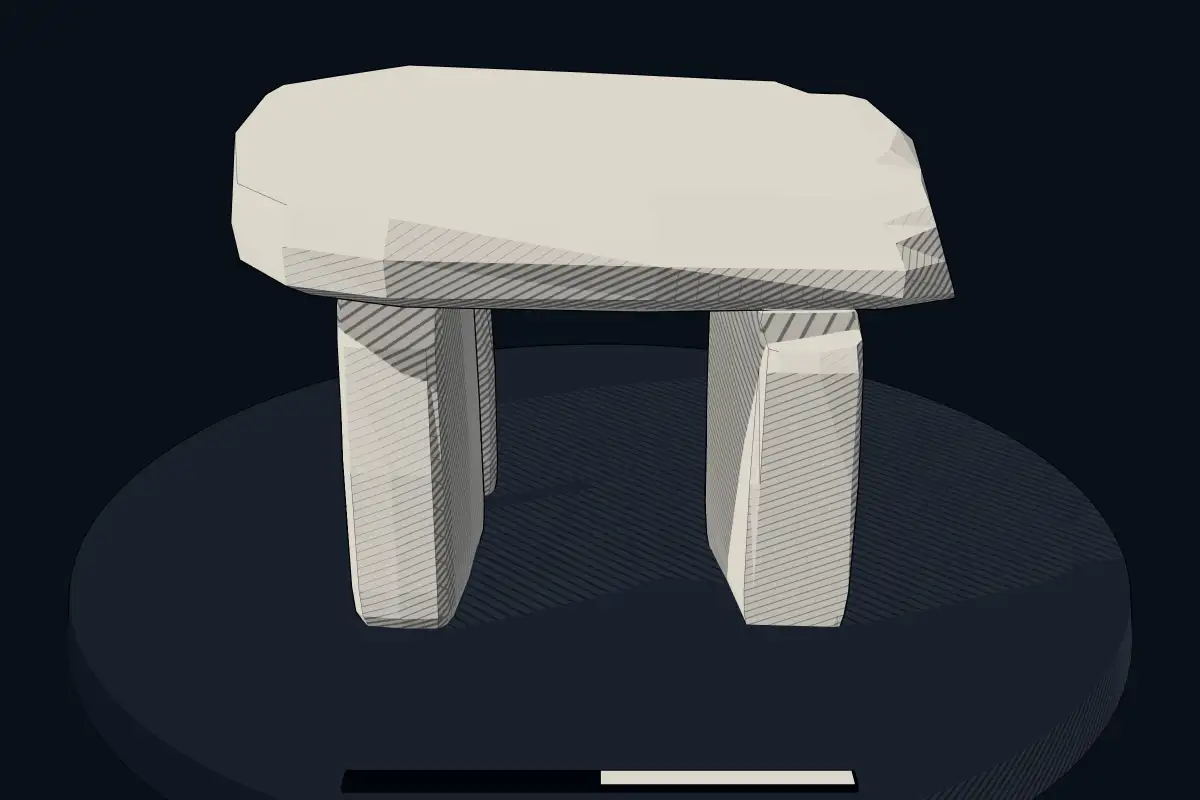
The reconstruction is ours, not a survey: it shows what a monument of this type looks like, at the size the record gives for this one.
Photographs
5 photographs, each with its author and licence
More photographs


Lore
Evidence & Lore
What the sources actually support — and, kept apart, what has been claimed.
What the evidence supports
Dates
Est. 3500–2800 BCEHow this date was established: Type comparisonTypical range for dolmens in Denmark; this site has not been dated itself. Danish dolmens (dysser) belong to the Nordic megalith tradition which emerged predominantly between 3500 and 2800 BC.Source for this date
Where it stands
Denmark
The pin marks the monument itself — its exact point.
- Coordinates
- 54°41′38″ N, 11°46′50″ EFor a GPS or map app: 54.69397, 11.78060
Access is as our sources describe it; we have not visited the site to check.
Nearby
The closest sites in the Atlas, by straight line.
 Frejlev Langdysse3500–2800 BCE
 Frejlev Dyssekammer3500–2800 BCE
- Megalithic mound (tumulus with integral stones)Freilev3500–500 BCE
 Boyes Høj3500–2800 BCE
- Megalithic mound (tumulus with integral stones)Freilev3500–500 BCE
- Megalithic mound (tumulus with integral stones)Freilev3500–500 BCE
- Megalithic mound (tumulus with integral stones)Frejlev Skov3500–500 BCE
- Megalithic mound (tumulus with integral stones)Frejlev Skov3500–500 BCE


Sources
Every record behind this page, with the link it came from.
2 sources behind this page
- 01Wikidata Q30109544wikidata.org
- 02Source for this dateen.wikipedia.org
Image files
- Raahøj-5.jpgPraeceptorCC BY-SA 3.0
- Raahøj-1.jpgPraeceptorCC BY-SA 3.0
- Råhøj 02.JPGErik DamskierPublic domain
- Råhøj 03.JPGErik DamskierPublic domain
- Råhøj 01.JPGErik DamskierPublic domain
Report a correctionWrong date, name, photograph or source? Tell us and it will be put right.
Around this place
The ten nearest sites, by compass
Credit
Text, licence and sources
Text from the Wikipedia article "Råhøj" (German), licensed CC BY-SA 4.0; authors are listed in the page history. Reused under CC BY-SA 4.0. Read on Wikipedia · Edit history and authors
- Wikipedia (German): RåhøjCC BY-SA 4.0
- Wikidata Q30109544CC0