
Megalithic mound (tumulus with integral stones)The Copper Age
Poskær Stenhus
Datedc. 3350–3250 BCE
Photo Old Dane · CC BY-SA 4.0Source file on Wikimedia Commons

Overview
About this site
Overview
Poskær Stenhus is the largest round barrow in Denmark, dated to between 3350 and 3250 BCE. It stands near the village of Knebel on the hilly southern part of the Djursland peninsula.
The central burial chamber has a capstone weighing 11 tonnes (12 tons), surrounded by 23 slabs taller than a man, forming a circle. The site is a protected ancient monument.
Read on Wikipedia2 min readCC BY-SA 4.0
Age sources
How old this site is, and who says so.
Range across all claimsc. 3350–3250 BCE
EstimatedWhat this badge means
A reading of this site: what its style says, or a statement published about it.
- 3350–3250 BCEPublished sourcec. 3300 BCE. The source gives one year, so it is shown as a 100-year window (D-08).Source: en.wikipedia.org
- 3300 BCEAtlas research notesc. 3300 BCESource: en.wikipedia.org
Where it sits in time
The site's dated range, placed against world reference points.
The scale is logarithmic: each step to the left is about ten times older than the last.
Article
Poskær Stenhus
Poskær Stenhus lies on the hilly southern part of the peninsula of Djursland, at the entrance to the Baltic Sea between Denmark and Sweden.
DescriptionSources for this section
- Wikipedia (English): Poskær StenhusCC BY-SA 4.0
Sources for this section
- Wikipedia (English): Poskær StenhusCC BY-SA 4.0
Poskær Stenhus lies on the hilly southern part of the peninsula of Djursland, at the entrance to the Baltic Sea between Denmark and Sweden. The central burial chamber is equipped with a capstone weighing 11 tonnes (12 tons), surrounded by 23 slabs taller than a man, which form a circle.
The capstone is the lesser half of a granite slab brought to Denmark from northern Scandinavia by the movement of ice age glaciers. Its underside is remarkably flat, and it was possibly split from the other half by the builders of the dolmen. The other half is a 19-tonne (21-ton) slab 2 km (1.2 mi) to the north-west, placed as the capstone of another dolmen, Agri Dyssen. How these slabs were transported and erected by Stone Age people is not known.
Later historySources for this section
- Wikipedia (English): Poskær StenhusCC BY-SA 4.0
Sources for this section
- Wikipedia (English): Poskær StenhusCC BY-SA 4.0
Apart from Denmark's easternmost island, Bornholm, the country has no bedrock. Large granite slabs were therefore sought out for construction, and many dolmens have disappeared or been damaged.
In 1859 a landowner, Ole Hansen, attempted to dynamite slabs from Poskær Stenhus. A local priest started a process to stop the destruction of the burial site, which ended with official protection of the site in 1860. Hansen was given compensation of 100 rigsdaler. A broken slab with drill marks from the dynamiting remains at the barrow. At least one slab was destroyed before the site was protected.
ContextSources for this section
- Wikipedia (English): Poskær StenhusCC BY-SA 4.0
Sources for this section
- Wikipedia (English): Poskær StenhusCC BY-SA 4.0
Denmark has a very large number of surviving barrows, which have been protected by law since 1937. The oldest belong to the Funnel Beaker culture of the fourth millennium BCE, whose long barrows and stone-chambered tombs are usually distinguished from the great majority of round mounds, most of which are younger.
Tradition and region
About this kind of monument
Danish barrows (gravhøje)
Denmark has a very large number of surviving barrows, protected by law since 1937, and the Atlas draws most of its Danish mounds from the national register of monuments. The oldest belong to the Funnel Beaker culture of the fourth millennium BCE, whose long barrows and stone-chambered tombs are described in their own articles. The great majority of the round mounds are younger. Many were raised in the Nordic Bronze Age, from about 1700 to 500 BCE.
The Bronze Age barrows hold remarkable burials. In a number of them, oak coffins stayed sealed and waterlogged, so that wool clothing, hair and textiles survived; only the bones of the dead are gone. The Egtved Girl, a young woman buried beneath the mound Storehøj in a woollen blouse and corded skirt with a bronze belt plate, is the best-known case: tree rings in her oak coffin date the burial to the summer of 1370 BCE. Borum Eshøj gave similar finds from the fourteenth and thirteenth centuries BCE. Later in the Bronze Age cremation took over from inhumation, and the dead were buried in urns.
Mound-building did not stop with the Bronze Age: Danish round barrows were raised from the Neolithic to the Viking Age.
When visiting, look for flat tops where old diggers cut in, and for the hollows where kerb stones were once removed.
Paraphrased from Wikipedia: Tumulus, Wikipedia: Funnel beaker culture, Wikipedia: Nordic Bronze Age, Wikipedia: Egtved Girl, Wikipedia: Borum Eshøj, Wikipedia: Jelling · CC BY-SA 4.0
From the article
Dated moments in the story
- 300 BCE
Poskær Stenhus is the largest round barrow in Denmark, dating back to 3.300 B.C.
Source - 1859
In 1859 a landowner, Ole Hansen, attempted to dynamite slabs from Poskær Stenhus.
Source - 1860
A local priest started a process to stop the destruction of the burial site, ending with an official protection of the site in 1860. As part of this, Hansen was given a compensation of 100 rigsdaler.
Source
See it in 3D
An interpretive reconstruction of the monument, standing on the real ground at its exact point, under the sun for that place and season. Drag to look around it.
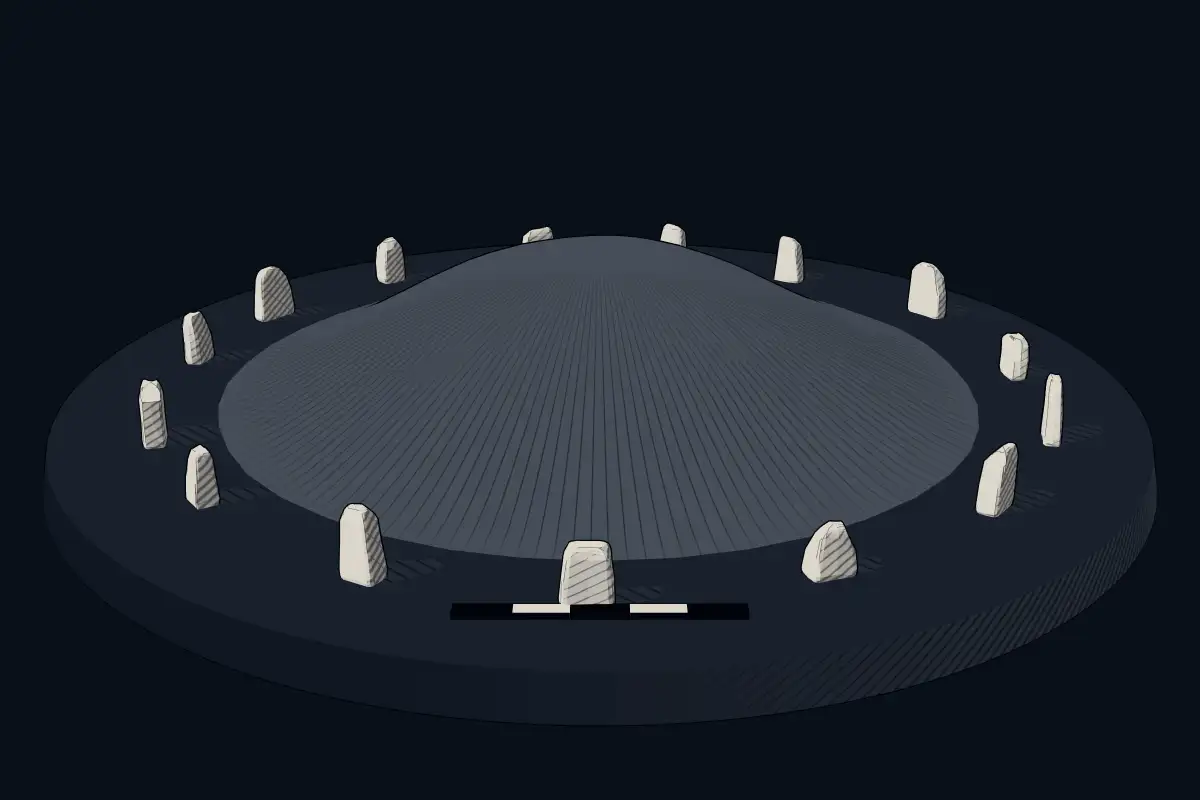
The reconstruction is ours, not a survey: it shows what a monument of this type looks like, at the size the record gives for this one.
Photographs
8 photographs, each with its author and licence
More photographs


Lore
Evidence & Lore
What the sources actually support — and, kept apart, what has been claimed.
What the evidence supports
Dates
3350–3250 BCEHow this date was established: Stated by the sourcec. 3300 BCE. The source gives one year, so it is shown as a 100-year window (D-08).Source for this date
Measured facts
- Location
- Near Knebel on Djursland, DenmarkSource: Location
- Barlow ranking
- Largest round barrow in DenmarkSource: Barlow ranking
- Capstone weight
- 11 tonnes (12 tons)Source: Capstone weight
- Surrounding slabs
- 23 slabs taller than a manSource: Surrounding slabs
- Related slab
- A 19-tonne slab lies 2 km northwest atop Agri DyssenSource: Related slab
- Protection
- Official protection in 1860Source: Protection
- Heritage designation
- protected ancient monument in DenmarkSource: Heritage designation
Where it stands
Denmark
The pin marks the monument itself — its exact point.
- Coordinates
- 56°13′07″ N, 10°30′07″ EFor a GPS or map app: 56.21853, 10.50194
Access is as our sources describe it; we have not visited the site to check.
Nearby
The closest sites in the Atlas, by straight line.
- Megalithic mound (tumulus with integral stones)Svinhøj3500–500 BCE
- Megalithic mound (tumulus with integral stones)Agri3500–500 BCE
- Megalithic mound (tumulus with integral stones)Knebel3500–500 BCE
- Megalithic mound (tumulus with integral stones)Knebel3500–500 BCE
- Megalithic mound (tumulus with integral stones)Knebel3500–500 BCE
- Megalithic mound (tumulus with integral stones)Knebel3500–500 BCE
- Megalithic mound (tumulus with integral stones)Knebel3500–500 BCE
 Agri Dyssen3500–500 BCE

Sources
Every record behind this page, with the link it came from.
2 sources behind this page
- 01Wikidata Q12332088wikidata.org
- 02Wikipedia (en)en.wikipedia.org
Image files
- Poskær Stenhus 2.JPGOld DaneCC BY-SA 4.0
- Poskær stenhus panorama1 Panorama ny.jpgVilly Fink IsaksenCC BY-SA 3.0
- 308DK (1) Poskær Stenhus (15001519549).jpgRüdiger Stehn from Kiel, DeutschlandCC BY-SA 2.0
- 308DK (2) Poskær Stenhus (15001800688).jpgRüdiger Stehn from Kiel, DeutschlandCC BY-SA 2.0
- Poskær Stenhus (Syddjurs Kommune).1.45414.ajb.jpgAjepbahCC BY-SA 3.0 de
- Poskær Stenhus (Syddjurs Kommune).2.45414.ajb.jpgAjepbahCC BY-SA 3.0 de
- Poskær Stenhus 1.JPGOld DaneCC BY-SA 4.0
- Set fra vejen fra Agri.JPGVilly Fink IsaksenCC BY-SA 3.0
Report a correctionWrong date, name, photograph or source? Tell us and it will be put right.
Around this place
The ten nearest sites, by compass
Credit
Text, licence and sources
Adapted from the Wikipedia article "Poskær Stenhus" (English), licensed CC BY-SA 4.0; authors are listed in the page history. Reused under CC BY-SA 4.0. Read on Wikipedia · Edit history and authors
- Wikipedia (English): Poskær StenhusCC BY-SA 4.0
- Wikidata Q12332088CC0