Passage tomb (passage grave)The Copper Age
Maredys
DatedEst. 3500–2800 BCE
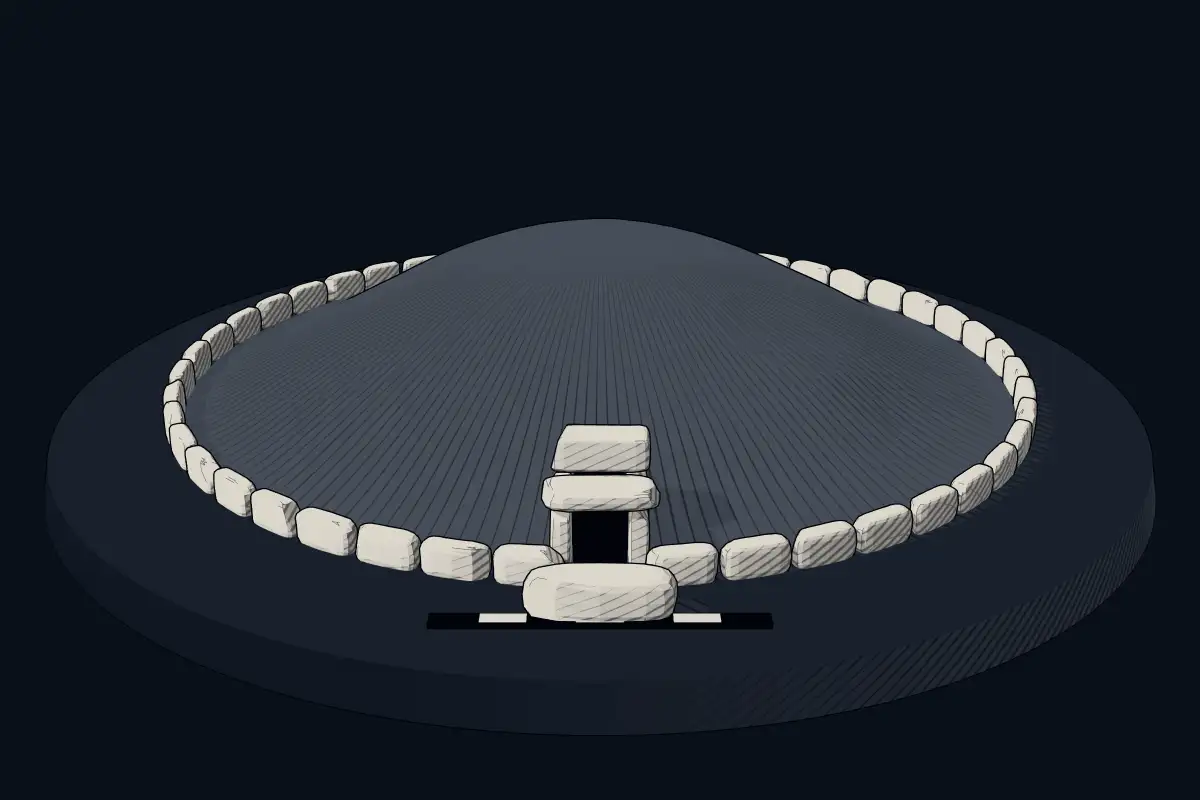
No licensed photograph yetWe have no photograph we may publish for this site, so the interpretive 3D view leads instead.
Overview
About this site
Overview
Maredys is a passage grave in Ferslev parish, Frederikssund Municipality, Denmark. It is a megalithic tomb of the northern group of the Neolithic Funnel Beaker culture and is dated to between 3500 and 2800 BCE on typological grounds.
The round mound is 18 m in diameter and 2 m high. Only the capstones of the chamber and passage project from it, and two of them bear cup marks. A cup-marked stone was found beside the grave in 1978.
Read on Wikipedia2 min readCC BY-SA 4.0
Where it sits in time
The site's dated range, placed against world reference points.
The scale is logarithmic: each step to the left is about ten times older than the last.
Article
Maredys
SettingSources for this section
- Wikipedia (German): MaredysCC BY-SA 4.0
Sources for this section
- Wikipedia (German): MaredysCC BY-SA 4.0
The tomb lies in the east of the forest Sømer Skov. The passage grave Orkenspends Dys lies 110 m east-south-east of it. There are, or were, numerous other megalithic tombs in the immediate surroundings.
Its wall stones are entirely hidden within the mound, and only the four capstones project.
DescriptionSources for this section
- Wikipedia (German): MaredysCC BY-SA 4.0
Sources for this section
- Wikipedia (German): MaredysCC BY-SA 4.0
The mound is round, with a diameter of 18 m and a height of 2 m. No stone kerb can be made out. The chamber is classed as a passage grave. It is oriented north-east to south-west and is about 5.5 m long. Its wall stones are entirely hidden within the mound, and only the four capstones project. Cup marks can be seen on the upper surfaces of two of these stones.
The entrance lies on the south-eastern long side and is preceded by a passage oriented north-west to south-east. Of the passage only three capstones are visible, and its wall stones are likewise buried in the mound.
FindsSources for this section
- Wikipedia (German): MaredysCC BY-SA 4.0
Sources for this section
- Wikipedia (German): MaredysCC BY-SA 4.0
A cup-marked stone was discovered in 1978, west-north-west of the tomb and only 2 m from the foot of the mound. It is 2 m long, 1.2 m wide and 0.7 m thick, and its upper surface bears numerous cup marks of varying size.
Research historySources for this section
- Wikipedia (German): MaredysCC BY-SA 4.0
Sources for this section
- Wikipedia (German): MaredysCC BY-SA 4.0
Staff of the Danish National Museum documented the site in 1873 and 1942. The cup-marked stone was found next to the grave in 1978, and staff of the forestry and nature authority carried out a further documentation in 1989.
ContextSources for this section
- Wikipedia (German): MaredysCC BY-SA 4.0
Sources for this section
- Wikipedia (German): MaredysCC BY-SA 4.0
In Denmark and Sweden the passage grave is the grandest form of the Funnel Beaker culture's megalithic tombs. It has a chamber under a mound, entered by a long passage of large stones. Nordic megalith architecture, the style of Scandinavia and northern Germany, emerged mainly between 3500 and 2800 BCE.
Tradition and region
About this kind of monument
Scandinavian passage graves
In Denmark and Sweden the passage grave is the grandest form of the Funnel Beaker culture's megalithic tombs. A passage grave has a chamber under a mound, entered by a long passage of large stones. Nordic megalith architecture, the style of Scandinavia and northern Germany, emerged mainly between 3500 and 2800 BCE, and passage graves are one of its main types alongside dolmens, long barrows and stone cists.
Kong Asgers Høj on the Danish island of Møn is one of the best known. Its chamber is 10 metres long and 2 metres wide, with a passage 7.5 metres long. This kind of grave is found primarily in Denmark, Germany and Scandinavia, and only occasionally in France and the Netherlands. The tomb is structurally untouched since ancient times, though it may have been cleared at some time, and it was reused for secondary burial in the Corded Ware period. Passage graves were often used for generations. At Frälsegården in Sweden, genetic analysis of several dozen buried individuals suggests that the dead were largely male descendants of one ancestor, with women who had married in from outside, so such a tomb could belong to an extended family.
The passage grave tradition is thought to have originated in Brittany and been spread to other regions by colonists, a view found in the wider literature but one that remains debated.
Dating of Scandinavian tombs relies on the pottery of the Funnel Beaker culture and on radiocarbon dates from bone.
When visiting, look at the size of the capstones over the chamber, the kerbstones around the mound, and the line of the passage.
Paraphrased from Wikipedia: Passage grave, Wikipedia: Nordic megalith architecture, Wikipedia: Funnel beaker culture, Wikipedia: Kong Asgers Høj · CC BY-SA 4.0
From the article
Dated moments in the story
- 1873
In den Jahren 1873 und 1942 führten Mitarbeiter des Dänischen Nationalmuseums Dokumentationen der Fundstelle durch.
Source - 1978
1978 wurde unmittelbar neben dem Grab ein Schalenstein entdeckt.
Source - 1978
Westnordwestlich des Maredys, nur 2 m vom Hügelfuß entfernt, wurde 1978 ein Schalenstein entdeckt.
Source - 1989
Eine weitere Dokumentation erfolgte 1989 durch Mitarbeiter der Forst- und Naturbehörde.
Source
Lore
Evidence & Lore
What the sources actually support — and, kept apart, what has been claimed.
What the evidence supports
Dates
Est. 3500–2800 BCEHow this date was established: Type comparisonTypical range for passage tombs in Denmark; this site has not been dated itself. Danish passage graves belong to the Nordic megalith tradition which emerged predominantly between 3500 and 2800 BC.Source for this date
Where it stands
Denmark
The pin marks the monument itself — its exact point.
- Coordinates
- 55°47′24″ N, 11°52′47″ EFor a GPS or map app: 55.78994, 11.87985
Access is as our sources describe it; we have not visited the site to check.
Nearby
The closest sites in the Atlas, by straight line.
- Passage tomb (passage grave)Orkenspends Dys3500–2800 BCE
- Passage tomb (passage grave)Venslev Marker3500–2800 BCE
- Megalithic mound (tumulus with integral stones)Venslev Marker3500–500 BCE
- Passage tomb (passage grave)Venslev Marker3500–2800 BCE
- Megalithic mound (tumulus with integral stones)Store Mørkebjerg3500–500 BCE
- Megalithic mound (tumulus with integral stones)Store Mørkebjerg3500–500 BCE
- Megalithic long barrowVenslev Marker3500–2800 BCE
- Megalithic mound (tumulus with integral stones)Sømme Skov3500–500 BCE
Sources
Every record behind this page, with the link it came from.
2 sources behind this page
- 01Wikidata Q30146850wikidata.org
- 02Source for this dateen.wikipedia.org
Report a correctionWrong date, name, photograph or source? Tell us and it will be put right.
Around this place
The ten nearest sites, by compass
Credit
Text, licence and sources
Adapted from the Wikipedia article "Maredys" (German), licensed CC BY-SA 4.0; authors are listed in the page history. Reused under CC BY-SA 4.0. Read on Wikipedia · Edit history and authors
- Wikipedia (German): MaredysCC BY-SA 4.0
- Wikidata Q30146850CC0