
Megalithic mound (tumulus with integral stones)
Ludshøj
DatedEst. 3500–500 BCE
Photo Thomas Vedelsbøl · CC0Source file on Wikimedia Commons

Overview
About this site
Overview
Ludshøj, formerly Lyshøj, is a burial mound on a hill beside Øllemose Å in Gribskov Municipality, Denmark. It is thought to be the only surviving barrow of a group of mounds south of Blistrup in North Zealand, and is a protected ancient monument.
A rich grave of the Younger Bronze Age was found here in 1871 during gravel digging.
Read on Wikipedia1 min readCC BY-SA 4.0
Where it sits in time
The site's dated range, placed against world reference points.
The scale is logarithmic: each step to the left is about ten times older than the last.
Article
Ludshøj
It is thought to be the only preserved barrow of a group of mounds south of Blistrup in North Zealand, and is given as 30 metres high.
DescriptionSources for this section
- Wikipedia (Danish): LudshøjCC BY-SA 4.0
Sources for this section
- Wikipedia (Danish): LudshøjCC BY-SA 4.0
Ludshøj stands on a hill by the stream Øllemose Å. It is thought to be the only preserved barrow of a group of mounds south of Blistrup in North Zealand, and is given as 30 metres high.
FindsSources for this section
- Wikipedia (Danish): LudshøjCC BY-SA 4.0
Sources for this section
- Wikipedia (Danish): LudshøjCC BY-SA 4.0
In 1871, gravel digging at the site struck a rich grave of the Younger Bronze Age. It contained a sword, an arrowhead, a fitting for an arrow quiver and a razor of bronze, together with tweezers, a double button and a needle of gold.
ContextSources for this section
- Wikipedia (Danish): LudshøjCC BY-SA 4.0
Sources for this section
- Wikipedia (Danish): LudshøjCC BY-SA 4.0
Denmark has a very large number of surviving barrows, protected by law since 1937. Many round mounds were raised in the Nordic Bronze Age, from about 1700 to 500 BCE. The catalogue's broader typological range for Ludshøj is 3500 to 500 BCE.
Tradition and region
About this kind of monument
Danish barrows (gravhøje)
Denmark has a very large number of surviving barrows, protected by law since 1937, and the Atlas draws most of its Danish mounds from the national register of monuments. The oldest belong to the Funnel Beaker culture of the fourth millennium BCE, whose long barrows and stone-chambered tombs are described in their own articles. The great majority of the round mounds are younger. Many were raised in the Nordic Bronze Age, from about 1700 to 500 BCE.
The Bronze Age barrows hold remarkable burials. In a number of them, oak coffins stayed sealed and waterlogged, so that wool clothing, hair and textiles survived; only the bones of the dead are gone. The Egtved Girl, a young woman buried beneath the mound Storehøj in a woollen blouse and corded skirt with a bronze belt plate, is the best-known case: tree rings in her oak coffin date the burial to the summer of 1370 BCE. Borum Eshøj gave similar finds from the fourteenth and thirteenth centuries BCE. Later in the Bronze Age cremation took over from inhumation, and the dead were buried in urns.
Mound-building did not stop with the Bronze Age: Danish round barrows were raised from the Neolithic to the Viking Age.
When visiting, look for flat tops where old diggers cut in, and for the hollows where kerb stones were once removed.
Paraphrased from Wikipedia: Tumulus, Wikipedia: Funnel beaker culture, Wikipedia: Nordic Bronze Age, Wikipedia: Egtved Girl, Wikipedia: Borum Eshøj, Wikipedia: Jelling · CC BY-SA 4.0
From the article
Dated moments in the story
- 1871
I forbindelse med grusgravning stødte man i 1871 på en rig grav fra yngre bronzealder, der indeholdt et sværd, en pilespids, et beslag til et pilekogger, en ragekniv af bronze samt en pincet, en dobbeltknap og en nål af guld.
Source - 2007
Ludshøj i Slots- og Kulturstyrelsens database Ludshøj Arkiveret 6. maj 2007 hos Wayback Machine på fortidsminder.dk Holbo Herreds Kulturhistoriske Centre (2005).
Source - 2007
Arkiveret fra Nationalpark Kongernes Nordsjælland originalen 29. august 2007. Hentet 2007-04-23. {{cite web}}: Tjek |url= (hjælp)
Source
See it in 3D
An interpretive reconstruction of the monument, standing on the real ground at its exact point, under the sun for that place and season. Drag to look around it.
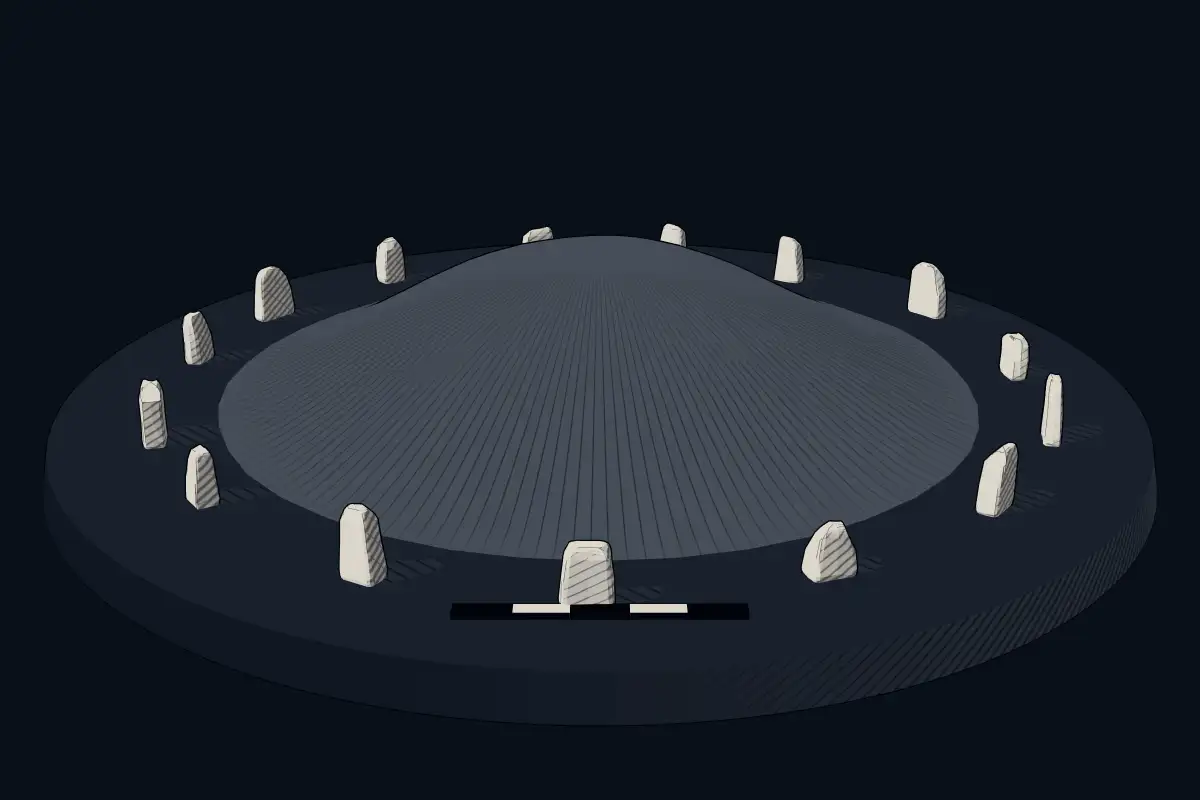
The reconstruction is ours, not a survey: it shows what a monument of this type looks like, at the size the record gives for this one.
Photographs
1 photograph, each with its author and licence
Lore
Evidence & Lore
What the sources actually support — and, kept apart, what has been claimed.
What the evidence supports
Dates
Est. 3500–500 BCEHow this date was established: Type comparisonTypical range for megalithic mounds in Denmark; this site has not been dated itself. Denmark has about 20,000 preserved tumuli with the oldest around 5,000 years old; the Neolithic examples are Nordic megalithic mounds (dysser) of c. 3500-2800 BC.Source for this date
Where it stands
Denmark
The pin marks the monument itself — its exact point.
- Coordinates
- 56°04′38″ N, 12°12′51″ EFor a GPS or map app: 56.07729, 12.21416
Access is as our sources describe it; we have not visited the site to check.
Nearby
The closest sites in the Atlas, by straight line.
 Baunehøj3500–500 BCE
- Megalithic mound (tumulus with integral stones)Maglehøje3500–500 BCE
 Embedshøj3500–500 BCE
 Sommerhøj3500–500 BCE
- Megalithic mound (tumulus with integral stones)Maglehøiene3500–500 BCE
- Megalithic mound (tumulus with integral stones)Maglehøiene3500–500 BCE
- Megalithic mound (tumulus with integral stones)Bakkebjerg3500–500 BCE
- Megalithic mound (tumulus with integral stones)Sommerhøj3500–500 BCE


Sources
Every record behind this page, with the link it came from.
2 sources behind this page
- 01Wikidata Q12325021wikidata.org
- 02Source for this dateen.wikipedia.org
Image files
- Ludshøj 06-07-2013.JPGThomas VedelsbølCC0
Report a correctionWrong date, name, photograph or source? Tell us and it will be put right.
Around this place
The ten nearest sites, by compass
Credit
Text, licence and sources
Adapted from the Wikipedia article "Ludshøj" (Danish), licensed CC BY-SA 4.0; authors are listed in the page history. Reused under CC BY-SA 4.0. Read on Wikipedia · Edit history and authors
- Wikipedia (Danish): LudshøjCC BY-SA 4.0
- Wikidata Q12325021CC0