
Megalithic mound (tumulus with integral stones)The Copper Age
Hohøj
DatedEst. 3500–500 BCE
Photo cisko66 · CC BY 3.0Source file on Wikimedia Commons

Overview
About this site
Overview
Hohøj is a burial mound on top of a hill 2 km south-east of Mariager, in Mariagerfjord Municipality, Denmark. The mound is 12 m high and 72 m in diameter, which makes it the largest in Denmark. It is a protected ancient monument.
Investigations in the 1990s indicate that it dates from the older Bronze Age, between 1410 and 1310 BCE.
Read on Wikipedia2 min readCC BY-SA 4.0
Where it sits in time
The site's dated range, placed against world reference points.
The scale is logarithmic: each step to the left is about ten times older than the last.
Article
Hohøj
Before the surrounding plantations grew up, 75 church towers could be counted from the top of the mound, among them the spire of Viborg Cathedral.
DescriptionSources for this section
- Wikipedia (Danish): HohøjCC BY-SA 4.0
Sources for this section
- Wikipedia (Danish): HohøjCC BY-SA 4.0
The hill itself is 110 m high. Before the surrounding plantations grew up, 75 church towers could be counted from the top of the mound, among them the spire of Viborg Cathedral. Many tall trees were felled in 2015, and there is now a view over Mariager Fjord. South-east of the building on Hohøj stands a stone unveiled on 4 July 1920 in memory of the Reunification of 1920. Fifty metres west of Hohøj lies Lushøj, where the Blicher stone is raised.
HistorySources for this section
- Wikipedia (Danish): HohøjCC BY-SA 4.0
Sources for this section
- Wikipedia (Danish): HohøjCC BY-SA 4.0
The hill is known for its historic public meetings, including constitution-day meetings. In 1846 Steen Steensen Blicher, a priest in Spentrup parish, planned a public meeting on Hohøj on the model of the Himmelbjerg meetings, but it was not held because of his failing health. The first Hohøj meeting took place in 1912, with Jeppe Aakjær as speaker. He argued that a memorial stone to Blicher ought to be raised at the place, and in 1919 Aakjær unveiled the stone, inscribed with Blicher's poem Jyden han er stærk og sej. The poet Nis Petersen also had a connection to the mound and wrote the Hohøj poems in the collection Nattens Pibere.
The first constitution-day meeting was held on Hohøj in 1913. Between the two world wars the meetings developed into a large popular festival; Prime Minister Thorvald Stauning spoke there in 1931 and 1932. Meetings later declined, and in 1990 the Hohøj committee, which owns Hohøj and its surroundings and is closely linked to the party Radikale Venstre, decided that they should be held again.
ContextSources for this section
- Wikipedia (Danish): HohøjCC BY-SA 4.0
Sources for this section
- Wikipedia (Danish): HohøjCC BY-SA 4.0
Denmark has a very large number of surviving barrows, protected by law since 1937. Many were raised in the Nordic Bronze Age, from about 1700 to 500 BCE, and the great majority of the round mounds are younger than the Funnel Beaker tombs of the fourth millennium BCE.
Tradition and region
About this kind of monument
Danish barrows (gravhøje)
Denmark has a very large number of surviving barrows, protected by law since 1937, and the Atlas draws most of its Danish mounds from the national register of monuments. The oldest belong to the Funnel Beaker culture of the fourth millennium BCE, whose long barrows and stone-chambered tombs are described in their own articles. The great majority of the round mounds are younger. Many were raised in the Nordic Bronze Age, from about 1700 to 500 BCE.
The Bronze Age barrows hold remarkable burials. In a number of them, oak coffins stayed sealed and waterlogged, so that wool clothing, hair and textiles survived; only the bones of the dead are gone. The Egtved Girl, a young woman buried beneath the mound Storehøj in a woollen blouse and corded skirt with a bronze belt plate, is the best-known case: tree rings in her oak coffin date the burial to the summer of 1370 BCE. Borum Eshøj gave similar finds from the fourteenth and thirteenth centuries BCE. Later in the Bronze Age cremation took over from inhumation, and the dead were buried in urns.
Mound-building did not stop with the Bronze Age: Danish round barrows were raised from the Neolithic to the Viking Age.
When visiting, look for flat tops where old diggers cut in, and for the hollows where kerb stones were once removed.
Paraphrased from Wikipedia: Tumulus, Wikipedia: Funnel beaker culture, Wikipedia: Nordic Bronze Age, Wikipedia: Egtved Girl, Wikipedia: Borum Eshøj, Wikipedia: Jelling · CC BY-SA 4.0
From the article
Dated moments in the story
- 1310 BCE
Undersøgelser i 1990'erne viser at den stammer fra ældre bronzealder mellem 1410 og 1310 f.Kr.
Source - 1846
Allerede i 1846 planlagde Steen Steensen Blicher, der var præst i Spentrup Sogn, et folkemøde på Hohøj i lighed med Himmelbjergmøderne.
Source - 1912
Det første Hohøjmøde blev afholdt i 1912 med Jeppe Aakjær som taler.
Source - 1913
I 1913 blev det første grundlovsmøde afholdt på Hohøj.
Source - 1919
Ideen vandt genklang, og i 1919 kunne Aakjær indvie stenen, hvorpå Blichers digt "Jyden han er stærk og sej" var indhugget.
Source - 1920
Sydøst for bygningen på Hohøj står en sten, der blev afsløret 4. juli 1920 til minde om Genforeningen i 1920. 50 m vest for Hohøj ligger Lushøj, hvor Blicherstenen er rejst.
Source - 1931
Statsminister Thorvald Stauning talte der i 1931 og 1932. P.
Source - 1990
I 1990 besluttede komiteen, at der atter skulle afholdes grundlovsmøder.
Source - 2012
I jubilæumsåret 2012 talte klima- og energiminister Martin Lidegaard og professor Steen Wackerhausen .
Source - 2013
Hohøj i Slots- og Kulturstyrelsens database Mariager Museum: Hohøj Danske fortidsminder: Hohøj og oldtidssporene i Alstrup Krat Arkiveret 24. september 2013 hos Wayback Machine Geologiske interesseområder: Hohøj Skov- og Naturstyrelsen: Alstrup Krat og Hohøj - en turguide
Source - 2015
Der er i 2015 blevet fældet mange høje træer, så der nu er en flot udsigt over Mariager Fjord.
Source
See it in 3D
An interpretive reconstruction of the monument, standing on the real ground at its exact point, under the sun for that place and season. Drag to look around it.
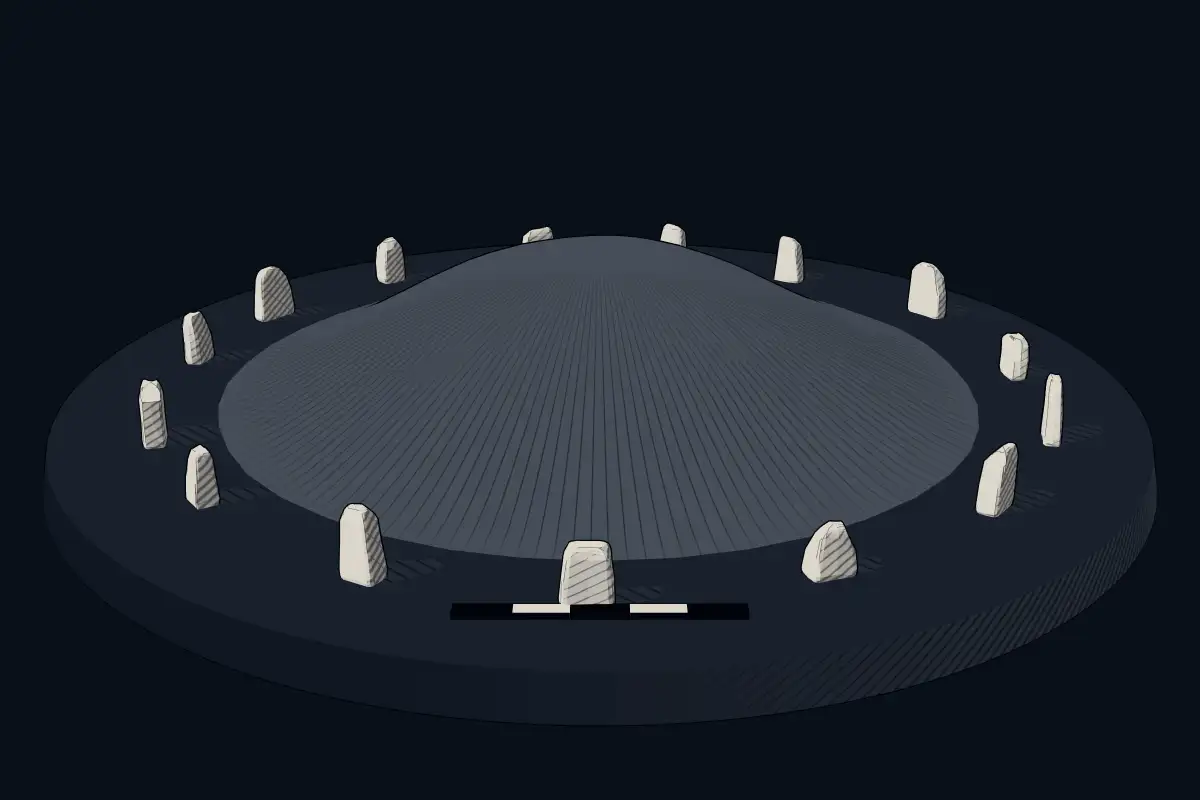
The reconstruction is ours, not a survey: it shows what a monument of this type looks like, at the size the record gives for this one.
Photographs
4 photographs, each with its author and licence
More photographs


Lore
Evidence & Lore
What the sources actually support — and, kept apart, what has been claimed.
What the evidence supports
Dates
Est. 3500–500 BCEHow this date was established: Type comparisonTypical range for megalithic mounds in Denmark; this site has not been dated itself. Denmark has about 20,000 preserved tumuli with the oldest around 5,000 years old; the Neolithic examples are Nordic megalithic mounds (dysser) of c. 3500-2800 BC.Source for this date
Where it stands
Denmark
The pin marks the monument itself — its exact point.
- Coordinates
- 56°38′41″ N, 10°00′03″ EFor a GPS or map app: 56.64461, 10.00087
Access is as our sources describe it; we have not visited the site to check.
Nearby
The closest sites in the Atlas, by straight line.
- Megalithic mound (tumulus with integral stones)Alstrup3500–500 BCE
- Megalithic mound (tumulus with integral stones)Lushøj3500–500 BCE
- Megalithic mound (tumulus with integral stones)Alstrup3500–500 BCE
- Megalithic mound (tumulus with integral stones)Alstrup3500–500 BCE
- Megalithic mound (tumulus with integral stones)Torshøj3500–500 BCE
- Megalithic mound (tumulus with integral stones)Hohøj3500–500 BCE
- Megalithic mound (tumulus with integral stones)Hohøj3500–500 BCE
- Megalithic mound (tumulus with integral stones)Alstrup Krat3500–500 BCE
Sources
Every record behind this page, with the link it came from.
2 sources behind this page
- 01Wikidata Q12316993wikidata.org
- 02Source for this dateen.wikipedia.org
Image files
Report a correctionWrong date, name, photograph or source? Tell us and it will be put right.
Around this place
The ten nearest sites, by compass
Credit
Text, licence and sources
Adapted from the Wikipedia article "Hohøj" (Danish), licensed CC BY-SA 4.0; authors are listed in the page history. Reused under CC BY-SA 4.0. Read on Wikipedia · Edit history and authors
- Wikipedia (Danish): HohøjCC BY-SA 4.0
- Wikidata Q12316993CC0