
Menhir (standing stone)The Bronze Age
Hestestenene
Also known asHorse-Stones
DatedEst. 2800–1800 BCE
Photo Torbenbrinker · CC BY-SA 4.0Source file on Wikimedia Commons

Overview
About this site
Overview
The Hestestenene (Danish; Horse-Stones, German Pferdesteine) are four bautastones standing on a cliff 34 m high, west of the village of Gudhjem beside the coastal path to Rø, on the Danish island of Bornholm. The monument is a protected ancient monument in Denmark, and the catalogue gives a typological estimate of 2800 to 1800 BCE for it.
Cremation burials are documented within the stones. Local tradition holds that the stones are a wedding couple with a horse-drawn wagon who plunged into the depths at this spot.
Read on Wikipedia2 min readCC BY-SA 4.0
Where it sits in time
The site's dated range, placed against world reference points.
The scale is logarithmic: each step to the left is about ten times older than the last.
Article
Hestestenene
DescriptionSources for this section
- Wikipedia (German): HestesteineCC BY-SA 4.0
Sources for this section
- Wikipedia (German): HestesteineCC BY-SA 4.0
The four stones are numbered 5135-1a to 5135-1d and are monoliths. Stone 5135-1a measures 1.6 × 0.95 × 0.5 m, stone 5135-1b 1.85 × 1.3 × 0.55 m and stone 5135-1c 1.7 × 0.75 × 0.55 m. Stone 5135-1d measures 2.5 × 2 × 1 × 0.7 m and has been stabilised with cement.
According to a Bornholm legend, the Hestestenene are a wedding couple together with their horse-drawn wagon, who fell into the depths at this place.
FolkloreSources for this section
- Wikipedia (German): HestesteineCC BY-SA 4.0
Sources for this section
- Wikipedia (German): HestesteineCC BY-SA 4.0
According to a Bornholm legend, the Hestestenene are a wedding couple together with their horse-drawn wagon, who fell into the depths at this place. It is, however, documented that cremation burials were carried out within the stones.
ContextSources for this section
- Wikipedia (German): HestesteineCC BY-SA 4.0
Sources for this section
- Wikipedia (German): HestesteineCC BY-SA 4.0
Bautastones (Danish bautastenen) are erected menhirs that were set up for ritual purposes in Denmark and Scandinavia from the 5th century BCE to the 5th century CE. About 1000 bautastones are said to have stood on Bornholm originally.
In Scandinavia a standing stone is called a bauta or bautastein. The introduction to the Heimskringla by Snorri Sturluson says that it was the custom to burn all the dead and raise monoliths for them, and that this custom was kept in Norway and Sweden for a long time.
Tradition and region
About this kind of monument
Scandinavian standing stones (bautastones)
In Scandinavia a standing stone is a bauta or bautastein, and the word Bauta is also used in Germany. Overall 1,176 menhirs are registered in Norway, and the stones are often included as part of a tomb. The introduction to the Heimskringla by Snorri Sturluson says that it was the custom to burn all the dead and raise monoliths for them, and that this custom was kept in Norway and Sweden for a long time. As a rule each grave was marked with a single stone, but sometimes several stones were used, as in the burial site known as De fem dårlige jomfruer at Karmsund.
In Sweden menhirs were erected as markers for the graves of warriors until the thirteenth century. Snorri writes that the Swedes burned the body of their king Vanlade and raised a stone over his ashes by the River Skyt, and the custom is mentioned in the Hávamál as well. Many Scandinavian standing stones are therefore not Neolithic at all but later memorials.
Anundshög near Västerås shows how the stones sit among other graves: of its 42 remains, 14 are standing stones, alongside 12 burial mounds, 10 round stone settings, 5 stone ships and one runestone.
For the Atlas, a Scandinavian stone that has not been excavated receives a broad range and is marked as of uncertain date, since a bauta cannot be dated by shape alone.
When visiting, look near burial mounds and beside old roads.
Paraphrased from Wikipedia: Bautastone, Wikipedia: Menhir, Wikipedia: List of menhirs, Wikipedia: Anundshög · CC BY-SA 4.0
From the article
Dated moments in the story
- 1000
Auf Bornholm sollen ursprünglich etwa 1000 Bautasteine gestanden haben.
Source
See it in 3D
An interpretive reconstruction of the monument, standing on the real ground at its exact point, under the sun for that place and season. Drag to look around it.
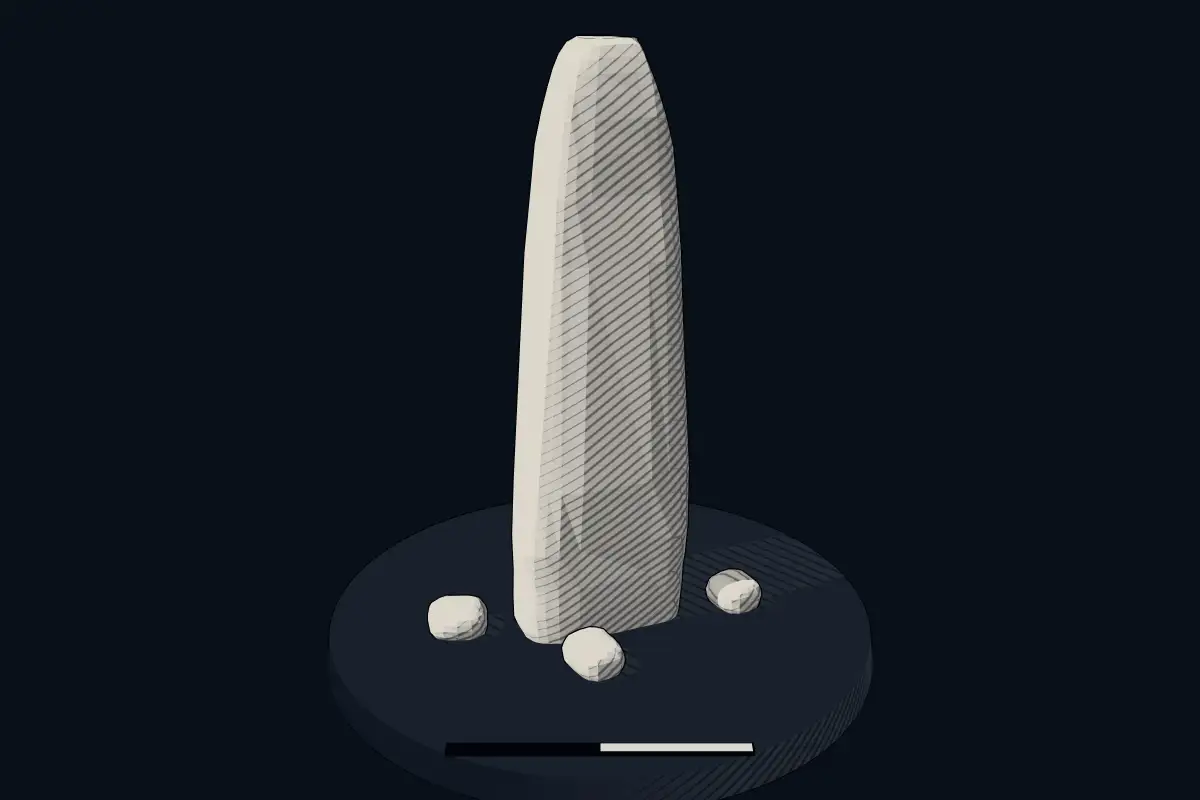
The reconstruction is ours, not a survey: it shows what a monument of this type looks like, at the size the record gives for this one.
Photographs
2 photographs, each with its author and licence
More photographs

Lore
Evidence & Lore
What the sources actually support — and, kept apart, what has been claimed.
What the evidence supports
Dates
Est. 2800–1800 BCEHow this date was established: Type comparisonTypical range for menhirs in Denmark; this site has not been dated itself. Standing stones are associated with the Beaker people of the European late Neolithic and early Bronze Age c. 2800-1800 BC.Source for this date
Where it stands
Denmark
The pin marks the monument itself — its exact point.
- Coordinates
- 55°12′46″ N, 14°57′26″ EFor a GPS or map app: 55.21282, 14.95729
Access is as our sources describe it; we have not visited the site to check.
Nearby
The closest sites in the Atlas, by straight line.
- Megalithic mound (tumulus with integral stones)Gudhjem Plantage3500–500 BCE
- Megalithic mound (tumulus with integral stones)Gudhjem Plantage3500–500 BCE
- Megalithic mound (tumulus with integral stones)Gudhjem Plantage3500–500 BCE
- Megalithic mound (tumulus with integral stones)Gudhjem Plantage3500–500 BCE
- Megalithic mound (tumulus with integral stones)Bjerget3500–500 BCE
- Megalithic mound (tumulus with integral stones)Gudhjem Plantage3500–500 BCE
- Megalithic mound (tumulus with integral stones)Gudhjem Plantage3500–500 BCE
- Megalithic mound (tumulus with integral stones)Gudhjem Plantage3500–500 BCE
Sources
Every record behind this page, with the link it came from.
2 sources behind this page
- 01Wikidata Q26774841wikidata.org
- 02Source for this dateen.wikipedia.org
Image files
- GudhjemHestestene.JPGTorbenbrinkerCC BY-SA 4.0
- Heste-Stenene 2008-07.jpgHans-Peter BalfanzCC BY-SA 3.0
Report a correctionWrong date, name, photograph or source? Tell us and it will be put right.
Lore, kept apart
Legends and claims
These are stories and claims reported by the sources. They are not evidence, and they never stand in for the dating above.
- Tradition
Bautasteine (dänisch Bautastenen) sind aufgerichtete Menhire, die in Dänemark und Skandinavien vom 5.
Bautasteine (dänisch Bautastenen) sind aufgerichtete Menhire, die in Dänemark und Skandinavien vom 5. Jahrhundert v. Chr. bis zum 5. Jahrhundert n. Chr. für rituelle Zwecke aufgerichtet wurden. Auf Bornholm sollen ursprünglich etwa 1000 Bautasteine gestanden haben. Die Pferdesteine sind laut einer Bornholmer Sage ein Hochzeitspaar samt Pferdefuhrwerk, das hier in die Tiefe stürzte. Belegt ist indes, dass innerhalb der Steine Feuerbestattungen vorgenommen wurden.
Source
Around this place
The ten nearest sites, by compass
Credit
Text, licence and sources
Adapted from the Wikipedia article "Hestesteine" (German), licensed CC BY-SA 4.0; authors are listed in the page history. Reused under CC BY-SA 4.0. Read on Wikipedia · Edit history and authors
- Wikipedia (German): HestesteineCC BY-SA 4.0
- Wikidata Q26774841CC0